
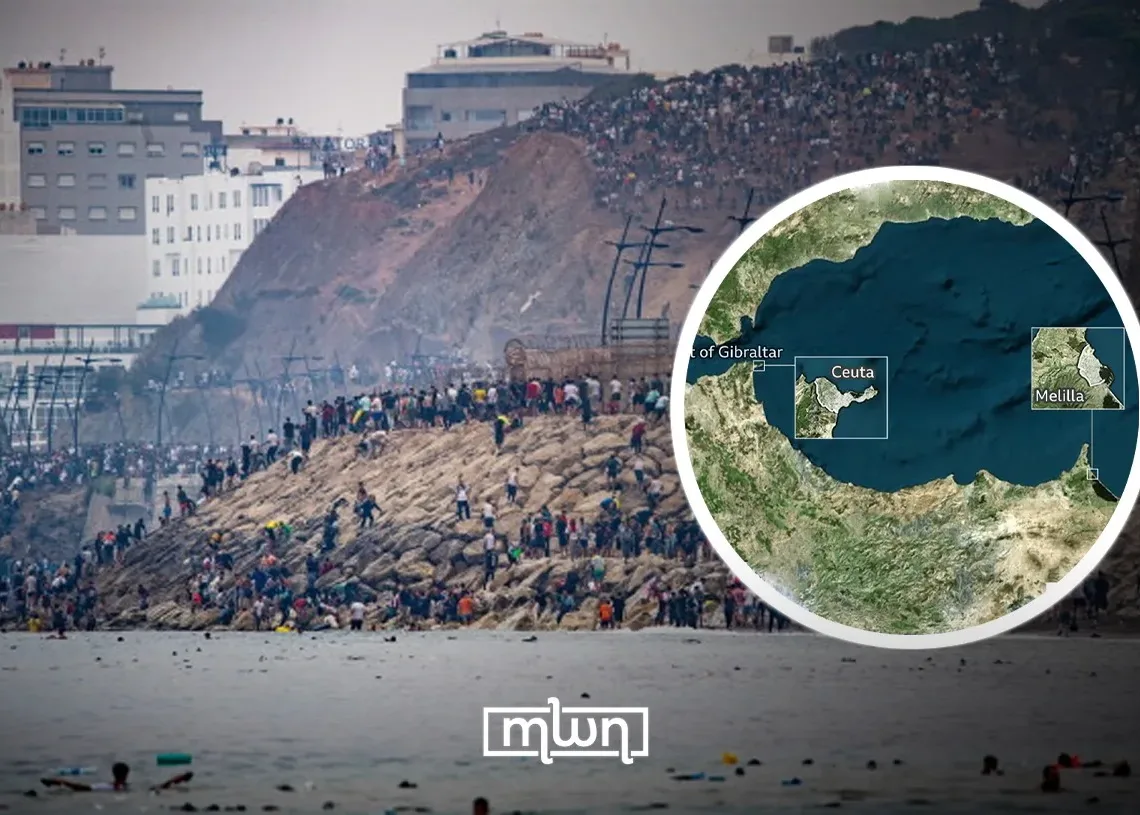
Rabat – The president of Gran Canaria’s Cabildo, Antonio Morales, has urged Spain and the European Union to take a closer look at Morocco’s growing influence in the region, arguing that the recent crisis in Ceuta carries implications that extend well beyond migration.
In a statement issued today, Morales described the events in the Spanish enclave as part of a broader geopolitical picture and warned that developments in Morocco’s political, economic, and military power could eventually affect the Canary Islands.
“Today, it is Ceuta; tomorrow, if we do not act, it could be the Canary Islands,” he said, calling for a “firm response” from Spanish and European institutions.
A crisis Morales says goes beyond migration
Morales argued that the large-scale movement toward Ceuta in late July should not be treated as an isolated migration episode.
He drew particular attention to Morocco’s subsequent response after messages circulated on social media that called for another attempt to enter the enclave on August 15. Moroccan authorities reinforced controls along the country’s land and maritime borders, preventing a repeat of the earlier mass movement.
For Morales, that shift in Morocco’s approach raises a larger question about Rabat’s ability to exert pressure through developments that affect Spain directly.
His comments place Ceuta within a wider debate over Morocco’s growing regional weight and its increasingly assertive role in the Atlantic.
Dakhla project adds another dimension
Morales also pointed to Morocco’s infrastructure ambitions in Western Sahara, particularly the planned Dakhla Atlantic port.
The project, estimated at around €1.3 billion, forms part of Morocco’s efforts to develop the region into a major economic and maritime hub. For the Gran Canaria official, its strategic relevance goes beyond trade and infrastructure.
He also highlighted the Tropic Seamount, an underwater mountain south of the Canary Islands that contains deposits of tellurium, cobalt, nickel, and rare earth elements. Such minerals have gained importance because of their use in clean-energy technologies and high-tech industries.
The area has long drawn attention from both Spain and Morocco because of its economic potential and its location in the Atlantic.
Airspace and military concerns
Morales further raised the question of airspace over Western Sahara. The area falls within the Canarias Flight Information Region, which operates from Gran Canaria.
According to Morales, Morocco has gradually expanded its ability to manage parts of the airspace through zones associated with military exercises. He presented this development as another example of the changing balance of capabilities in the region.
His concerns also extend to Morocco’s defense posture. Morales cited the country’s stronger ties with the United States and the increase in Moroccan defense spending as signs of a broader strategic shift.
Taken together, he argued, these developments warrant greater attention from Madrid and Brussels.
Morales’ remarks reflect concerns in the Canary Islands about Morocco’s expanding presence in the Atlantic. While the Ceuta crisis provided the immediate backdrop for his statement, his argument reaches much further, encompassing infrastructure, strategic minerals, airspace, defense, and Morocco’s growing influence across the region.