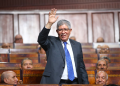
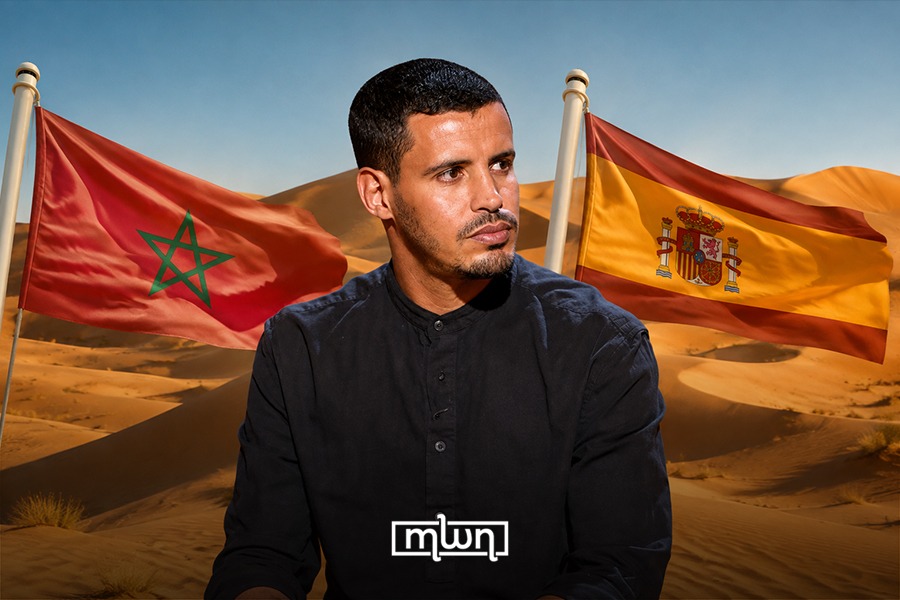
Rabat – Moroccan political analyst and author Samir Bennis has challenged the portrayal of Taleb Alisalem as a “Morocco expert” in Spanish media, pointing to overlooked aspects of Alisalem’s family background and the complex history of the region.
In a post on X, Bennis questioned whether Alisalem should be presented to Spanish audiences as an expert on Morocco or Western Sahara, particularly as Spanish television programs have increasingly turned to him for commentary on Morocco, Ceuta, Melilla, and the Western Sahara dispute.
Bennis’ criticism comes as Alisalem has become a recurring voice in Spanish media coverage of relations between Madrid and Rabat. Spanish broadcasters including Antena 3, Telemadrid, and Telecinco have recently featured him as a political analyst or Sahrawi activist.
Antena 3 described Alisalem as a “political analyst of Sahrawi origin” and a recurring contributor to Espejo Público. The channel has repeatedly aired his views on Morocco’s alleged objectives toward Ceuta and Melilla and on the use of migration as political pressure.
Telemadrid has likewise presented him as a political analyst, including in a July 31 appearance following the migration crisis in Ceuta. Telecinco’s Vamos a ver also consulted him about Morocco’s “intentions,” with the program identifying him as a political analyst.
It is against this growing media profile that Bennis has focused attention on a question he says deserves greater scrutiny. Who exactly is Taleb Alisalem, and what does his family history tell us about the way his Sahrawi identity is presented?
Alisalem’s family
“Alisalem, a translator who has never published any academic work on relations with Morocco and whom the media present as an ‘expert’ on the subject, is not even originally from Oued Eddahab or Saguia el-Hamra, that is, from what is referred to in Spain as Western Sahara,” Bennis wrote.
According to him, Alisalem’s family was included in Spain’s 1974 census, but this does not mean that the family originated in the territory then administered by Spain. He says the family came from Tan-Tan and belonged to Ait Lahsen, one of the tribes of the Tekna confederation.
Bennis situates this case within the wider history of the Sahara, where tribal and family networks long crossed territories that are today divided among Morocco, Western Sahara, Mauritania, and Algeria. He argues that the borders and political identities associated with the current dispute should not be projected backward onto that earlier period.
Spain conducted its final census of the territory in 1974, as decolonization approached and international pressure grew for a referendum. The census later became a key reference point in determining potential voters.
However, the region’s nomadic population and cross-border tribal ties made the process complicated. People belonging to tribes with traditional links outside the territory were also recorded. This is particularly relevant to the Tekna, including the Ait Lahsen of Tan-Tan and the Izarguien of Tarfaya, who were among those included in the census.
Why Alisalem’s father went to France
Bennis considers Alisalem’s father’s migration history particularly significant to understanding the family’s background. He maintains that Ali Salem Abidin was from Tan-Tan and belonged to the Moroccan community in France before the Western Sahara conflict.
Bennis points to what he sees as a historical inconsistency in interpreting Abidin’s trajectory. If he had originated in the territory then under Spanish administration, he asks, why would he have migrated to France rather than Spain?
“The answer is simple,” the Moroccan analyst argues. “Before the conflict, there was no Sahrawi community in France because the inhabitants of the Sahara were nominally considered Spanish, while the inhabitants of Wadi Noun did not have that status and therefore emigrated to France.” Ali Salem Abidin later joined the Polisario Front from Paris but was transferred to Errachid prison after being accused of being a Moroccan spy sent to sabotage the camps, Bennis adds. He was eventually released toward the end of the 1980s and returned to Morocco.
Bennis places this personal history within the broader social geography of the pre-colonial and colonial Sahara. For centuries, the region’s inhabitants moved across vast desert spaces in response to access to water, grazing lands, trade routes, and kinship ties. Tribal confederations and extended family networks often had members living in different locations.
The areas of Tan-Tan and Tarfaya were also under Spanish colonial control for periods before their integration into Morocco. This created a situation in which people with strong social, tribal, and family links to southern Morocco could also find themselves under Spanish administration or appear in Spanish colonial records.
This history is particularly important when discussing the Tekna.
Bennis says the Ait Lahsen were among the Tekna groups recorded in the Spanish census, while identifying them with Tan-Tan rather than the territory of Western Sahara itself.
The distinction does not mean that people from Tan-Tan or other areas north of Western Sahara could not identify as Sahrawi. Rather, it points to the fact that Sahrawi identity, tribal affiliation, place of residence, and colonial administrative boundaries have never been perfectly interchangeable categories.
That is the historical context Bennis brings into a debate that is often presented in much simpler terms.
Alisalem’s growing presence in Spanish media
Alisalem’s visibility in Spain has grown considerably during the recent tensions surrounding Ceuta.
On July 31, Telemadrid interviewed him about Morocco’s intentions toward Ceuta and Melilla. He argued that Moroccan territorial ambitions toward the two cities were real and would eventually become a major issue.
Antena 3 subsequently featured him several times. On August 7, the channel presented him as a “Sahrawi activist and political analyst” while reporting his criticism of Spanish policy toward Morocco.
On August 14, Antena 3 again quoted him on Morocco’s alleged strategy around Ceuta, including his claim that Rabat was seeking to test Spain’s ability to respond to a border crisis.
On August 17, he argued on Espejo Público that Morocco could seek negotiations over the political and legal status of Ceuta and Melilla. The program referred to him as an “expert” while presenting his analysis of Morocco’s objectives.
Telemadrid also interviewed him on August 18 about the presence of King Mohammed VI’s yacht near Ceuta, presenting Alisalem as an activist who interpreted the event as part of a broader Moroccan strategy.
His appearances show that Bennis is not challenging an isolated description. Alisalem has become a recurring source for Spanish broadcasters discussing Morocco.
Bennis’ criticism therefore goes beyond a dispute over one man’s biography. It raises a broader question about how Spanish media select and label commentators on one of North Africa’s most politically sensitive disputes.
Alisalem is openly involved in “advocacy” on Western Sahara. He has addressed the UN’s Decolonization Committee on behalf of the Sahrawi cause, where he called for the decolonization of Western Sahara and described Morocco’s presence in the territory as an occupation.
Those positions are not hidden. They are part of his public record.
The issue Bennis raises is therefore not whether Alisalem has a political position. He clearly does.
Rather, it is whether Spanish audiences are given enough context when he is introduced as an “expert” or political analyst on Morocco.
That distinction becomes particularly important when his comments concern highly contested issues such as Moroccan policy, migration, Ceuta and Melilla, and Western Sahara.
Bennis, who has written extensively on Western Sahara and Moroccan-Spanish relations, has made the question of competing narratives around the territory a central part of his own work. His 2024 book, “The Self-Determination Delusion: How Activist Scholars and Journalists Have Hijacked the Western Sahara Case”, examines what he describes as the growing influence of activist scholarship and advocacy on international reporting and analysis of the regional dispute.
His criticism of Alisalem reflects that broader line of argument. For Bennis, the problem extends beyond Spanish media outlets consulting a Sahrawi activist. He argues that audiences should also be given sufficient context about the interviewee’s political affiliations, personal background, and the historical circumstances that shaped the identities being invoked.
At the center of his argument is the simple historical point that Sahara’s past cannot always be mapped onto today’s borders.
From this perspective, Bennis argues that a fuller understanding of the Sahara’s history is essential when assessing competing claims about identity and representation, particularly when individuals are presented as authoritative voices on who is, or is not, Sharawi, Moroccan, or qualified to speak about the Western Sahara dispute.