
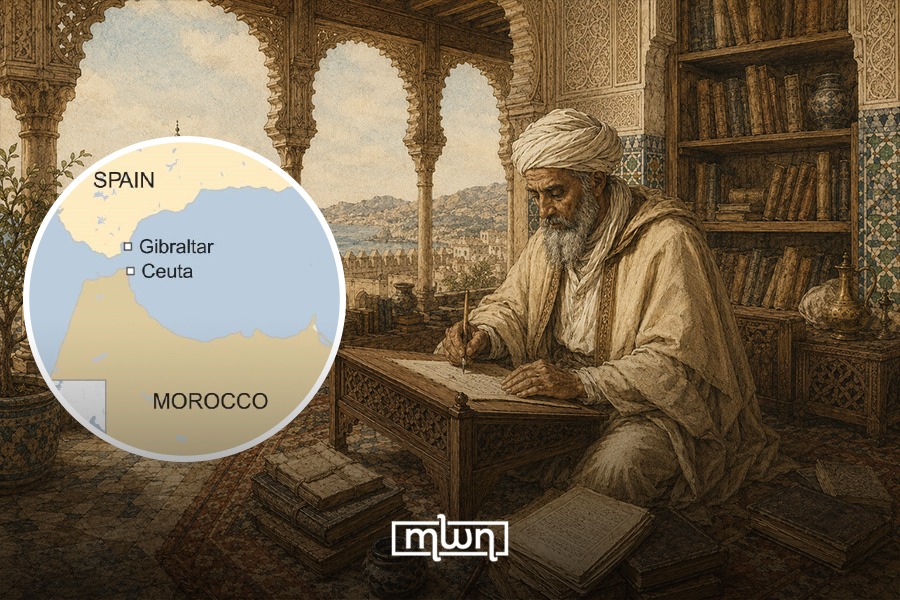
Rabat – Nearly eight centuries after his death, Abu al-Abbas al-Azafi remains closely associated with one of the most enduring religious traditions in Morocco and across the Muslim world: the commemoration of the birth of Prophet Mohammed.
Born in Ceuta in 1162, al-Azafi was a jurist, religious scholar, teacher, and expert in the study and transmission of Islamic traditions. He belonged to the Banu al-Azafi, the family that would later exercise political authority in Ceuta during the 13th century. But his historical importance rests less on the political fortunes of his family than on his efforts to give the Mawlid a structured place in the religious and social life of Muslims in the western Islamic world.
His most famous work, Al-Durr al-Munazzam fi Mawlid al-Nabi al-Muazzam, was devoted to the birth of the Prophet and became closely associated with the development of Mawlid celebrations in Ceuta and the wider Maghreb.
A scholar from medieval Ceuta
Al-Azafi lived during a period when Ceuta was an important center of Islamic learning and a major port linking the Maghreb with al-Andalus and the wider Mediterranean.
The city was home to scholars working in Islamic law, hadith, theology, language, and mysticism. Historical accounts describe Ceuta in the 12th and 13th centuries as a city where religious scholarship and commercial exchange existed alongside growing political and military pressure from Christian powers in the Iberian Peninsula.
It was in this environment that al-Azafi developed his scholarly career.
The Moroccan League of Religious Scholars describes al-Azafi as a jurist and hadith scholar who became a sought-after teacher among scholars of riwaya and diraya, reflecting his expertise in the transmission and study of Islamic traditions. He was also a qadi, or Islamic judge, in Ceuta. His work therefore combined religious learning with a role in the city’s legal and social life.
Al-Azafi also wrote a biographical work on the Moroccan saint Abu Yaaza, known as Di’amat al-Yaqin fi Za’amat al-Muttaqin. The work reflects his interest not only in law and religious tradition but also in the lives and spiritual reputations of prominent figures of his time.
Yet it was another subject that would ultimately make his name particularly enduring.
Why Mawlid mattered to al-Azafi
Al-Azafi’s most important surviving association is with the development of the Mawlid in Ceuta.
His Al-Durr al-Munazzam focused on the birth of Prophet Mohammed and the religious meaning attached to commemorating it. The work was later completed by his son, Abu al-Qasim al-Azafi, who would go on to play an important political role in Ceuta.
The historical context helps explain why the celebration mattered to al-Azafi.
A study published through the French School of Rome describes al-Azafi’s initiative as part of a broader development of forms of devotion centered on the Prophet that emerged in the Maghreb during the first part of the 13th century. The study places Ceuta at the center of this development, alongside Safi, another important Moroccan port.
Ceuta’s position made the question particularly significant. The city was deeply connected to al-Andalus and Christian Mediterranean communities through trade and travel. It was also exposed to military pressure. The same historical study notes that Ceuta faced attacks and threats from Christian powers during a period when Muslim political control in the Iberian Peninsula was weakening.
A religious response to a changing society
Modern descriptions sometimes portray al-Azafi simply as the scholar who introduced Mawlid to Ceuta. The historical picture is more interesting.
Recent Cambridge research on the social history of the medieval Maghreb explains that al-Azafi encouraged the celebration of Mawlid partly in response to the growing influence of Christian festivals among Muslims living around the Strait of Gibraltar.
According to the study, al-Azafi’s son later explained that Muslims in the region had developed habits associated with Christmas through long-standing commercial and social contact with Christian communities. The Mawlid could therefore provide an alternative religious celebration centered on the Prophet.
This does not mean that al-Azafi simply invented a festival from nothing. Mawlid traditions existed elsewhere in the Muslim world, and historians have traced different forms of the commemoration to earlier periods and regions.
What distinguished al-Azafi was his effort to organize and promote the celebration within the western Islamic context.
His work transformed the commemoration into a subject of religious writing while giving it a framework that could be transmitted to later generations.
From a Ceutan initiative to a wider tradition
Al-Azafi died in Ceuta in 1236. His work did not end with him.
His son Abu al-Qasim completed Al-Durr al-Munazzam after his death and later became ruler of Ceuta. Cambridge research identifies Abu al-Qasim as the figure who officially introduced the Mawlid feast in the city, building on his father’s work.
This distinction is important.
Al-Azafi’s historical role was primarily that of a scholar and religious advocate, while his son helped turn the ideas contained in his father’s work into an established public practice.
From Ceuta, the celebration became increasingly embedded in the religious culture of the Maghreb and al-Andalus. Historical scholarship has linked the Azafi family’s work to the spread of Mawlid traditions across the western Islamic world.
The development was also part of a larger transformation in how Muslims expressed devotion to the Prophet.
In Morocco, Mawlid eventually became connected not only to private religious devotion but also to public ceremonies and dynastic institutions. The celebration was formally adopted by Moroccan rulers during the centuries following al-Azafi’s death, becoming an established feature of the country’s religious calendar.
The scholar behind the celebration
It is tempting to remember al-Azafi only through Mawlid. But his career was broader.
He belonged to a scholarly culture that placed enormous importance on the transmission of knowledge. His work on religious traditions, biography, and the Prophet’s life reflected the intellectual priorities of medieval Maghrebi scholarship.
His association with the Banu al-Azafi also placed him within one of Ceuta’s most influential families. The family eventually emerged as a political force in the city during the period of instability that followed the weakening of Almohad authority. Ceuta subsequently experienced competition between different regional powers before the Azafis established autonomous rule.
Yet al-Azafi’s own legacy is primarily intellectual and religious rather than political.
He represents a period when Ceuta was not merely a strategic port at the entrance to the Mediterranean but a place where scholars produced works that circulated beyond the city.
Why Morocco remembers al-Azafi today
That history explains why Morocco’s Minister of Endowments and Islamic Affairs Ahmed Toufiq invoked al-Azafi during the Mawlid ceremony chaired by King Mohammed VI at the Royal Palace in Rabat on Monday.
Speaking before the King, Toufiq described Morocco’s attachment to the Prophet as having both a political and an emotional dimension. He linked the latter to a long scholarly tradition of documenting and commemorating the Prophet’s virtues.
Toufiq specifically placed al-Azafi alongside another famous Ceutan scholar, Qadi Iyad, whose Al-Shifa became one of the best-known works on the Prophet’s qualities and rights. He described the sequence as moving from Iyad’s Al-Shifa, to al-Azafi’s Al-Durr al-Munazzam, and eventually to Imam al-Jazuli’s Dala’il al-Khayrat.
Al-Azafi’s story ultimately offers another way of understanding medieval Ceuta.
Centuries before the city became part of the modern territorial dispute between Morocco and Spain, it was a major center of Islamic scholarship. Its scholars traveled, taught, wrote, and participated in intellectual networks stretching across the Strait of Gibraltar and the Maghreb.
Al-Azafi’s contribution was particularly distinctive. He took a form of devotion centered on the Prophet and gave it a scholarly framework in a city where Muslims lived in close contact with Christian communities and where political and religious boundaries were constantly being negotiated.
His book survived him. His son carried his project forward. And the celebration he helped establish became part of Morocco’s religious tradition.
Nearly eight centuries later, his name was recalled during the same celebration he devoted his scholarship to explaining.