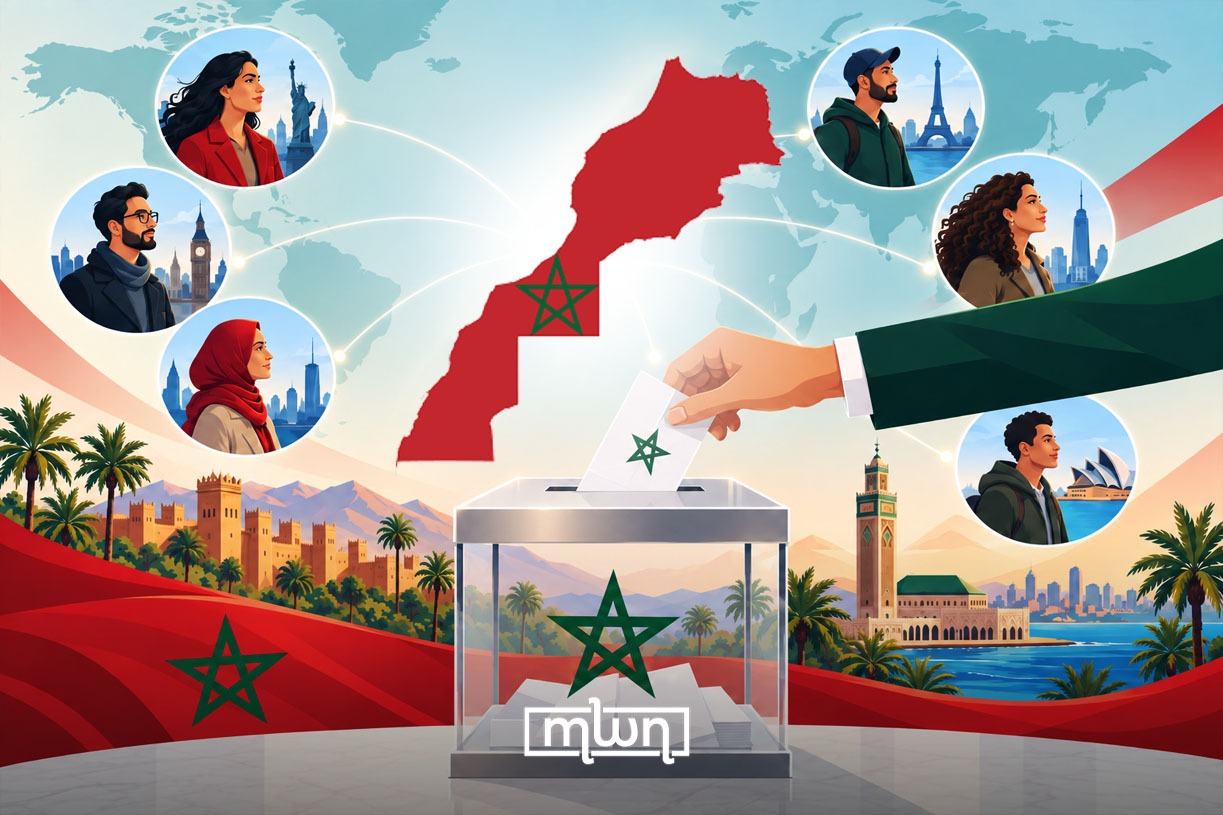
On September 23, 2026, Morocco will hold its fourth parliamentary election since the adoption of the 2011 Constitution. That constitutional reform, introduced in the aftermath of the February 20 Movement and the wider Arab Spring protests, made an important commitment to more than 5 million Moroccans living outside the country. For the first time, the Constitution explicitly recognized Moroccans residing abroad (MREs) as full citizens with political rights, including the right to vote and to be eligible for election, with the law determining the conditions and modalities for exercising these rights from their countries of residence. Fifteen years later, however, that constitutional commitment remains only partially realized.
Moroccans residing abroad still cannot cast their ballots directly in Moroccan elections from their country of residence. To vote, they can return to Morocco to do so in person or appoint someone in Morocco to vote on their behalf using proxy voting. The result is a persistent gap between a constitutional right and its practical exercise.
A constitutional promise of full citizenship
The 2011 Constitution contains several provisions specifically addressing the rights and political participation of Moroccans residing abroad:
Article 16 commits the state to protecting the rights and legitimate interests of Moroccan citizens living abroad and maintaining their ties with Morocco.
Article 17 goes further by explicitly recognizing their full citizenship rights, including the right to vote and to be eligible for election at the local, regional and national levels and, crucially, states that the law shall determine the conditions and modalities for the effective exercise of voting and candidacy from their countries of residence.
Article 18 requires public authorities to promote the broadest possible participation of Moroccans abroad in consultative and good-governance institutions.
Article 30 establishes voting as a personal right and national duty.
Article 163 assigns the Council of the Moroccan Community Abroad (CCME) an advisory role concerning public policies affecting the Moroccan diaspora.
These provisions established a constitutional framework in which MRE political participation was no longer simply a matter of government policy but rather a constitutional commitment. However, Article 17 also left an important task to the legislature, namely, determining the practical conditions and modalities for exercising these rights from the countries of residence. The central problem since 2011 has therefore not been the absence of constitutional recognition, or legislation governing MRE voting, but the absence of a legislative framework providing for direct electoral participation from countries of residence.
Fifteen years of incomplete implementation
The legal framework (Article 72 of Organic Law No. 27.11) adopted after the 2011 Constitutional reform has provided MREs with a mechanism for proxy voting that allows Moroccan voters residing outside the Kingdom and registered on the general electoral lists to vote by proxy. The mechanism means that the Moroccan citizen abroad does not cast the ballot personally. Instead, the voter authorizes another eligible voter in Morocco to cast it on their behalf.
For the 2026 parliamentary election, the government has once again relied on proxy voting, but it has modernized this procedure through the E-Procuration platform. An MRE can enter identification and electoral information online, designate a proxy, validate the authorization electronically, and send the resulting document to the proxy. The proxy then votes in Morocco on behalf of the citizen abroad. The platform makes the procedure easier administratively, but it does not create electronic voting. The ballot is still physically cast in Morocco by another voter acting as proxy.
The introduction of E-Procuration has also generated reports of technical difficulties for some users. In September 2026, there were reports and testimonies from Moroccans residing abroad who encountered problems accessing the platform. In one reported case, a Moroccan resident in Belgium who said he was officially registered with Moroccan consular authorities and held a consular registration certificate found that the platform did not recognize his national identification number as belonging to an MRE. These reported cases do not establish the scale of the problem nationally, but they illustrate how technical or data-integration problems can create an additional practical barrier for MREs attempting to use the new proxy-voting mechanism.
There are therefore still no Moroccan parliamentary polling stations in embassies or consulates where MREs can personally cast their ballots, and there are no dedicated parliamentary constituencies abroad. This is particularly significant because Morocco demonstrated that voting operations abroad were administratively possible during the 2011 constitutional referendum, when polling was organized through Moroccan diplomatic missions.
Why proxy voting remains contested?
The disagreement over proxy voting is not simply about convenience. For many members of the diaspora and organizations advocating for their political participation, the fundamental issue is whether a proxy can provide the same form of political agency as personally casting one’s own ballot.
The first concern is the principle of personal voting. Article 30 of the Constitution states that voting is a personal right. A proxy necessarily introduces another individual between the voter and the ballot. The MRE makes the political choice, but another person physically casts the ballot in the polling station.
The second concern is confidentiality. A voter who delegates their vote must communicate their electoral preference, or at least rely on the proxy to reproduce that preference accurately. This creates a relationship of trust that does not exist when a voter personally enters a voting booth and marks a ballot in secret.
The third concern is control. A proxy arrangement cannot provide the same degree of certainty that the voter’s instructions will be followed. The voter abroad cannot personally verify how the ballot was marked.
The fourth concern is equal citizenship. An MRE and a Moroccan living in Morocco possess the same constitutional citizenship, yet they do not have the same practical means of exercising the vote. Citizens living in Morocco vote personally at polling stations; citizens living abroad generally must either travel to Morocco or delegate the act of voting to someone else.
For these reasons, some diaspora advocates and organizations have characterized proxy voting as undemocratic and have argued that it is inconsistent with Articles 17 and 30 of the Constitution and does not provide an effective mechanism for broad diaspora participation.
The CNDH evidence: Limited observed use of proxy voting
The most significant evidence regarding the limitations of proxy voting comes from Morocco’s own election-observation record. The National Human Rights Council (CNDH), a constitutional entity that conducts independent election observation, has repeatedly documented very limited use of proxy voting among MREs in its observation samples.
During the 2011 parliamentary elections, CNDH observers recorded only two cases of proxy voting among 847 observed polling stations. The Council explicitly concluded that the low use of the mechanism warranted consideration of alternative methods, including electronic voting and mail ballots. The pattern continued in the 2015 local and regional elections when CNDH observers recorded 17 instances of proxy voting in their sample of 1,405 observation questionnaires. During the 2015 and 2016 parliamentary and local elections, the Council recorded only five instances of proxy voting. The Council and other election-observation bodies subsequently continued to call for consideration of alternative arrangements for MRE participation.
The significance of these figures and observations documented through CNDH’s election-monitoring samples is that they show a consistent pattern of limited observed use of proxy voting, rather than establishing its overall level of use among the entire diaspora. This conclusion was also reflected in the observations of the Parliamentary Assembly of the Council of Europe following Morocco’s 2021 parliamentary elections. Its election-observation report documented barriers affecting citizens living abroad and noted concerns regarding the arrangements available to MREs to exercise their voting rights.
The CNDH’s 2021 election observations provide another important indicator. The Council reported that more than 100 Moroccans residing abroad ran as candidates, including 29 as heads of electoral lists, demonstrating that some MREs actively sought to participate in Moroccan political life through candidacy. Yet, MRE issues appeared in only 12.5% of the electoral campaign activities observed. This provides an additional indication that limited electoral participation cannot necessarily be attributed solely to a lack of political interest among the diaspora. Rather, the institutional mechanisms for translating that interest into electoral participation remain limited.
Political parties: Proposals without legislative implementation
Moroccan political parties have not been uniformly silent on the issue. Following the adoption of the 2011 Constitution, several parties moved beyond general political declarations and proposed concrete legislative mechanisms for diaspora participation. In 2014, the Justice and Development Party (PJD), Istiqlal Party, and Socialist Union of Popular Forces (USFP) proposed draft laws addressing MRE voting and representation. These initiatives went as far as proposing electoral constituencies and parliamentary seats for Moroccans abroad. The debate had also moved toward concrete questions: How many constituencies? How many seats? Where would they be located? How would voting take place?
Other parties, including PAM, RNI, PPS, USFP, and Istiqlal, have especially focused on the restructuring and organization of the CCME. The broader record therefore demonstrates that the question has repeatedly entered the legislative agenda without producing a permanent system of direct voting and candidacy from abroad.
This prolonged gap between constitutional recognition and legislative implementation has also generated competing interpretations about why direct diaspora voting and representation have not been institutionalized. Some members of the diaspora and analysts have argued that political considerations may partly explain the reluctance to establish a system of direct voting and representation from abroad. They contend that a diaspora electorate, many of whose members reside in democratic societies and have experience with electoral participation, could introduce a new political constituency whose preferences might affect domestic political dynamics. Some observers go further, arguing that political authorities may have concerns about the uncertainty associated with such an electorate and the difficulty of anticipating its electoral behavior.
Although the issue has also resurfaced in electoral campaign programs for the 2026 elections, it is not addressed in the same way by all major parties. The Left Alliance (Tahaluf Alyasar) has an elaborate section on MREs and calling for direct parliamentary representation through electoral constituencies abroad as an alternative to proxy voting. The PJD also provides a section on MREs, including their political and institutional participation. The PPS proposes establishing electoral constituencies specifically for MREs, allowing electronic advance voting abroad, and using Moroccan consulates for registration, candidacy procedures, voting, and the counting of ballots.
At the same time, other major parties such as RNI, PAM, Istiqlal, and the Popular Movement (MP) place greater emphasis in their 2026 programs and related party initiatives on economic, investment, cultural, talent, and consultative entities related dimensions of diaspora policy than on direct parliamentary representation. The 2026 party landscape therefore presents differentiated approaches to implementing Article 17, ranging from explicit proposals for direct electoral representation abroad to greater emphasis on economic, institutional, cultural, or party-level engagement with the diaspora.
The role and limits of Morocco’s consultative institutions
The CNDH has been one of the most consistent institutional voices calling for alternatives to proxy voting. Its 2011 election observation explicitly recommended consideration of alternative mechanisms, including electronic or postal voting, because of the extremely limited use of proxy voting. In 2015, the Council again recorded low use of the mechanism, and its election-observation findings continued to support consideration of alternative arrangements, including postal and electronic voting.
On the other hand, the CCME occupies a different constitutional position. Article 163 gives it an advisory role concerning public policies affecting Moroccans abroad. Over the years, the question of political participation has remained part of the broader institutional debate concerning the rights and representation of the diaspora. More recently, the CCME has called for measures including voting and candidacy from countries of residence, polling stations abroad, dedicated constituencies, and reforms to the electoral framework
The persistence of the issue despite repeated institutional recommendations and consultations illustrates the central problem that these recommendations have not been translated into a durable electoral mechanism.
Conclusion
Following the Arab Spring, Morocco has frequently presented its constitutional reform process as evidence of its distinctive approach to political and civic participation. Yet, more than fifteen years after the adoption of the Constitution, the political participation of Morocco’s diaspora remains constrained in practice. This situation stands in contrast with developments elsewhere in the region where many countries have established mechanisms for voting, particularly in Egypt, Libya, Yemen, Algeria, Tunisia, Bahrain, Lebanon, Bahrain, Syria, Iran, and Oman, including through diplomatic missions, consulates, and other designated polling locations for eligible citizens residing abroad.
The gap is particularly significant given the broader role that the Moroccan diaspora already plays in the country’s economic and social life. Remittances from Moroccans living abroad reached approximately MAD 119 billion in 2024, representing a substantial and sustained source of external income; the World Bank estimates that remittances were equivalent to 7.8 percent of Morocco’s GDP that year. Bank Al-Maghrib also identified transfers from Moroccans abroad as a principal driver of the increase in Morocco’s secondary-income surplus. The resilience of these transfers during the COVID-19 pandemic was particularly notable: remittance inflows to Morocco increased by approximately 6.5 percent in 2020, even as the global economy experienced severe disruption. Beyond their financial importance, the diaspora’s continued links with families and communities in Morocco point to a wider social relationship that extends well beyond the transfer of funds.
As Morocco prepares to form a new government and Parliament following the September 23 election, the question of how Morocco will address the political participation of its diaspora will remain significant. The issue is not simply whether MREs should participate in Morocco’s political life, the Constitution already recognizes their citizenship and electoral rights, but how those rights can be given effective practical expression from countries of residence. Article 17 leaves it to legislation to establish the conditions and modalities for that exercise, while Article 18 calls for the broadest possible participation of MREs in consultative and good-governance institutions.
This creates an important paradox in Morocco’s relationship with its diaspora. The state has increasingly recognized MREs as important economic, social, cultural, and developmental partners, while their political participation remains comparatively under-institutionalized. The coming parliamentary term will therefore provide an opportunity to assess whether Morocco’s relationship with its diaspora continues to emphasize economic and cultural contributions, or evolves toward a more comprehensive model encompassing political participation and representation. Such a shift would not necessarily replace the diaspora’s existing economic and social contributions; rather, it could provide an institutional framework for engaging more systematically with the human capital, civic experience, professional networks, and perspectives of Moroccans living abroad.
This question has broader implications for the relationship between the Moroccan state and millions of citizens living beyond its borders, particularly as Morocco enters a potentially significant phase in the Sahara issue. The Security Council Resolution 2797 (2025) called for negotiations to take Morocco’s Autonomy Proposal as their basis and recognized that genuine autonomy could represent a “most feasible outcome.” In this context, meaningful inclusion of a diverse Moroccan diaspora, including individuals and families with past associations with or support for the Polisario Front, could become an increasingly important dimension of Morocco’s approach to citizenship, political inclusion, and national cohesion. A more institutionally integrated diaspora could also represent an opportunity to connect Morocco’s existing economic and social relationship with its citizens abroad to a broader framework of civic and political participation.
*The author’s views don’t reflect any institutional affiliation.