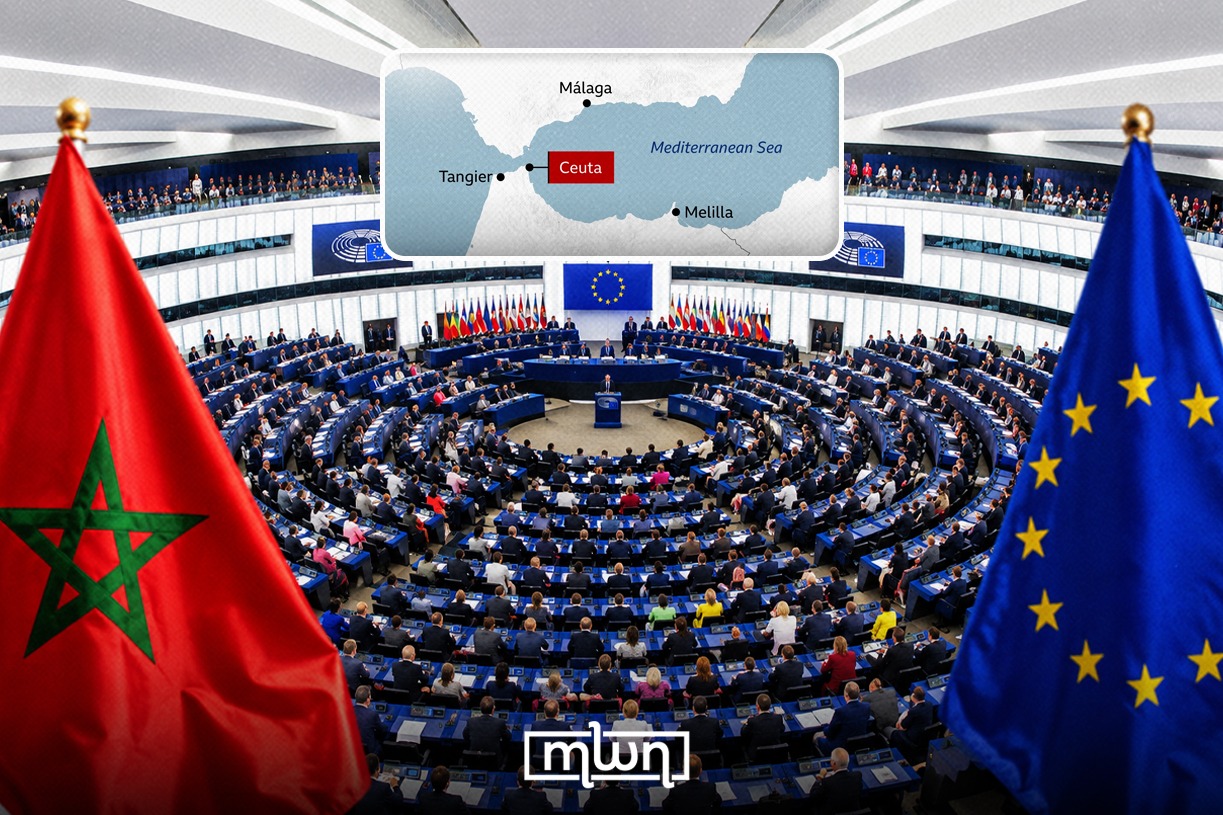
Since the outbreak of the migration crisis in Sebta, about six weeks ago, the Spanish political scene has focused on this subject, which has become the center of debates, newspaper headlines, and an electoral issue instrumentalized by the right and the far right in order to bring down the coalition led by the Socialist Party of Pedro Sanchez.
However, what took many observers by surprise was the turn of events because the affair was Europeanized, and the right-wing coalition in the European Parliament seized this opportunity to weaken the Sanchez government and take revenge on Morocco, which has suffered several setbacks, particularly with regard to the Moroccan Sahara affair and the inclusion of products originating in these provinces in the free trade agreement and the fisheries agreement.
Relations between Morocco and the European Union evolved since 1969 from a simple trade agreement to a multidimensional strategic partnership; the 1996 Association Agreement (in force in 2000) laid the foundations, strengthened by Morocco’s integration into the European Neighborhood Policy in 2004 and the obtaining of Advanced Status in 2008, which recognized Morocco as a “privileged partner” and aimed to foster regulatory convergence and strengthen cooperation on security and migration.
Today, the EU is Morocco’s leading economic partner and investor, with close cooperation in trade, energy (notably through the 2022 Green Partnership), health and education. However, this partnership is marked by recurring tensions around migration (Ceuta and Melilla), the Sahara, and the conditionality of funding.
Since the year 2000, a new player has entered the competition in the Morocco-EU equation; now the European Parliament is inviting itself into the European Union’s foreign and defense policy. Admittedly, it does not have binding decision-making powers, since strategic choices are the responsibility of the Member States and the Council, nevertheless, it exercises political influence through its non-binding resolutions and recommendations.
Although in the texts it is the governments and the council that make the final decisions (sovereign powers), the European Parliament has nevertheless established itself over the years as an unavoidable actor thanks to the combined use of its budgetary, control and consultation powers, but also through informal practices such as privileged access to information, parliamentary diplomacy and the political pressure exerted by its resolutions. It is therefore no longer a simple registration chamber but a strategic actor that exploits the institutional rules and loopholes of the treaties to obtain more competences, by delaying decisions, by linking the issues between different arenas (linkage and bargaining) or by forging alliances with Member States and other institutions. For example, in trade and international cooperation agreements, the EP has gradually imposed its right of veto, transforming an advisory role into a real power of de facto co-decision. (Rosén, Guri (2018)
Indeed, before the adoption of the Lisbon Treaty (2009), the role of the European Parliament in foreign policy was largely consultative, but since then this institution has acquired a power of consent on international agreements that has become over time a de facto power of codecision with a significant impact.
This article surveys the impact of the EU’s organizational changes, in particular the autonomy of the European Parliament, on relations between Morocco and the EU; to do this, we will first scrutinize these relations between 2000 and 2026 in order to identify the characteristics and nature of cooperative or conflictual interactions, to then explain this evolution based on hypotheses partly deduced from the relevant theories of the sociology of organizations and Foreign Policy (the political and bureaucratic model in decision-making) and empirically tested in our case.
Behaviour of the European Parliament towards the Kingdom of Morocco
After a serene decade and a half between 2000 and 2011, when cooperation had taken precedence over the conflict, the Morocco-EU relationship has deteriorated since 2016, and this coincided with the parliamentarization of the EU’s foreign and security policy when the parliament began to play the role of lecturing the Union’s partners and as a defender of norms. The status of the Moroccan Sahara remains the main sticking point, while the EU continues to depend on Morocco for migration control and regional security.
The organizational change of the EU and the empowerment of the European Parliament, which has shifted from a marginal observer to a central protagonist, has had an impact on EU-Morocco relations that have become tumultuous since 2011, when it blocked bilateral agreements under the pretext of human rights concerns.
There was a time, not so long ago, when Morocco was a good student of Europe; in 2008, the European Parliament (EP) rolled out the red carpet for it of the “Advanced Status” and a flamboyant cooperation score. Fifteen years later, the diplomatic climate turned into a storm, in September 2026, faced with the arrival of 70,000 migrants in Ceuta, the Strasbourg hemicycle passed a resolution describing the situation as a “hybrid attack”, demanding the immediate freezing of European funds with a Goldstein score: -9.8 an abyssal abyss, transforming the assembly of MEPs into an implacable inquisitorial court that persists in its conduct while national governments have turned the page, as illustrated by the spectacular Spanish-Moroccan rapprochement of 2022, carried by the recognition of the autonomy of the Sahara.
The 2011 veto on the fisheries agreement (-8.0), the condemnations of the dismantling of Gdim Izik in 2010 (-7.5), or the outcry over the “Pegasus” affair fomented in 2021 (-7.0) have created a floor of structural mistrust. Each new case is now investigated in the light of previous convictions as a judge would do with a recalcitrant.
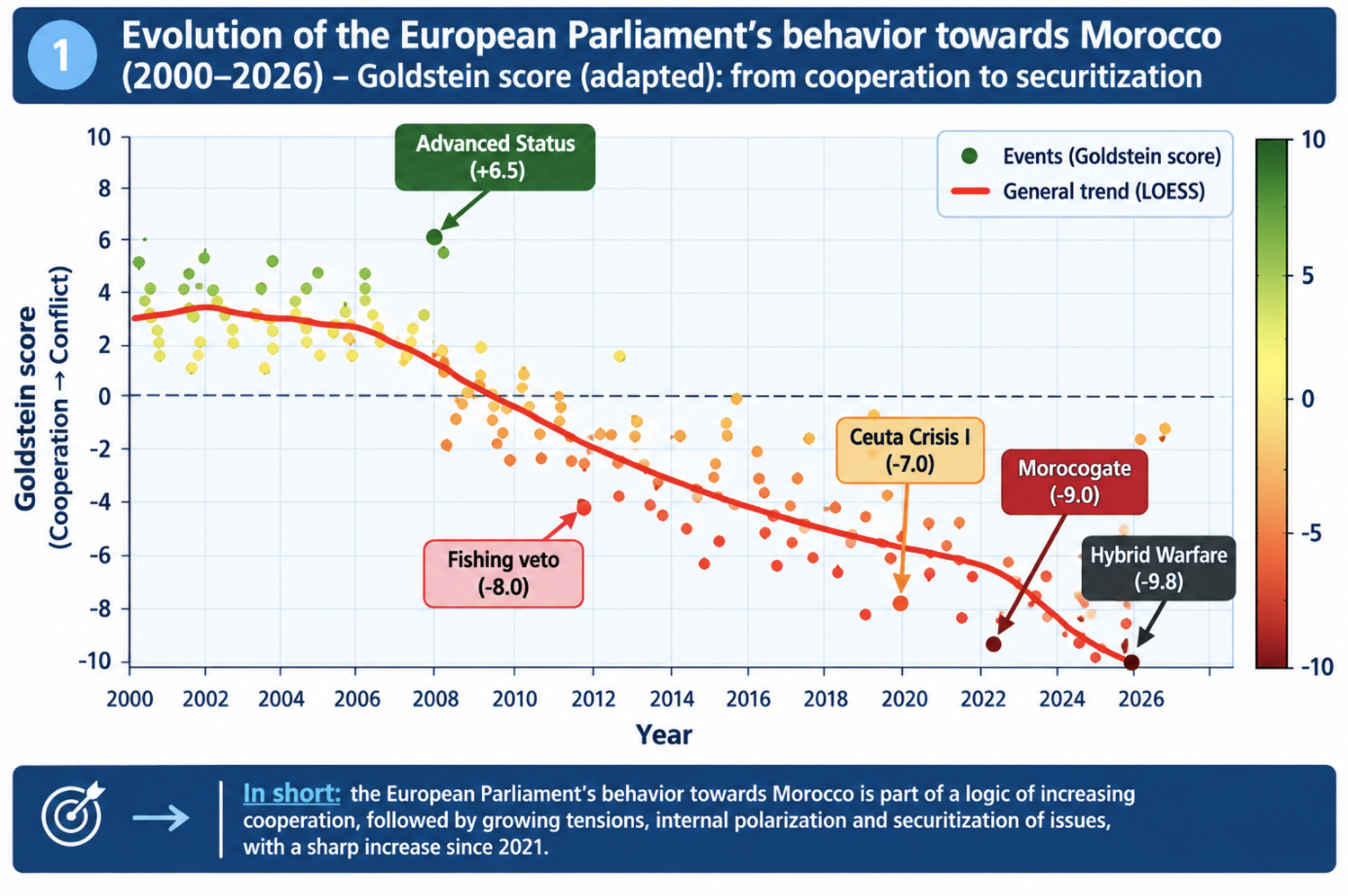
-The pivotal moment was indeed on 14 December 2011, when the European Parliament rejected the extension of the EU-Morocco Fisheries Agreement. This rejection, motivated by concerns about the benefits for the population of the Saharan provinces and the legality of fishing in the “disputed” waters, demonstrated the European Parliament’s ability to oppose both the Commission and the Moroccan government. This parliamentary pressure forced the renegotiation of the agreement, leading to a new protocol in 2013 that included statements about the benefits for local populations.
Nevertheless, the European Parliament ended up approving the EU-Morocco Agricultural Agreement despite its inclusion of the Sahara territories. It also approved, in January and July 2019, three agreements including the Sahara (the amendment of the Association Agreement, the Agricultural Agreement and the Fisheries Agreement), but the Court of Justice of the EU annulled all three of them on 4 October 2024, considering that they had been concluded without the consent of the population of the Sahara: three votes narrowly obtained, erased five years later by the Court (role-playing or mere coincidence).
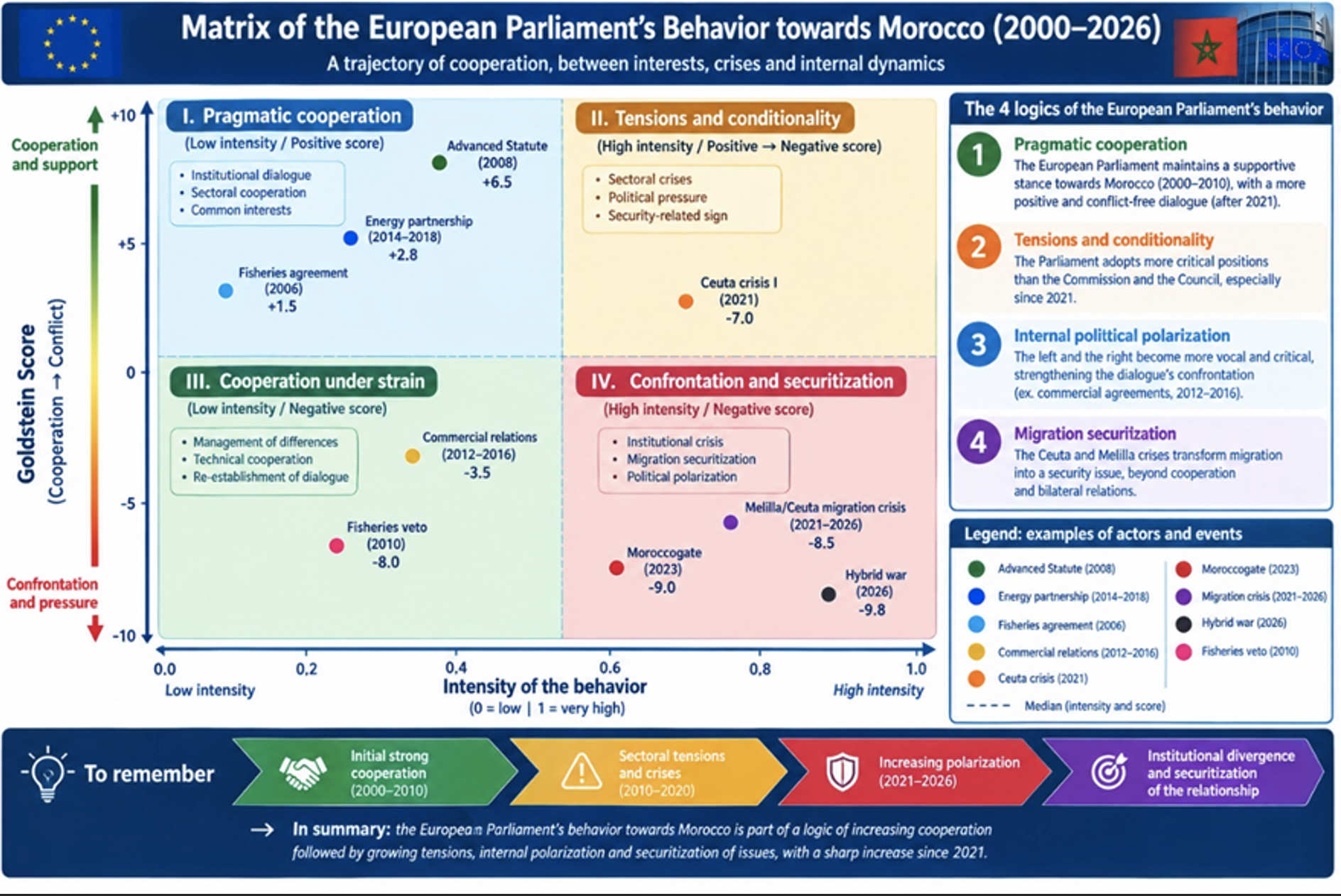
What the graph shows is less a simple deterioration than a change in nature: from a relatively stable technocratic cooperation, the relationship is evolving towards a politicized, tense interaction that is increasingly structured by confrontational logics.
Is this a cyclical development linked to the change of coalitions in the EP or a major trend?
To answer this question, it would be necessary to compare the behaviour of the EP with that of the Commission and the European Council, because the flattering and diplomatic statements of forums and press conferences do not necessarily reflect real behaviour and hide many sometimes harsh realities.
The observation of the factual data reveals two distinct phases: 2000-2011, a transitional period; 2011-2015 but after 2022, divergence becomes the norm; we therefore move from a cooperative convergence to a structured and persistent divergence, revealing an internal fragmentation of the EU, with the European Parliament playing here a role as an amplifier of the hardening, which reflects an increased politicisation of the EU-Morocco relationship, in contrast to the more managerial approach of the other institutions.
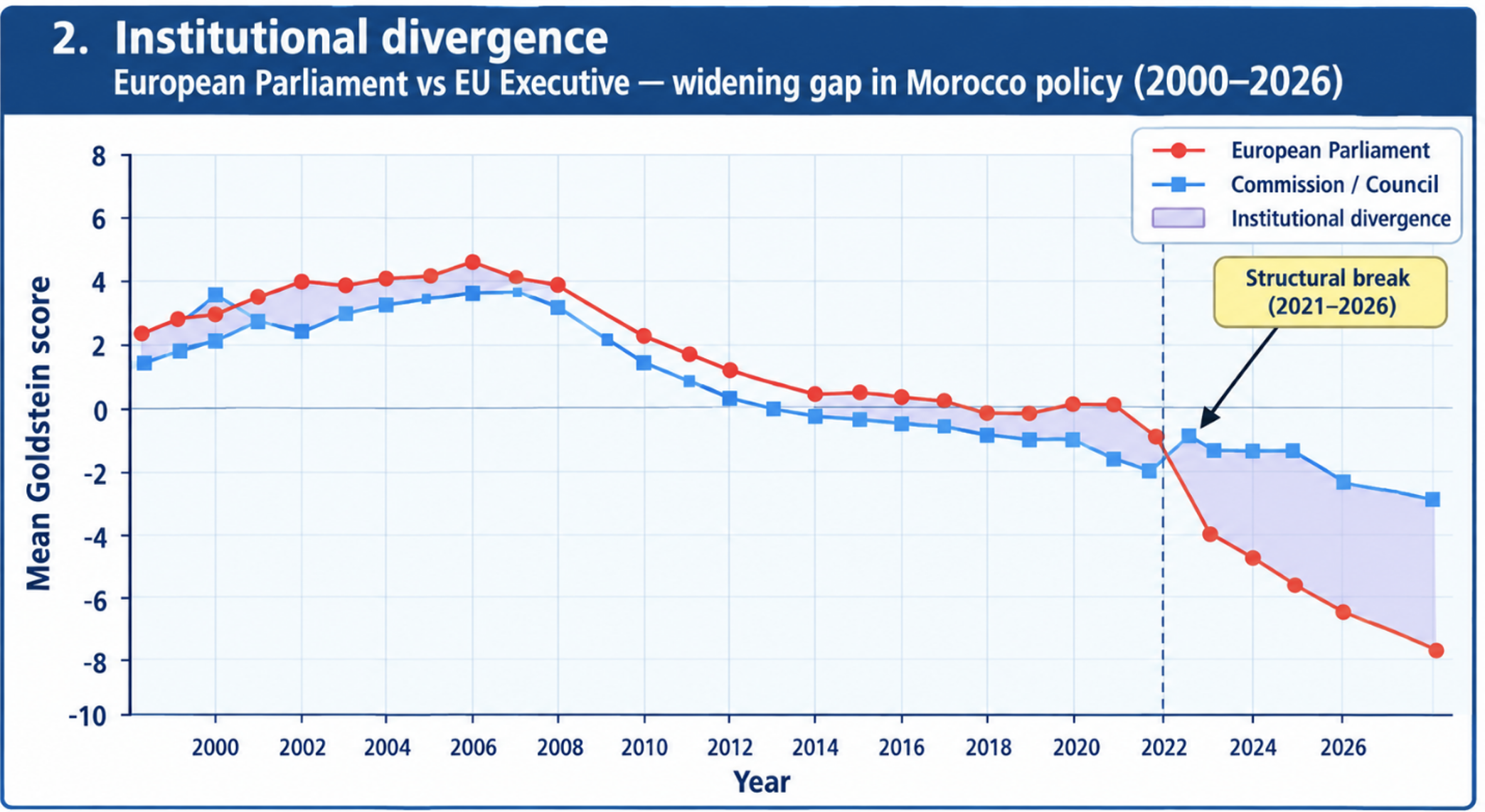
The observation of the data also suggests that the hardening of the EU’s behaviour is a strong trend; it is not an isolated act of the Parliament, judging by the interactions of all the European institutions that are flexing in a synchronized way, with a clear accentuation of the European Parliament that is proving to be the most virulent and leading the ball around the issues of Morocco’s territorial integrity, migration and human rights to make ethical.
There is also a marked polarisation between spheres of cooperation and spheres of conflict. On the one hand, the economic and institutional spheres are clearly driving the relationship upwards: trade (+3.40) appears to be the main driver of cooperation, followed by democracy and institutional interactions, which remain firmly anchored in the positive zone of functional coopegration, where interests are aligned and relatively depoliticised.
Conversely, the sovereign and socio-political domains concentrate tensions. Migration (-2.86), territorial integrity (-2.44) and security (-2.25) show the most negative scores, revealing a structural conflictuality. Human rights and the judiciary confirm this trend, although in a slightly less intense way. In other words, the closer we get to the issues of sovereignty and political norms, the more conflictual the relationship becomes.
Role of the European Parliament in amplifying the 2021 and 2026 Sebta migration crises
A comparison between the European Parliament’s resolutions of 2021 and 17 September 2026 highlights an unprecedented hardening of the European Union’s doctrine in the face of migration crises, marking the shift from humanitarian management to a logic of national security and territorial defense.
In 2021, the institution focused mainly on child protection and denounced the violation of the UN convention; five years later, the Parliament explicitly qualifies these events as “hybrid attacks” and “hybrid warfare” aimed at destabilizing the territorial integrity of the Union and the “instrumentalization of migration”, thus imposing an intransigent security prism.
Parliament used coercive semantics by demanding the immediate freezing of EU funds for Morocco and threatening Morocco’s access to the single market (paragraphs 21 to 23 of RSP Resolution 2870/2026).
The text has not spared the P Sanchez government either, now in the crosshairs of the European right, whose policy of massive regularization has been pointed out.
This doctrinal shift is made possible by a complete overhaul of the European legal architecture in the course of 2026; the European Parliament is now relying on the Pact on Migration and Asylum, which entered into force on 12 June 2026, to force Spain to deploy strict screening and asylum procedures directly at the border. The return of irregular migrants to Morocco is considerably facilitated by the regulation of 24 February 2026, which included this country on the official list of safe countries of origin at EU level.
This sequence reminds us of a fundamental truth of the European Union: its diplomacy has become multi-headed and is turning into the coercion of interdependence, and that in the future the Union’s partners must adapt their strategies vis-à-vis the EU, which has become increasingly unpredictable, as evidenced by the successive changes in regulations and the use of the “Brussels Effect” in competition.
It should be remembered in passing that the European Union’s regulatory pressure on Morocco has increased since 2000, as evidenced by the constant and uninterrupted progression of the pressure index (calculated by us) over a quarter of a century. The index has thus risen from 32.4 in 2000 to 55.4 in 2025, marking an overall increase of more than 70%. This upward trend appears to be particularly sustained over the recent period (particularly between 2020 and 2025), reflecting a gradual, even accelerated, tightening of European normative requirements with regard to the Kingdom, affecting several strategic sectors, including the financial sector (the CRD VI directive on transfers of Moroccan Residents Overseas), the automotive industry (severe rules of origin for EV cars) and others with the CBAM carbon certification, and the phosphate fertilizer sector targeted by the authorized cadmium thresholds.
The ideological change in the hemicycle and the reversal of the EP’s behaviour
To understand the virulence of the Parliament’s resolutions on Morocco, it is necessary to scrutinize the composition of the hemicycle. The analysis of the votes reveals an unprecedented political phenomenon: the formation of what political analysts call a “horseshoe coalition” (an unnatural union between the far left and the far right) on Moroccan issues; the far left (Greens, GUE/NGL) and the sovereignist right (ECR, Identity and Democracy) find a paradoxical common ground. The former wave the flag of human rights, the Sahara and imprisoned journalists, while the latter cry out about the “migratory invasion” and territorial integrity. The result is only a circumstantial majority that isolates the pragmatic center (Renew, moderate S&D). This alliance of circumstance pushes the pragmatic centre to harden its own positions to avoid being accused of naivety or laxity.
Indeed, long structured by the stability of the “Grand Coalition” between the centre-right (EPP) and the centre-left (S&D), the European Parliament has undergone a profound political recomposition that has radically altered its balance of power and, by extension, its diplomacy. At the turn of the 2000s, this absolute majority favoured a pragmatic, consensual and pro-integration foreign policy, as evidenced by the hemicycle’s massive support for Morocco’s “Advanced Status” in 2008 (Goldstein’s score of +6.5). However, the continuous erosion of this moderate central bloc since 2014 has fragmented the assembly, transforming the hemicycle into a proxy inquisition court because it is the Member States that can ultimately temper the enthusiasm of MEPs by sending them a strong and audible signal.
What Strategic Role of Member States Play in the Sustaining Cooperation?
The analysis of the causal path of the factors that condition the variations of European diplomacy reveals that the best predictor of EU-Morocco relations is the ideological colouring of the hemicycle in Strasbourg; when the EP is composed of a moderate majority coalition, cooperation prospers; when coalitions fracture and the coalition is too fragmented between the extremes (right and left), crises multiply.
The analysis suggests a more marked propensity of left-wing coalitions to favour cooperation, while some right-wing coalitions are more on the confrontational side. However, this relationship remains nuanced: belonging to the right does not automatically lead to a confrontational position, with some coalitions maintaining a cooperative orientation. (figure below)
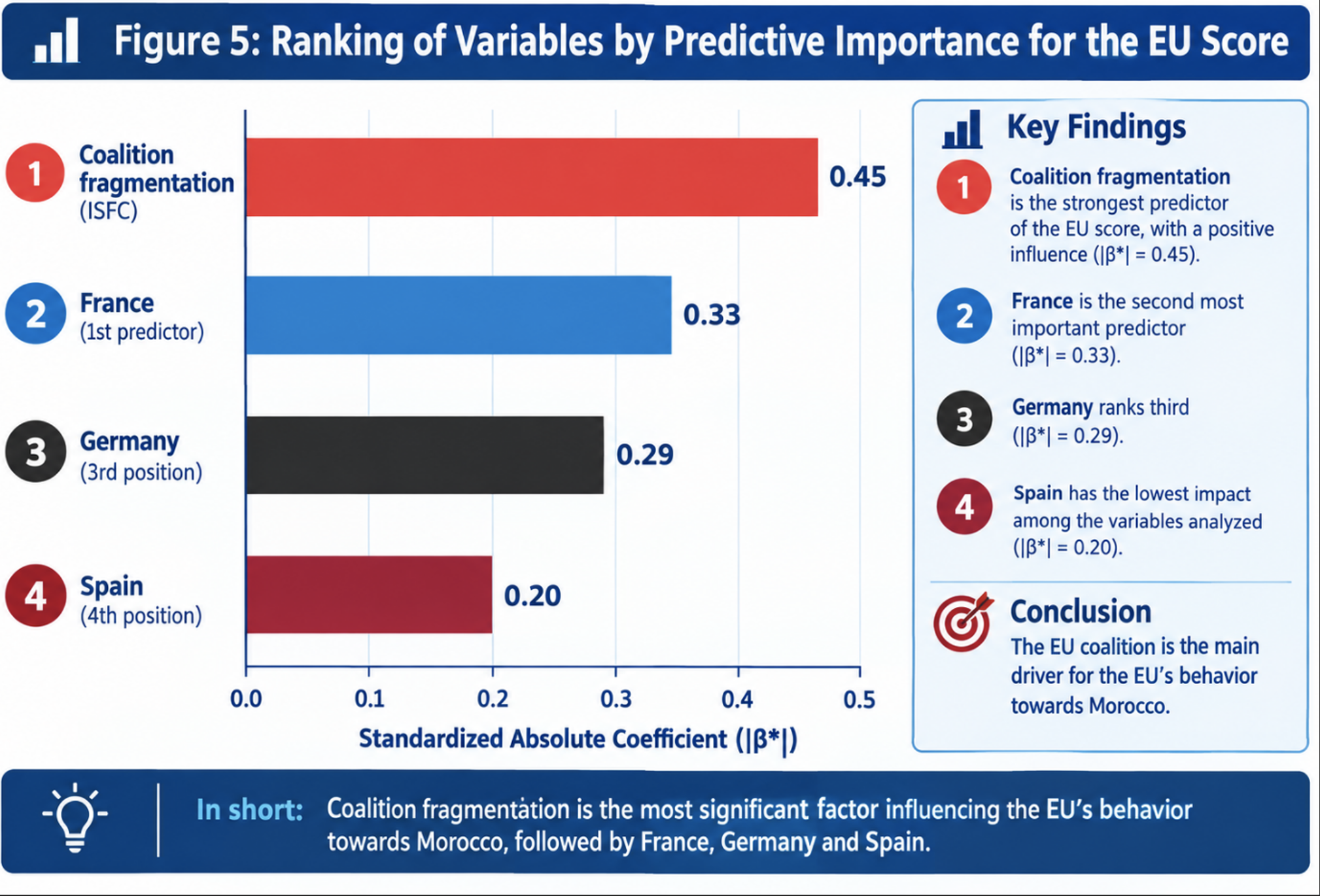
However, a fine interpretation of the analysis reveals that the European position is not the result of a single factor, but of the articulation of several levels of decision-making: the political orientation, the behaviour of coalitions and the configuration of national governments and the state of bilateral relations between Morocco and the most influential member countries, in particular the France-Germany-Spain trio.
The analysis highlights above all the weight of the Franco-German binomial, which confirms its presence in a very clear way in the shaping of Moroccan policy in Europe, whose influence on the EU’s position is positive and statistically significant (β = 0.33; 0.29). But it is the configuration of the parliamentary coalition that presents the most marked negative statistical link (β = –0.45; p < 0.001).
These analysis results reveal a multi-level political mechanism: national power relations help to shape the composition of governments; they then project their preferences into the European arena; finally, the structure of coalitions can amplify or contain this influence. With an R² of 0.62, the model explains a substantial part of the variations observed in the EU’s position; the dominant coalition in the hemicycle appears to be a transmission belt between domestic and European politics. But the image reflected in the EP is not entirely faithful because the European Parliament is becoming more and more autonomous and sometimes escapes the control of the Member States and becomes uncontrollable.
What lessons can be learned?
Interdependence should be balanced and not coercive; third countries in the European neighborhood such as Morocco and Türkiye bear a heavy burden of European border control and deserve better treatment and an even more preferential status because these countries alone have to manage the return of migrants, monitor departures, host camps that are sometimes saturated, and absorb social and economic tensions, all this with limited means and without real decision-making power, which turns the discourse of partnership into a disproportionate burden for them. The situation is untenable in the medium and long term, and we will see an amplification of crises if Spain and especially the Franco-German duo do not learn the necessary lessons.
The modest objective of this essay is to shed, as far as possible, on a period and a component of Moroccan diplomacy in order to draw the necessary lessons; since 2000, the prowess of Moroccan diplomacy no longer needs to be demonstrated; the diplomacy of “smart power” has allowed many achievements that are so salutary because Morocco has come out of an era of reactivity, an era of proactivity, an era of management, an era of solution and influence in all directions, which has allowed the return of the Kingdom to the AU and above all the recognition of the Moroccanness of the Sahara by the international community.
Exclusively intergovernmental diplomacy is necessary but not sufficient; the time has come to put more emphasis on minilateralism and regionalism on the one hand (notably with the GCC, BRICS or even the Shanghai Organization) (e.g. mobilization of a coalition of partners dissatisfied with EU policies) and on the other hand on informal diplomacy, on networks, and multifaceted influence that adapts to rapid changes and makes it possible to react to the “behavioral disorders” of certain international actors.
The other major lever, which has always been the strength of the Kingdom of Morocco, during difficult trials, is the strengthening of the domestic front and the mobilization around the Throne, as in 1954 and 1975 during the organization of the Green March, by sending a strong signal to the international community after the legislative elections of September 23, 2026.
References:
- Crum B (2006) Parliamentarisation of the CFSP through informal institution-making? The fifth European Parliament and the EU High Representative. Journal of European Public Policy 13(3): 383–401.
- Dür A (2008) Measuring interest group influence in the EU: A note on methodology. European Union Politics 9(4): 559–576.
- Eeckhout P (2012) The EU’s Common Foreign and Security Policy after Lisbon: From pillar talk to constitutionalism. In: Biondi A, Eeckhout P and Ripley S (eds) EU Law after Lisbon. Oxford: Oxford University Press, pp. 266–291.
- Guri Rosén and Kolja Raube: Influence beyond formal powers: The parliamentarisation of European Union security policy, The British Journal of Politics and International Relations 2018, Vol. 20(1) 69 –83.
- GDELT Project (2013-) — The GDELT Event Database, gdeltproject.org. (author’s dataset 2025-26)
- Reuters (2002-2026) ; AFP (2000-2026) ; EFE (2005-2024) ; El País (2005-2025) ; Le Monde ; Jeune Afrique ; MAP (Maroc, officiel) ; SPS (Polisario, officiel) ; Politico Europe (2019-2025) ; Euractiv ; MediaPart / Le Soir / Knack (Qatargate 2022-2023).