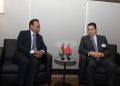

Moroccan Foreign Minister Nasser Bourita chose to open Morocco’s address to the United Nations General Assembly on September 22, 2026, by invoking King Mohammed VI’s assessment of a world undergoing rapid transformation, where certainty is receding and international law faces repeated violations. The reference was more than a diplomatic formality. It established the political framework for a message that countries cannot safeguard their security by merely containing crises or awaiting negotiated settlements while the conditions sustaining violence and instability remain unaddressed.
This explains why Bourita brought together armed groups, climate change, Palestine, Africa, and the Moroccan Sahara. These were not separate issues assembled for a diplomatic agenda, but different dimensions of a common challenge involving the protection of sovereignty, the development of resilient institutions, and Morocco’s capacity to contribute to regional stability while defending its national interests.
Holding armed groups’ sponsors accountable
By calling for accountability for states that shelter, finance, and arm non-state armed groups, Bourita shifted attention from the activities of these organizations to the conditions enabling their survival.
His warning about threats to maritime passages, straits, and critical infrastructure illustrates why armed groups can no longer be treated solely as domestic security concerns. Their activities affect international trade, food security, and countries far removed from conflict zones.
The Moroccan position challenges an approach that targets perpetrators while leaving their support networks intact. Bourita’s emphasis on the responsibility of sponsoring states also raises the question of whether international accountability mechanisms can effectively address the use of armed organizations to advance objectives that governments cannot openly pursue.
In the Sahel, where armed groups, smuggling networks, and organized crime intersect, this position has implications for Morocco’s security and the regional stability required for its economic connectivity initiatives. Holding sponsors accountable, however, ultimately depends on establishing responsibility and applying international accountability mechanisms.
Gaza’s future depends on Palestinian institutions
On Palestine, Bourita did not present Morocco’s contribution to Gaza as a substitute for political demands. He reaffirmed support for an independent Palestinian state with East Jerusalem as its capital, respect for the ceasefire, unhindered humanitarian assistance, and continued support for the Palestinian Authority and UNRWA.
He also warned against settlement expansion, settler violence, and Israeli measures affecting the legal status of Palestinian territories, linking these developments to displacement and the erosion of the foundations of Palestinian statehood.
In Jerusalem, Bourita highlighted King Mohammed VI’s responsibilities as Chairman of the Al-Quds Committee and the work of the Bayt Mal Al-Quds Agency, alongside his condemnation of unilateral Israeli measures and repeated violations of the sanctity of Al-Aqsa Mosque. This connects Morocco’s political position to practical efforts to preserve the city’s identity and support its inhabitants.
Morocco’s participation in the International Stabilization Force for Gaza introduces another dimension, involving Palestinian police training, senior military officers, a field hospital, and readiness to undertake counter-extremism programs.
The UN Security Council authorized the force through Resolution 2803 in November 2025. Morocco subsequently formalized its participation in the mission, becoming one of its five founding troop-contributing countries.
The challenge is to help restore Palestinian institutions’ capacity to provide security and essential services without separating those efforts from the political objective of statehood. The practical impact of Morocco’s contribution will depend on developments on the ground and the implementation of the broader political arrangements.
The Atlantic is more than a maritime gateway
In Africa, the same approach takes an economic and developmental form. King Mohammed VI’s initiative to provide Sahel countries with Atlantic access, the Atlantic African States Initiative, and the African Atlantic Gas Pipeline seek to expand economic opportunities for countries whose geographical isolation compounds existing vulnerabilities.
The significance of these projects extends beyond connecting roads, ports, and markets. They offer a framework for regional integration in which economic cooperation complements security efforts.
This gives practical meaning to the King’s call for Africa to trust Africa, through initiatives that require sustained partnerships and implementation.
The presence of water and climate change in an address on international security follows the same logic. Morocco’s investment in dams, seawater desalination, and inter-basin water transfers, alongside its target of reducing greenhouse gas emissions by up to 53% by 2035, concerns societies’ ability to withstand drought and disruptions to food production.
Turning this approach into wider regional benefits will also depend on financing, technology transfer, and sustained international cooperation.
The Moroccan Sahara and October’s diplomatic test
On the Moroccan Sahara, Bourita’s message carried particular significance ahead of the next Security Council discussions.
He outlined six principles defining Morocco’s position following Resolution 2797, adopted in October 2025. They include autonomy under Moroccan sovereignty, UN-sponsored negotiations, the responsibilities of the four parties, and rejection of both the continued status quo and ceasefire violations.
The resolution establishes Morocco’s Autonomy Proposal as the basis for negotiations toward a mutually acceptable political settlement.
With MINURSO’s current mandate expiring on October 31, 2026, attention is turning to the next phase of the political process and the responsibilities of the parties involved.
Bourita also connected the dispute to development in Morocco’s southern provinces and residents’ participation in the September 23 legislative elections. By highlighting elected representation and local governance, he placed institutional and economic developments alongside the UN-led diplomatic process.
Morocco’s next diplomatic responsibilities
Bourita concluded by announcing Morocco’s candidacy for a non-permanent seat on the UN Security Council for 2028-2029, placing these messages within a broader diplomatic horizon.
Morocco is presenting not only its positions on international disputes but also areas where it intends to contribute, from Palestinian institutional capacity to African integration and the UN process concerning the Moroccan Sahara.
The address reflects a foreign policy approach grounded in King Mohammed VI’s assessment of global transformations, linking national interests to Morocco’s regional and international responsibilities.
Within this approach, diplomacy’s contribution extends beyond containing crises to addressing instability’s underlying causes, strengthening institutions, and expanding development opportunities. Developments in Gaza, the Sahel, and upcoming UN deliberations will test how these commitments translate into tangible results.