It’s past 10 p.m. My dad is in the driver’s seat, my mother is riding shotgun, and I’m in the backseat. We’re hosting guests tomorrow, and my mom is planning to make one of her signature dishes, “tanjia”. My mom isn’t Mrakchi, but she has mastered the recipe she learned from my grandmother, who is.
We hop from butcher to butcher, but somehow none of them have “lmelj”—beef shank—the cut my mom was hoping to use. After around five stops, we start wondering why it seems to be unavailable everywhere. If I were dealing with the same question on my own in the U.S., I probably would’ve googled something along the lines of “Why is beef shank so hard to come by?” But here, rather than relying on the internet for an answer, my parents go straight to the source: they ask the butcher.
One of them proceeds to explain that throughout the day, owners of Moroccan restaurants do the rounds of local butchers to purchase “lmelj” to, funnily enough, use for “tanjia”. That explanation quickly turns into a ten-minute conversation.
Part of me was a little irritated. We had spent the better part of an hour trying to find “lmelj” to no avail, only for my mother to give up on “tanjia” and decide on a different dish. At the same time, I found myself enjoying something about the search itself: the small interactions with each butcher, and especially the way a simple question could turn into a ten-minute conversation. After spending the past four years in the United States, I realized how much I had missed that kind of casual, unhurried exchange.
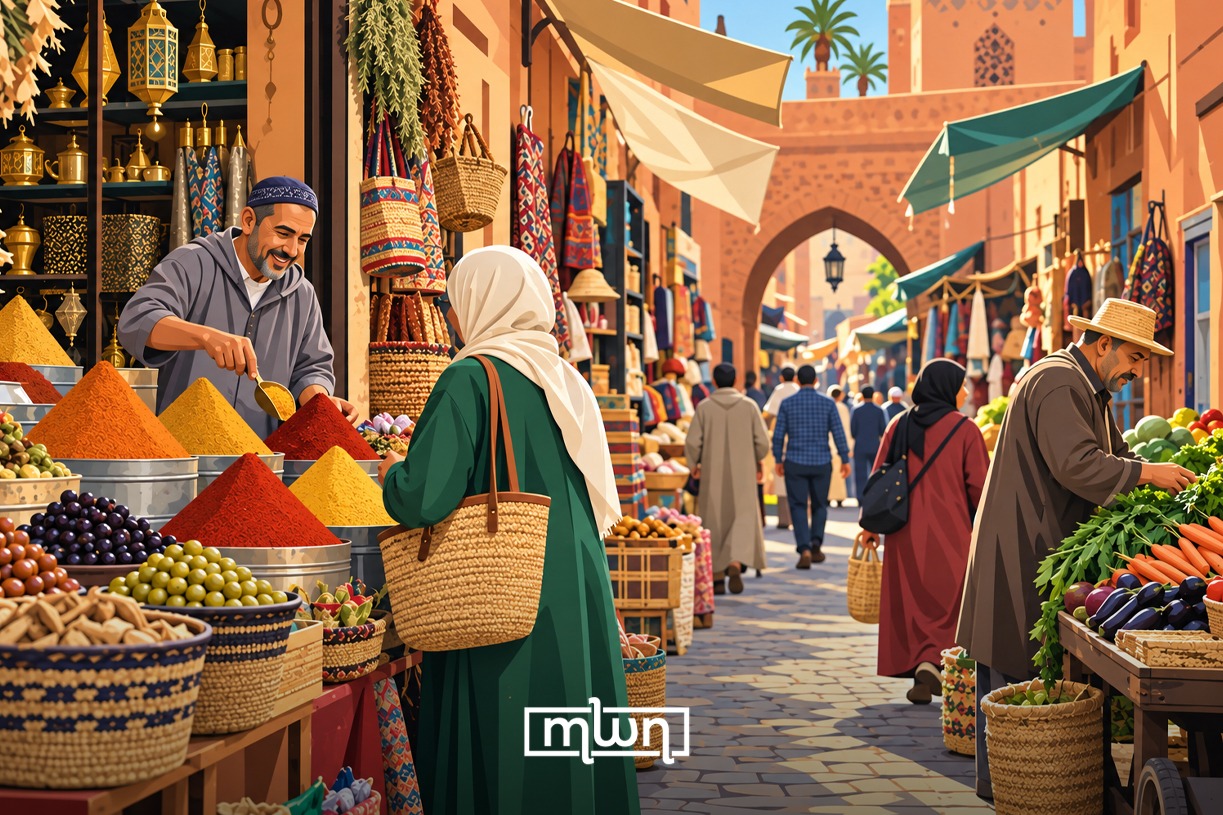
There’s something beautiful about buying things from the souq, each item from its specialized spot. They possess something that big chain grocery stores strip away: the human connection. The tips and tricks that each person shares with you.
My mom knows that Fatima sells spinach, but Zahra sells it already bagged. She knows which vendor will let her hand-pick the strawberries, and which one will pull out the unopened box from under the table to let her pick the freshest plums. She also knows that when she goes to the baker, if the next batch of fresh loaves will be coming out of the oven in ten minutes, he will let her know to come back for the fresh one, rather than a loaf that has been sitting on the counter for two hours. These seasoned vendors also share their wisdom with you. Don’t ask me what the science behind it is, but I now know that wrapping my avocado in newspaper will make it ripen faster.
Yes, it is time-consuming to hop from one stand to another and accept the fact that you just might not find the produce you are looking for. But there is something genuine and honest about that experience. If the crops are not available that week, you simply won’t find them.
Through these human interactions, there is less separation between seller and buyer. You build relationships based on trust, familiarity, and the promise of becoming a regular.
I miss having kombucha at my fingertips. I miss going to one store and buying everything at once: frozen chicken tenders in one aisle and chocolate-covered almonds in the next. But I would happily trade some of that convenience for an experience of grocery shopping that shifts from a soulless, frictionless ransaction, often completed at a self-checkout, to one where friction is precisely where the human connection lies. Where the produce you buy is more than just ingredients: it is a conversation, a story, the comfort of knowing who is behind your food, and even the occasional frustration of being overcharged. It is, above all, a human connection.
These long-standing community-building benefits of souqs, which we often take for granted, are now being deliberately cultivated elsewhere, including in U.S. neighborhoods where farmers markets are introduced in part to foster a stronger sense of community.
Project for Public Spaces, a nonprofit dedicated to helping people foster stronger communities through public spaces, recently highlighted research showing that farmers markets in the U.S. do much more than sell food. In a nationally representative survey of more than 5,000 people, over 60% of farmers market attendees said they went, at least in part, “to feel like you’re part of the community.” Nearly half said they had connected with others in their community or received information from local organizations while at a market, and more than 10% said they had actually made a friend there. The study also found that people who attended farmers’ markets more frequently reported both a stronger sense of community and greater participation in community life1.
These markets are recreating the kind of social interaction that is already built into the experience of shopping at a souq. You come for food, but along the way you run into people, exchange information, become familiar with vendors, and slowly become part of a place.
The comparison is not perfectly transferable to Morocco. People may go to the souq primarily because it is cheaper than the supermarket, not because they are searching for community. But intention is not the point. These repeated interactions still build familiarity, trust, and connection, whether or not anyone consciously seeks them out.
Inherited practices often endure because they serve purposes beyond their most obvious function. In cities like Marrakech, markets, artisan quarters, and gathering places have long sat at the heart of the medina, serving not only as places of commerce but as spaces where people meet, exchange information, and participate in public life. The souq is a place to buy food, but its social function is hardly new.
Convenience is great. There is no denying that. But the cost of prioritizing convenience can be the loss of humanity: the small talk that fills the void between weighing your bag of peaches and paying for them, the vendor who tells you to wait ten minutes for the fresh bread, and the lesson, learned perhaps too late, that if you want “lmelj”, you should buy it before 10 p.m.