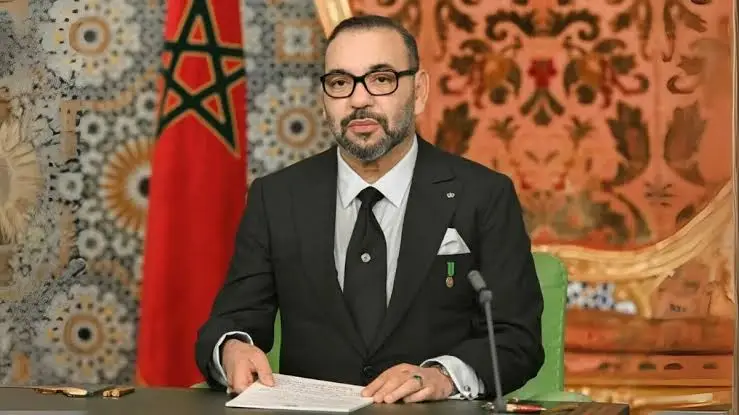
Rabat – King Mohammed VI expressed deep concern over the repeated and “heinous” attacks targeting Saudi Arabia in letters to King Salman bin Abdulaziz Al Saud and Crown Prince Mohammed bin Salman, saying the Houthi militias had targeted civilian and economic facilities, vital infrastructure, and cities and residential areas populated by civilians.
The monarch stressed that the attacks had gone beyond targeting facilities and civilians to include “desperate and sinful attempts” to target the holiest places on Earth and the most sacred sites in the hearts of Muslims: Mecca and Medina.
The attacks represented more than an assault on Saudi Arabia and its people, arguing that targeting the country and its holy sites affects Muslims worldwide, the King warned.
“These despicable attacks and desperate attempts to undermine the security, stability and prosperity of the proud Saudi people do not represent only an attack on brotherly Saudi Arabia, its people, and those performing Umrah there,” King Mohammed VI said. “They are a blatant attack on the feelings of more than one billion and 800 million Muslims across the world.”
He added that the attacks also represented a violation of the principles associated with Islam, including peace, tolerance, the protection of human life and the sanctity of religious sites.
Speaking on behalf of Morocco and the Moroccan people, King Mohammed VI expressed condemnation of what he described as “criminal acts,” holding the Houthi militias and those supporting, financing and arming them responsible.
He said those responsible should be held accountable “before God, before history and before international law,” adding that international sanctions should follow.
The monarch stated that an attack on Saudi Arabia is an attack on Morocco.
“The security and stability of Saudi Arabia, as well as the security of the other Gulf Cooperation Council states, is an inseparable part of the security of Morocco,” he said.
“Any attack on Saudi Arabia is an attack on Morocco,” the king added, emphasizing that Morocco considers standing with Saudi Arabia and the Gulf states to be a defense of “truth and legitimacy,” while defending their vital interests is part of defending shared strategic interests.
The Moroccan monarch further reaffirmed Morocco’s position of standing alongside Saudi Arabia in confronting threats from “terrorist and separatist militias” and the regional forces supporting them.
According to King Mohammed VI, such forces are pursuing policies that threaten neighboring countries, undermine regional stability and put vital maritime routes at risk.
He emphasized the importance of those routes to the global economy and international maritime security, placing the latest attacks within a wider regional security context.
King Mohammed VI invokes international law
King Mohammed VI also referred to United Nations Security Council resolutions concerning the conflict in Yemen and Houthi attacks.
He said the continuation of the attacks constituted a “blatant violation” of international law and relevant UN provisions, particularly Resolution 2216, adopted in 2015, and Resolution 2722, adopted in 2024.
Resolution 2216 includes measures concerning the Houthi movement and an arms embargo, while Resolution 2722 demanded that the Houthis immediately cease attacks against merchant and commercial vessels in the Red Sea.
King Mohammed VI said attacks against civilian areas, economic facilities and holy sites also constitute violations of international humanitarian law and international conventions and customs.
“They cannot pass without accountability or punishment,” he said.
Recent attacks raise regional concerns
The letters come amid a sharp escalation in Houthi attacks targeting Saudi Arabia in September.
On September 15, Saudi air defenses intercepted and destroyed a drone launched toward Mecca before it entered the restricted airspace around the holy city, according to Saudi authorities. The incident prompted renewed concerns over the security of the city and its worshippers.
The escalation has also included attacks against Saudi cities and energy infrastructure. A September 11 attack caused fires at a pumping station along Saudi Arabia’s East-West pipeline southeast of Medina.
On September 19, Houthi forces launched missiles and drones toward Riyadh, with reports of explosions and a fire near King Khalid International Airport. Saudi authorities also issued air-raid alerts in several areas.
The attacks continued on September 26, when Saudi authorities said they intercepted two ballistic missiles and two drones launched toward Saudi territory. The missiles were reportedly heading toward Khamis Mushait, while the drones were directed toward the Riyadh area.
The developments have also prompted wider regional coordination. Saudi Arabia, Pakistan and Türkiye held talks involving their military chiefs in Riyadh on September 25, while foreign ministers from Saudi Arabia, Türkiye, Egypt and Pakistan had earlier affirmed Saudi Arabia’s right to defend itself in accordance with international law.
The attempted targeting of Mecca has drawn particular international attention. Pakistan Prime Minister Shehbaz Sharif told the United Nations General Assembly that any attack threatening Mecca or Medina would constitute a “red line,” reflecting the wider concern surrounding the security of the two holy cities.
Against this backdrop, King Mohammed VI’s message places Morocco’s position within a broader call for the protection of Saudi civilians, infrastructure, religious sites and maritime security, while demanding accountability for those responsible for the attacks.