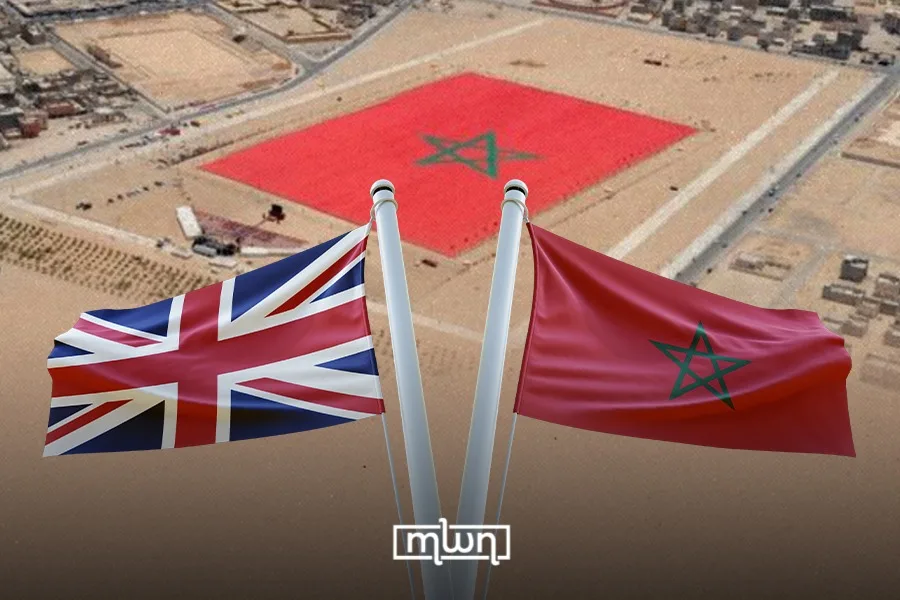
Marrakech – The United Kingdom has refused to sanction trade with Morocco’s Western Sahara, brushing aside a parliamentary push rooted in separatist framing of the territory.
The rebuff arrived in a written answer from Lord Wood of Anfield, the FCDO’s Parliamentary Under-Secretary of State for Europe, Eastern Europe, International Security, and Growth, on September 28.
Britain, he wrote, would “continue to engage with all relevant parties” behind the UN-led process toward a “just, lasting and mutually acceptable solution,” one forged through compromise and anchored in the UN Charter, “including the principle of respect for self-determination.”
That answer disposed of a question tabled on September 8 by Baroness Ruth Deech, a Crossbench peer. She had demanded to know why London withheld sanctions “in view of its annexation by Morocco and transfer into it of citizens” – a loaded characterization the government pointedly refused to endorse.
The stance is not new. Back in March 2025, Scottish National Party MP Graham Leadbitter twice pressed the Department for Business and Trade to bar UK firms, investors, and traders from dealings tied to the territory.
The government’s reply, delivered on March 24 by Douglas Alexander, then Minister of State for Trade Policy and Economic Security, was unambiguous: “it is for companies to take their own decisions on whether to do business” in Western Sahara, alongside continued backing for a UN-led political settlement.
What has hardened since then is London’s alignment with Rabat. On June 1, 2025, the UK-Morocco Joint Communiqué recast British policy, declaring Morocco’s 2007 Autonomy Plan “the most credible, viable and pragmatic basis for a lasting resolution” of the dispute.
The document, issued during then-UK Foreign Secretary David Lammy’s visit to Rabat for talks with Moroccan Foreign Minister Nasser Bourita, also welcomed Morocco’s readiness to negotiate in good faith and expand on what autonomy within the Moroccan state would entail and deliver.
Parliament confirmed the shift days later. On June 11, 2025, Hamish Falconer, then Parliamentary Under-Secretary for the Middle East and North Africa, told the Commons that the government had endorsed the Autonomy Plan on June 1, even while keeping to Britain’s legal line that the territory’s status remains “undetermined.”
The trajectory culminated at the Security Council. On October 31, 2025, the Council – with Britain among its five permanent members – adopted Resolution 2797, which set autonomy under Moroccan sovereignty as the basis for negotiations on the file and renewed the MINURSO mandate through October 2026.
For the first time, the UN’s premier body framed Rabat’s plan as the core of any settlement, sidelining the maximalist demands long pressed by separatism’s backers.
Within this context, Lord Wood’s refusal reads less as a single rebuff than as the settled posture of a permanent Council member. London has repeatedly declined to treat commerce with the Western Sahara as illicit, has left investment decisions to companies, and has backed the autonomy framework at every level – bilateral, regional, and international – including at the Security Council.
The change at Downing Street has not disturbed that line. Britain endorsed the Autonomy Plan under Keir Starmer in June 2025 and turned down the sanctions demand under his successor, Andy Burnham, who took office on July 20, 2026, with the position holding firm across the handover.
The sanctions campaign, by contrast, has failed to move the government. Deech’s demand echoed a framing – annexation, illegitimate settlement – that Britain has serially rejected in favor of a negotiated, autonomy-centered outcome. On the evidence of successive written answers, that rejection is neither accidental nor provisional.
Read also: UK Recognized Morocco’s Sovereignty Over Western Sahara Back in 1721