
I learned Abderrahmane El Gadi had died almost two months after his death.
This surprised me because, in another sense, he had not been absent from my life at all. From my home in the United States, I had been returning to recordings of the Moroccan Amazigh musician playing the lutar, the long-necked lute associated with the Middle Atlas. Among the sessions I enjoyed was aɣur-aš tawada (beware of leaving), performed with the intimacy that makes a recording feel less like a concert than a room one has somehow been allowed to enter.
Then I learned that the man I had been listening to was gone.
El Gadi came from El Ksiba, a small town in the Middle Atlas. Not far away is Ait Ishaq, birthplace of Hadda Ouakki, one of the great voices of Central Atlas Tamazight song, whose soaring voice seems almost made for the mountain country from which it emerged. El Gadi’s lutar belonged to that same broad musical geography, where voices, instruments and izlan (songs) have long circulated among towns and villages, weddings, markets and intimate gatherings.
But when I began reading the brief notices of El Gadi’s death that I could find online, I encountered something strange. They told me that he had been born in El Ksiba, but not when. I could find no date of birth. Not even his age at death appeared. Even his name shifted from one digital trace to another: El Gadi, LGadi, sometimes Abderrahman, sometimes Abderrahmane. Here was a musician whose recordings had travelled across borders, yet even the basic coordinates of his life were difficult to hold together.
I went looking for him.
The recordings were easy to find. El Gadi appeared again and again, lutar in hand, sometimes beside women singers, sometimes in Morocco, sometimes among Moroccans abroad. There were old songs, intimate sessions, performances in France and Germany, fragments uploaded by admirers.
Yet the closer I looked for the man behind the music, the thinner the trail became.
I wanted an obituary, a substantial biography, an account of his career. I wanted to know from whom he had learned, with whom he had performed, where he had travelled, how he had come to the lutar. I wanted to know what he thought he was doing when he played songs that had passed through other voices before reaching his own.
Instead, I kept finding music.
His lutar could sound from my computer thousands of miles away, but his life remained difficult to reconstruct. His music had travelled farther than his biography.
What kept drawing me back was not novelty but familiarity: the assurance of his lutar, the old izlan, the interplay with the singers around him. The instrument seemed to converse rather than merely accompany, answering a sung line, opening space for another, carrying an izli forward without overwhelming the voice. There was something unforced about these sessions, music still close to the social world from which it came.
Perhaps I noticed this contradiction because listening to music carried across distance has been part of my life for a very long time.
Long before I became a migrant, a cassette player migrated to me.
I grew up in the Ziz Valley of southeastern Morocco. Sometime in the mid-1970s, our family acquired its first cassette player. I remember the day vividly. It was a small Grundig with a single cassette deck and a radio with remarkably strong shortwave reception. A man from our village who had migrated to Germany had brought it back and sold it to my father.
My father gave the Grundig a prominent place in our living room. The little talk box seemed capable of pulling distant worlds into our house. We could hear the BBC in Arabic, Radio Paris, Spanish stations, Moroccan broadcasts and stations from neighboring Algeria. For a couple of hours each evening, we could also tune in to Tamazight broadcasts from Rabat, a brief daily window in which the language of our own valley came back to us over the national airwaves.
The cassette deck carried another kind of transmission. Migrants from the village living in Europe sometimes sent cassette letters home: recorded messages filled with voices, news and greetings. Long before a telephone call across borders became ordinary, a cassette could carry a familiar voice from Europe back into a house in the Ziz Valley.
Long before I knew words such as globalization or transnationalism, I could hear them.
The world arrived as sound.
The Grundig was also something of a status symbol, a desirable object brought from Europe by a migrant. But it quickly acquired a social life of its own. My father belonged to a circle of village elders and members of the taqbilt, the tribal council. They gathered regularly for afternoon tea after ‘asr prayer, rotating among their homes, not necessarily for formal meetings, but for friendship, conversation, news, stories, and village affairs.
When it was my father’s turn to host, they often sat in our garden. The Grundig joined them.
Tea was poured. Conversation wandered. The radio might bring news from Morocco, Algeria or farther away; at other moments someone put on a cassette. A machine that had travelled from Germany slipped into an older rhythm of hospitality, conversation and listening. The taqbilt already had its ways of gathering and exchanging information. The radio simply joined that world.
Then we discovered the Grundig’s weakness: batteries.
It consumed them much faster than we could afford to replace them. Our village did not yet have electricity, so listening required calculation. Playing music was one thing; wasting battery power rewinding a cassette was another.
So, we used a Bic pen.
Its plastic barrel fit into the cassette spool. We removed the tape, inserted the pen and turned it by hand until we reached approximately the place we wanted to hear again. Then the cassette went back into the Grundig, and the batteries were reserved for what mattered: the music.
For one of my brothers, the Grundig’s attraction was stronger still. He became so fascinated by it that he carried it pressed against his chest. My mother watched him until one day she joked that the cassette player did not need to be breastfed.
We laughed. The machine had entered the household almost as another member of the family.
Looking back, I am struck by how many kinds of movement converged in that little Grundig. A migrant carried it from Germany to the Ziz Valley. Shortwave signals arrived from London, Paris, Madrid, Rabat and Algiers. Recorded voices of migrants travelled back from Europe. The men of the taqbilt listened over tea. Children discovered recorded music through it. A Bic pen helped keep the music playing.
Before I travelled with cassettes, the cassette player had travelled to me.
Years later, when I left Morocco for the United States to continue my studies, I packed several cassettes by Mohamed Rouicha, the great Middle Atlas musician of my generation. Some were in Tamazight, others in Moroccan Arabic.
I did not think I was preserving anything. I packed them because I loved listening to them.
I had not packed an archive in my suitcase. I had packed music that gave me pleasure.
Only later did it become an archive.
The cassette belonged almost perfectly to migration. Small, inexpensive and reproducible, it allowed music to travel with people. Andrew Simon’s history of Egyptian cassette culture shows how cassette technology became entangled with the enormous human mobility of the 1970s and ’80s. My journey was different, but I was participating in the same technological possibility: I was leaving Morocco, but I did not have to leave all its sounds behind.
The technologies around those cassettes have come and gone. Cassette players disappeared. CDs arrived and receded. Music became a computer file, then something summoned from a phone. Eventually YouTube made available in seconds recordings that once had to be purchased, copied, heard on the radio or encountered at a wedding or musical gathering.
Yet the cassettes remain.
They moved with me through decades of academic nomadism in the United States. I no longer need them to hear Rouicha. But that is no longer why I keep them.
When I hold one now, I am holding the moment of departure. It leads back to the Ziz Valley, to my high-school years, to Morocco before I knew what it would mean to live most of my adult life elsewhere. It has become a material archive of departure.
For years, I thought I had been carrying those cassettes. Increasingly, I wonder whether they have also been carrying a place for me.
The cassette was designed to make sound portable.
Migration turned it into memory.
El Gadi came to me differently.
I never had to put his music in a suitcase. By the time I began listening to him, technology had learned to do the travelling for me.
From the United States, I could enter a qsara elsewhere.
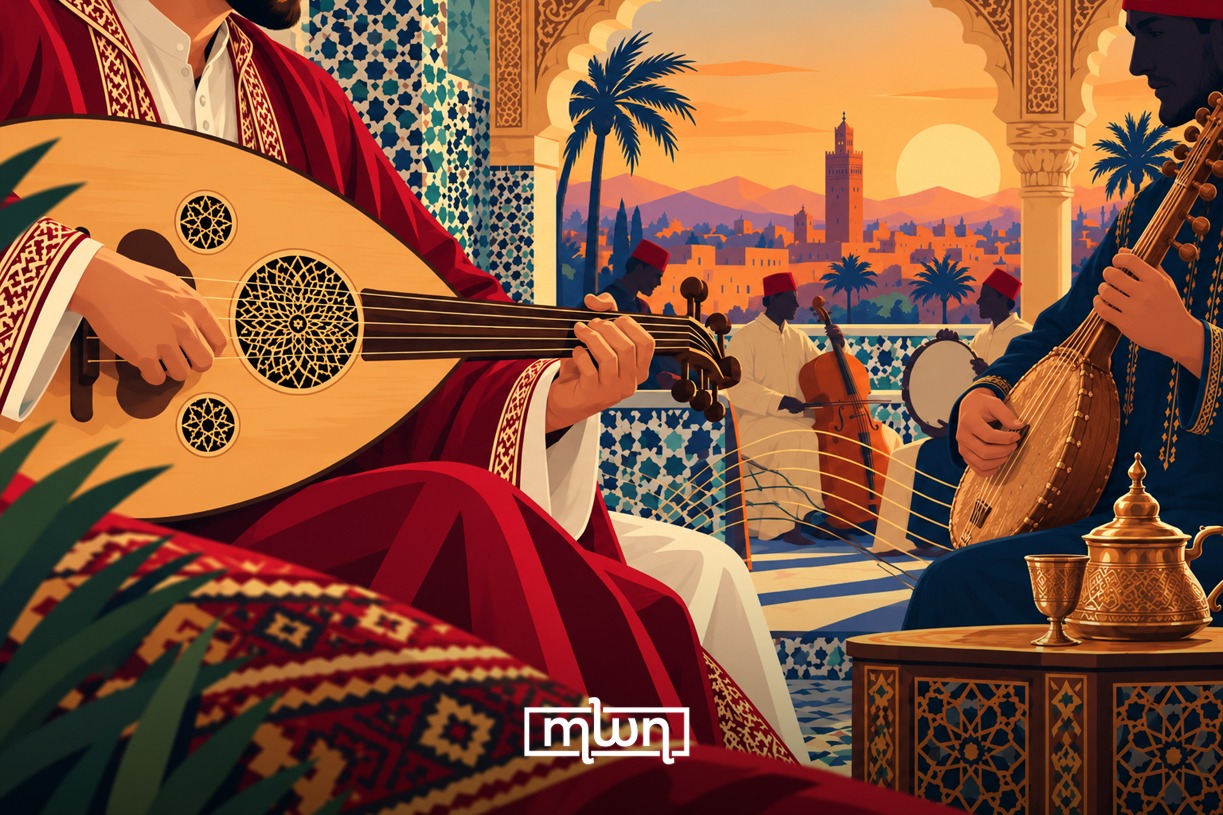
A qsara is not a genre so much as a social occasion: an informal musical gathering that can stretch late into the night, with people playing, singing, dancing, eating and talking together. In the Atlas sessions I watched, the lutar might anchor the music, but it did not make the music alone. Men beat the talunt, or bendir, the goatskin frame drum, and joined in singing the izlan. A line was offered; another voice answered. Rhythm and voice moved around the room, while listeners themselves could become participants. Someone might rise to dance; others sang along or called out their appreciation. There was al-ghrama, too, as someone stepped forward to offer money to a singer or musician. People talked and laughed, ate and shared what was before them. Conversation gave way to music; music returned to conversation.
In Arabic there is a word for something of the sensation music can produce in such moments: al-ṭarab.
No single English word quite contains it. Pleasure comes close, as do enchantment and emotional transport. Al-ṭarab emerges in the encounter between music and words, voice and instrument, performer and listener. A phrase catches you. A verse lands with unexpected force. The lutar answers the singer. Someone repeats a line because once was not enough.
A qsara makes room for that pleasure. A familiar verse can summon someone absent, a landscape left behind, an old love, a loss, another evening when the same words were sung.
This is why I hesitate to describe the qsara primarily as a place where heritage is preserved. That gets the sequence wrong. People gather because listening, singing, eating, laughing and sharing an evening feel good.
Perhaps pleasure is itself one of the mechanisms of transmission. Songs survive because people want to hear them again. Perhaps listening, too, is a form of keeping.
El Gadi’s own life had followed these migratory routes. Though rooted in the Middle Atlas town of El Ksiba, he spent much of his later life in Germany, including Frankfurt and Münster, while his music also carried him to France, where he performed among Moroccan communities. The qsaras I encountered online were therefore not simply performances abroad. They belonged to the social worlds in which his music continued to live.
A qsara can be made elsewhere: a lutar, the pulse of the talunt, voices answering voices, food on the table, an old verse, laughter, conversation, and people willing to enter the music rather than merely listen to it. Morocco has not been transported intact to Europe. People have carried enough of the ingredients of a meaningful gathering to make a place together again.
There is a circularity here I did not initially notice. The first cassette player of my childhood had travelled from Germany to our village in the hands of a migrant. Decades later, from the United States, I was watching El Gadi make music among Moroccan migrants in Germany and France.
The routes had changed. The movement had not.
Music does not abolish distance. It makes distance inhabitable.
Perhaps this is why the thin documentary record surrounding El Gadi troubled me. Here was a musical life capable of travelling from the Middle Atlas across the Mediterranean and eventually across the Atlantic to me.
Yet when the musician disappeared, I did not know.
At first I was tempted to call this obscurity. But the word seemed wrong. El Gadi was not obscure to those who listened to him. People invited him to perform. Singers performed beside him. Listeners knew his repertoire. Recordings circulated.
He had been recognized. The question was what kind of recognition this was.
Antonio Gramsci wrote about intellectuals, not Amazigh musicians. But his idea of the organic, authority emerging from a particular social world, suggests another possibility. What if we think of El Gadi as an organic artist?
His authority was produced within the social world through which the music itself lived. He did not require a conservatory or critic to certify his knowledge of an old izli. Authority could be made through musicians and singers, qsaras and weddings, invitations to perform, and listeners capable of hearing the difference between imitation and mastery.
Calling this world “informal” misses its complexity. It has reputations and hierarchies, teachers and apprentices, standards of judgement, memories of who played what with whom.
Organic recognition and institutional recognition are not the same thing. By institutional recognition I do not mean a single official archive, but the dispersed institutions and practices through which Morocco records its musical life: radio and television, newspapers, cultural institutions, festivals, biographies, scholarship and, finally, the obituary.
Rouicha eventually had both. He emerged from much the same Middle Atlas musical ecology but entered commercial recording, radio and television, international performance and, eventually, scholarship. El Gadi seems to have remained closer to the networks through which his music lived.
That helps me understand the strange fact with which my search began.
I had been listening to El Gadi. I simply did not know he was dead.
This does not mean his death went unnoticed by those closest to him. The point is different: the network that carried his music to me was not the same network that carried news of his life.
YouTube could bring a qsara into my home thousands of miles away and preserve a performance years after the room had emptied. But it could not reproduce the social relations surrounding the musician.
Digital circulation had given me cultural intimacy without social proximity.
I was close to the music and far from the musician.
What, then, had El Gadi been carrying?
Songs, certainly. But songs are only the audible surface of a larger body of knowledge: melodies, poetic forms, rhythms and techniques; how the lutar responds to a voice; which verses can change and which must remain recognizable; how an old song can speak to people sitting in a room now.
This is one of the ways folk music lives.
Perhaps it was fitting that the one biographical fact that survived most clearly was a place: El Ksiba. Folk does not mean fixed in place. My childhood Grundig had already taught me how porous a place could be. The Ziz Valley was profoundly local, the taqbilt, the garden, tea, family, neighbors, while voices from Algeria, Spain, France and Britain could enter the same afternoon.
Folk music travels because people travel.
Perhaps even knowledge is too cool a word for something that also lives through sensation. Musicians know through memory, technique and practice. Listeners know through anticipation, recognition and the bodily pleasure of a voice or verse, through al-ṭarab.
A musician can think with his fingers. A singer can think with a verse. A listener can know through al-ṭarab. A qsara can hold forms of knowledge and human connection that no library catalogue knows exist.
This knowledge rarely belongs to one person. Rouicha’s musical genealogy, for example, leads back to Hammū al-Yazīd, from whom he learned and whose repertoire he helped carry forward. Then I encountered a small detail in Mounia Mnouer’s writing about Rouicha that changed how I thought about this. Discussing songs by al-Yazīd, she notes that she could not find recordings of some of them.
The recording had disappeared.
The music had not. It had passed into other people.
Sometimes the musician becomes the archive.
But even that is too individual. Watch enough of El Gadi’s performances and other people emerge. Women, especially: Fatima Talgadit, Fatima El Akri Zemmouria, Fatima El Gadia, Moulati, Mouna Atlas.
Their names appear beside his in scattered recordings. Their voices are there. Their faces are there. Sometimes a name in a YouTube title is almost all that remains available to someone searching from afar.
I began looking for them too.
Their voices were easier to find than their lives.
El Gadi’s thin biography was beginning to look less like an exception than a clue.
The music itself is relational. Voice and lutar answer one another. Who, then, keeps the song? The instrumentalist? The woman who voices the verse? The musician who learned it from someone now dead? The listener who remembers another version?
Perhaps the question is wrong.
The knowledge is in the relationship.
Once I began looking this way, YouTube appeared differently.
At first, it seems to have solved disappearance. Search long enough and the past pours out: cassette transfers, weddings, qsaras, private gatherings, old performances, shaky phone videos.
But abundance is not the same as memory.
Andrew Simon begins his history of Egyptian cassette culture with an old photograph that resurfaced on Facebook: three men posing with a cassette radio, their identities initially unknown. Then someone recognized them. A comment began restoring social history to an image that had outlived its context.
Something similar happens beneath old Amazigh recordings. Someone remembers a singer, identifies a village, corrects a name, recalls hearing the musician decades earlier.
The comment section becomes an accidental catalogue. Someone, somewhere, kept a cassette, digitized a recording, remembered a name and thought the performance worth sharing.
An extraordinary archive, and a precarious one.
Channels disappear. Videos are removed. Dates vanish. One performer is named while another remains anonymous. Recordings reappear under different titles.
The recording survives while its context erodes.
There is a paradox here. The cassette was physically fragile but socially dense. Someone had to carry it, copy it, lend it, play it, perhaps even rewind it with a Bic pen. The digital recording appears almost immaterial and infinitely durable, yet it can become strangely lonely. The sound remains while the people, places and relationships that gave it meaning fall away.
This is an archive without an archive, scattered across cassettes, photographs, memories of weddings and qsaras, musicians’ repertoires, migrant households, YouTube channels and the recollections of people who can still say: I know who that is.
Digital technology creates an extraordinary illusion: because we can still watch something, we assume it has been saved.
But what exactly has been saved?
A camera can preserve El Gadi’s hands moving across the lutar. It cannot tell us who taught him a phrase. It can preserve a woman’s voice but not tell us where she learned the verse. It can show people gathered around food, laughing and listening, but not what memories a song awakened or why one verse suddenly quieted the room.
The recording preserves the performance. It does not necessarily preserve the world that made it meaningful.
This is what El Gadi’s death made personal.
Once I knew he was gone, I returned to his recordings with questions I had never thought to ask while he was alive. Who were the women singing beside him? What had he learned from older lutar players? What had younger musicians learned from him?
I wanted to ask about those qsaras in France and Germany. Who invited him? Who came to listen? What songs did they request? Which verse made someone remember home? What did it mean, for a few hours, to make that kind of togetherness somewhere else?
Most of all, I wanted to ask him.
I could not.
I had not simply missed an obituary. I had missed the possibility of a conversation.
Other conversations remain possible. Musicians remember musicians who have died. Women singers survive as names on cassette covers and YouTube titles. Families possess photographs and recordings no institution knows exist. Migrants remember qsaras in Europe.
Recognizing those memories does not mean turning every qsara into a heritage object. The people gathered there were living: listening, singing, eating and laughing, experiencing al-ṭarab, enjoying one another.
And in doing so, carrying something forward.
There is an Amazigh word I have been circling throughout this essay: amarg.
Translation never quite contains it. It gathers around longing, separation, homesickness, love and the ache of distance. It belongs to a musical world in which people have long sung of those who leave and those who remain.
Migration taught me another register of it.
My Rouicha cassettes have travelled with me for nearly 43 years. I did not carry them across the Atlantic because I wanted to preserve a tradition. I carried them because I wanted to listen.
I wanted the words, the lutar, the feeling.
The archive came later.
El Gadi came to me without a cassette. His music crossed the ocean digitally. I could sit in America and enter a qsara in Morocco, France or Germany.
But migrants know the difference between overcoming distance and abolishing it.
A recording can bring a voice close. It can make us feel.
It cannot give us the room.
Perhaps al-ṭarab and amarg meet somewhere in that distance: the pleasure of being moved by music and the ache of what remains beyond reach.
And perhaps this is why I keep returning to aɣur-aš tawada, “Beware of leaving.”
I had known the refrain long before I began thinking about any of this: aɣur-aš tawada, isul amarg digui uri iffiɣ: Do not leave. The longing is still in me; it has not gone.
Only now do I hear how much those words contain. The warning against leaving and the longing that follows departure had been there all along.
I had listened to the session before I knew El Gadi had died.
I listen differently now.
I press play.
The lutar begins. Voices enter.
For a few minutes, the Ziz Valley, the little Grundig that arrived from Germany, the Rouicha cassettes I carried across the Atlantic, the Middle Atlas, qsaras in Europe and the screen before me seem to belong to the same geography of listening.
I watch El Gadi’s hands move across the lutar. A genuine heartfelt smile spreads across his face. At moments he seems absorbed by the music, as though there were only the instrument, the voices, and the song.
Perhaps this, too, is al-ṭarab.
And I wonder what the people in that room knew that I do not.
The recording cannot answer.
Then the session ends.
For a moment, there is only the silence of my own room.
I can play the recording again tomorrow, or years from now. El Gadi will smile again. His hands will return to the lutar. The voices will enter. Someone will sing. Someone will answer. The room will fill again.
But only with sound.
The recording remains.
The room is gone.