Rabat – Morocco has contributed to ongoing mine-clearance efforts in Western Sahara, with the Royal Moroccan Army (FAR) reporting the clearance of 268.97 million square meters of land and the destruction of hundreds of explosive remnants of war, according to the latest report of UN Secretary-General António Guterres.
The figures form part of broader United Nations efforts to reduce the threat posed by landmines and unexploded ordnance in Western Sahara, where decades of dispute have left extensive areas contaminated by explosive remnants.
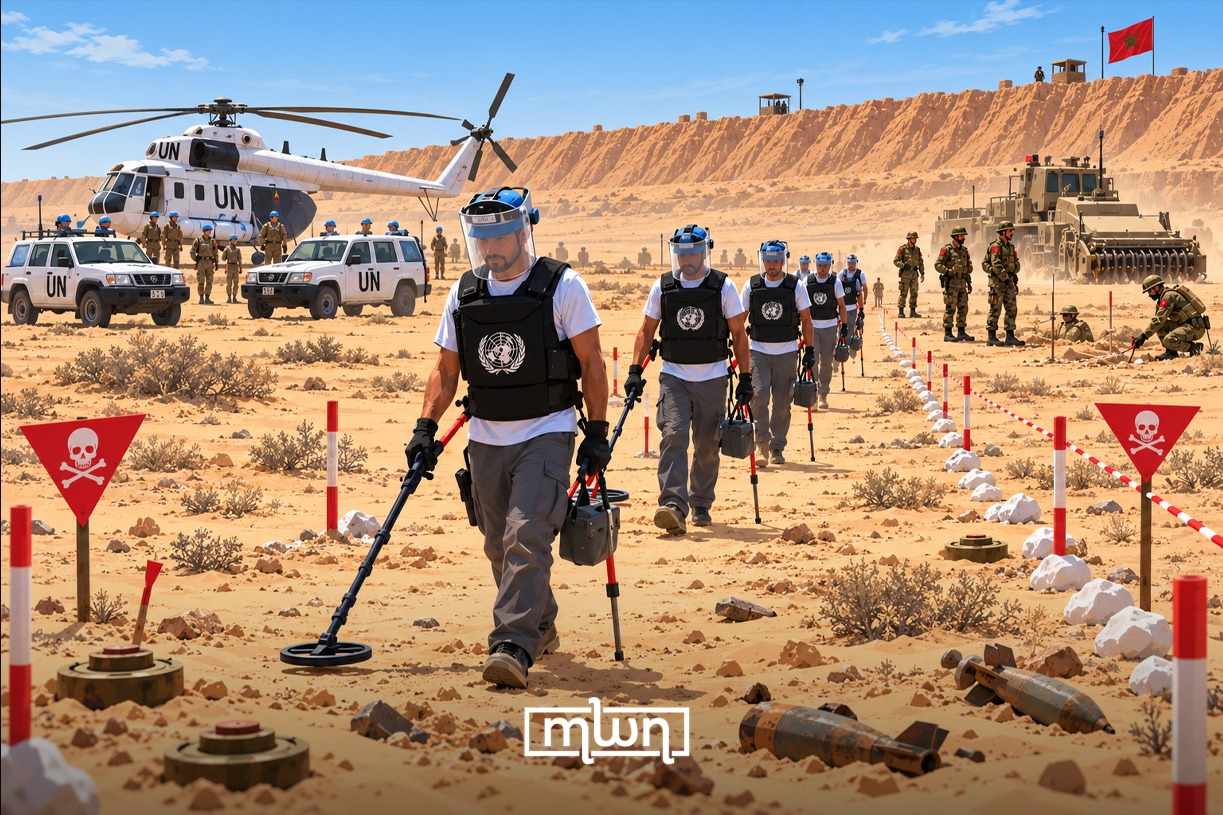
According to Guterres’ report, covering the period from October 1, 2025 to September 30, 2026, the Royal Moroccan Army informed the UN Mission in Western Sahara (MINURSO) that it had cleared approximately 268.97 million square meters of land west of the sand berm of explosive hazards.
During the same period, Moroccan authorities reported the destruction of 44 anti-personnel mines, five anti-tank mines, and 264 items of explosive ordnance.
The figures place Morocco’s mine-clearance activities alongside the work of the United Nations Mine Action Service (UNMAS), which operates as part of MINURSO and works to reduce risks from landmines and explosive remnants across the territory.
UNMAS has described Western Sahara as one of the world’s heavily contaminated areas with landmines and explosive ordnance. The contamination is largely a legacy of the 1975-1991 dispute and is concentrated around the approximately 1,465-kilometer-long sand berm that runs across the territory.
UN-led clearance efforts continue
During the reporting period, UNMAS mine-action teams carried out 1,330 missions aimed at ensuring the safe movement of MINURSO’s civilian and military personnel and logistical convoys, while also providing technical assistance during investigations into alleged strikes.
The teams had assessed 12,401 kilometers of roads east of the berm by August 15, determining that they were free of visible explosive ordnance. UNMAS also verified another 374 kilometers of roads used by MINURSO investigation teams to reach alleged strike sites and surrounding areas.
The UN service additionally cleared 1,794,124 square meters of land through minefield clearance operations conducted alongside non-technical surveys.
Despite the progress, significant contamination remains. As of August 15, 24 of the 68 known minefields and 31 of the 543 recorded cluster-munition strike areas east of the berm still required clearance.
Since October 2025, UNMAS has located and destroyed one landmine, 135 cluster munitions and six items of explosive ordnance. It also identified a previously unrecorded minefield for inclusion in future clearance operations.
The UN’s mine-action work has broader humanitarian implications. Landmines and unexploded ordnance continue to threaten civilians, nomadic communities, UN personnel and livestock, while restricting access to affected areas. UNMAS says its operations have released or cleared more than 84 million square meters of hazardous areas since the program was established in 2008, while more than 1,000 mine victims have been recorded east of the berm.
Security concerns persist
The mine-clearance figures come as the UN report also documents continuing security concerns in Western Sahara, including an attack in Es-Smara on May 5 for which Polisario claimed responsibility and involved three projectiles targeting the city.
MINURSO investigated the incident and found two impact craters and projectile debris, including fragments near a detention facility. The debris injured one civilian and caused material damage around the impact site.
The UN Special Representative and MINURSO Force Commander subsequently contacted the Polisario Front over the incident, expressing concern and stressing the need to avoid actions that could undermine the political process. UN Secretary-General Personal Envoy Staffan de Mistura also voiced concern, stressing that the period should be one of dialogue and negotiations rather than military escalation.
The United States condemned the attack, stating that such actions were inconsistent with the spirit of the recent negotiations.
The incident came as the UN and US sought to revive direct negotiations between Morocco, the Polisario Front, Algeria and Mauritania following seven years of political deadlock. Three rounds of talks took place during the first quarter of 2026.
The UN report said the negotiations produced deeper discussions on a potential transitional framework, autonomy, self-determination, security arrangements, resource sharing and other elements of a possible political settlement.
US lawmakers push Polisario-related terrorism legislation
The security debate surrounding the Polisario has also reached the US Congress, where lawmakers introduced legislation seeking sanctions or a potential terrorist designation under specified circumstances.
In June 2025, Representative Joe Wilson introduced the Polisario Front Terrorist Designation Act, H.R. 4119, alongside Representative Jimmy Panetta. The bill sought to impose sanctions on the Polisario Front and was referred to the House Foreign Affairs and Judiciary committees.
Representative Josh Gottheimer and several bipartisan co-sponsors introduced in July this year a second House bill, H.R. 9982, titled the Polisario Front Terrorist Designation Act of 2026. The legislation calls for imposing sanctions if the Polisario cooperates with an Iranian-affiliated terrorist organization.
Many months earlier, in March 2026, Senators Ted Cruz, Tom Cotton, and Rick Scott also introduced a Senate version of the legislation. The proposal would require the US Secretary of State to designate the Polisario as a terrorist organization if the Secretary determines that it is cooperating with Iranian groups already designated as terrorist organizations.
The bills have not resulted in a terrorist designation of the Polisario and remain legislative proposals. However, their introduction reflects growing attention among some US lawmakers to the group’s regional security ties and activities.
Mine clearance remains central to regional stability
The latest UN figures reflect that mine action remains a practical component of security and humanitarian work in Western Sahara, even as diplomatic efforts seek to address the broader dispute.
The United Nations has continued to coordinate mine-clearance operations with both sides. UNMAS says its work enables humanitarian access, supports MINURSO patrols and reduces risks to civilians and peacekeeping personnel.
The service has also worked with the Sahrawi Mine Action Coordination Office to expand access to areas near the berm. During the reporting period, this cooperation enabled access within eight kilometers of the berm and the establishment of a seven-kilometer corridor for essential clearance operations near major mine belts.
Guterres’ report ultimately recommends extending MINURSO’s mandate for another year, until October 31, 2027, while emphasizing the need to prevent further escalation and preserve space for the renewed political process.
“Until a mutually acceptable political solution is reached, MINURSO, through its monitoring and investigation of incidents and its engagement with the parties, continues to play a critical role in preventing an escalation of hostilities. I therefore recommend that, pending a mutually acceptable settlement of the conflict, the Council extend the mandate of MINURSO for another year, until October 31, 2027, taking into account developments in the political process,” Guterres said.
“Without MINURSO to monitor, investigate and report on incidents occurring in the territory and to engage with the parties to de-escalate tensions, the risk of escalation of hostilities would increase significantly, as would the potential for the effects of the conflict to spill over into an already volatile region.”
For Morocco, the reported clearance of 268.97 million square meters of land and the destruction of hundreds of explosive remnants represent a substantial contribution to efforts to reduce the risks left by decades of conflict. The figures also point to the continuing scale of the challenge, with thousands of square kilometers of potentially hazardous terrain still requiring assessment or clearance and civilians and peacekeepers continuing to face risks from explosive remnants.