Marrakech – A bill that would have granted Spanish nationality to Sahrawis born under Spanish administration collapsed this week after Pedro Sánchez dissolved the Cortes and called an early election for November 29.
The dissolution voids every initiative still moving through parliament, however advanced, and this one had nearly crossed the line. Tesh Sidi, the Más Madrid deputy who drove the text within Sumar, lamented that a measure “approved by broad majorities” would now end up “in the trash.”
The path had been long. Sumar introduced the bill in 2024, the PSOE voted against examining it in February 2025, and it then sat untouched for twelve months. Socialists and Sumar struck a deal only in June 2026. The Justice Commission cleared it in July, and on September 10 the Congress adopted it 168 to 31, with 145 abstentions – Vox against, the Partido Popular and Junts abstaining. The separatist Polisario’s representative in Spain attended the vote.
Un día triste en lo personal y para el pueblo saharaui. Las últimas vías las tiene el PP en el Senado y el gobierno vía real decreto(carta de naturaleza)
Los saharauis se quedan sin la ley para obtener la nacionalidad a dos semanas de su aprobación por el adelanto electoral…
— Tesh Sidi🇪🇭 (@teshsidi) October 5, 2026
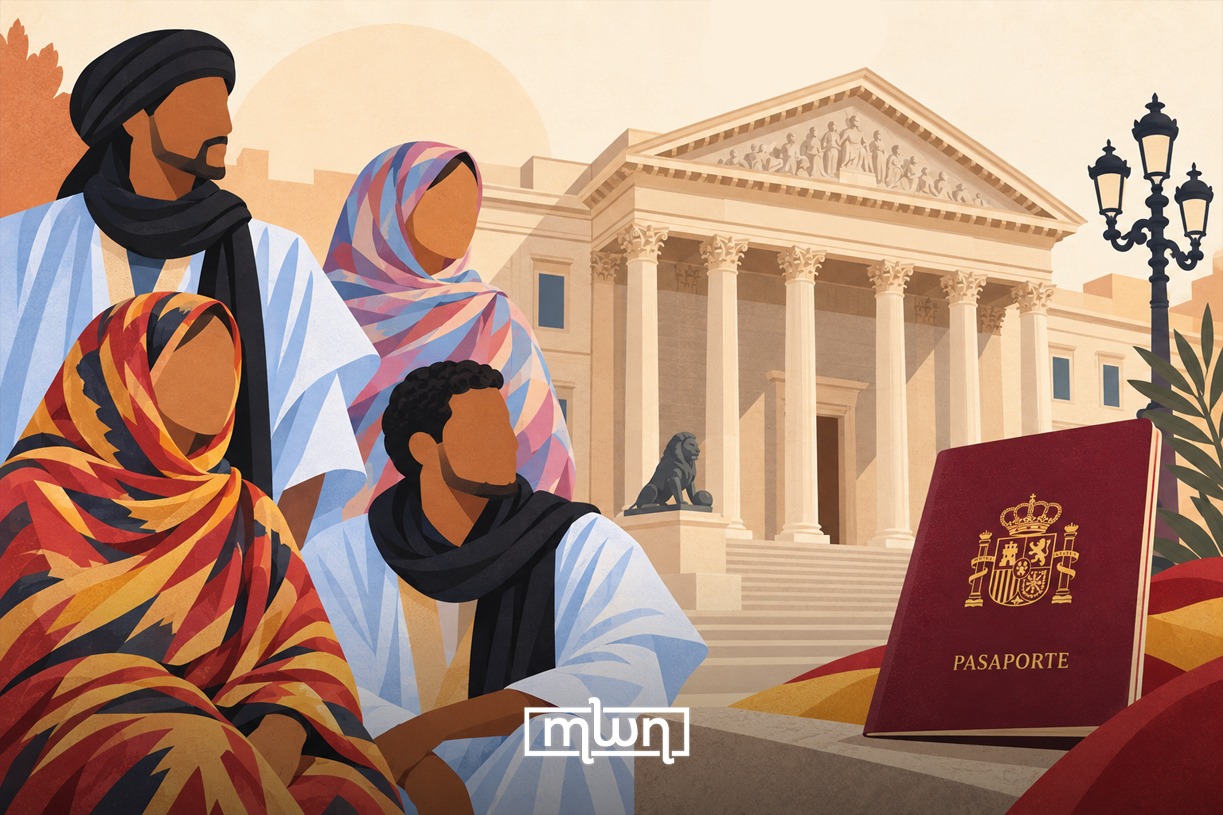
The vehicle was a carta de naturaleza, an exceptional naturalization requiring no residence in Spain. It covered anyone able to prove birth in the territory before September 29, 1977, plus first-degree descendants who could opt within five years. Estimates of beneficiaries ran from 70,000 to 80,000, and as high as 200,000 with descendants – a collective route to citizenship approved without a firm count of claimants.
Only the Senate remained. There the PP, holding an absolute majority, rewrote the text to demand two years of legal residence and to remove the option for children. Junts was expected to help the government restore the original wording the next week.
The election call extinguished that prospect. Two routes survive: the PP withdraws its Senate amendments before Tuesday’s electoral decree, or the government confers nationality case by case through royal decree – the same carta de naturaleza, now by executive fiat.
Beneath the humanitarian framing lay a harder calculus. Sidi herself cast the vote in combative terms, declaring that to abstain or vote against was to “side with Morocco.” Such wording strips the measure of any purely humanitarian pretense and recasts Spanish nationality as an instrument of confrontation.
Half a century after quitting the territory, Madrid again arrogates the authority to define identities in the Moroccan Sahara, reaching people who may have been born and raised entirely in Morocco, Algeria, or elsewhere.
The contradiction runs through the bill’s own preamble, which concedes that the Franco regime converted its African colonies into provinces to circumvent United Nations decolonization, then leans on that same provincialization to justify the passport. The so-called 53rd province is a colonial fiction when Francoism is the target, yet incontestable legal fact when it unlocks an EU document.
Defenders call this “restitution.” Yet Royal Decree 2258/1976 had already granted Sahara-born residents a single year to opt for nationality, after which unexercised claims lapsed – proof that Spain never recognized any automatic, collective nationality. A right that still existed would not require an exceptional procedure to manufacture it anew five decades later.
Here the sharper irony surfaces. The Polisario styles itself a liberation movement demanding independence, yet the citizenship it celebrates belongs to the former colonizer, and takes effect only once the applicant swears fidelity to the King of Spain and obedience to the Spanish constitution. A project proclaimed as emancipation terminates at a Ministry of Justice counter, beneath an oath of allegiance to the very crown it claims to have escaped.
The effects would not halt at Spain’s borders. As analysts argued, Article 20 of the EU treaty turns any Spanish nationality automatically into Union citizenship. They asked whether Madrid had weighed these new citizens settling in occupied Ceuta or Melilla, and whether Brussels had gauged the consequences for member states and for relations with Morocco.
The original text had even accepted birth certificates legalized by the Polisario – a step toward legitimizing the separatist apparatus Europe has funded in the Tindouf camps for decades without resolving who lives there.
For many in those camps, the passport was never about building a nation – it was an escape hatch. Five decades of promised statehood have produced no country, no citizenship, no future worth staying for, so the prize became a European document that lets its holder leave.
The scramble for a Spanish passport is itself the verdict: those meant to be the citizens of a liberated Sahara are instead reaching for any exit, toward Europe or back toward Morocco, because the separatist project has given them nothing to belong to.
Algeria, their host for fifty years, has never offered them its own nationality, and the structures that claim to represent them survive precisely by keeping that population in place. The passport chase exposes the whole enterprise: no state, no nationality, no nation – only camps whose political survival depends on the very people now searching for a way out.
The Sahrawi association behind the campaign has pledged to table the law again in the next legislature. For now, Spain’s bid to convert its colonial past into a passport has stalled on the timing of its own politics.
Read also: Ghost of Empire: Spain’s Sahrawi Citizenship Law Is a Colonial Trojan Horse