
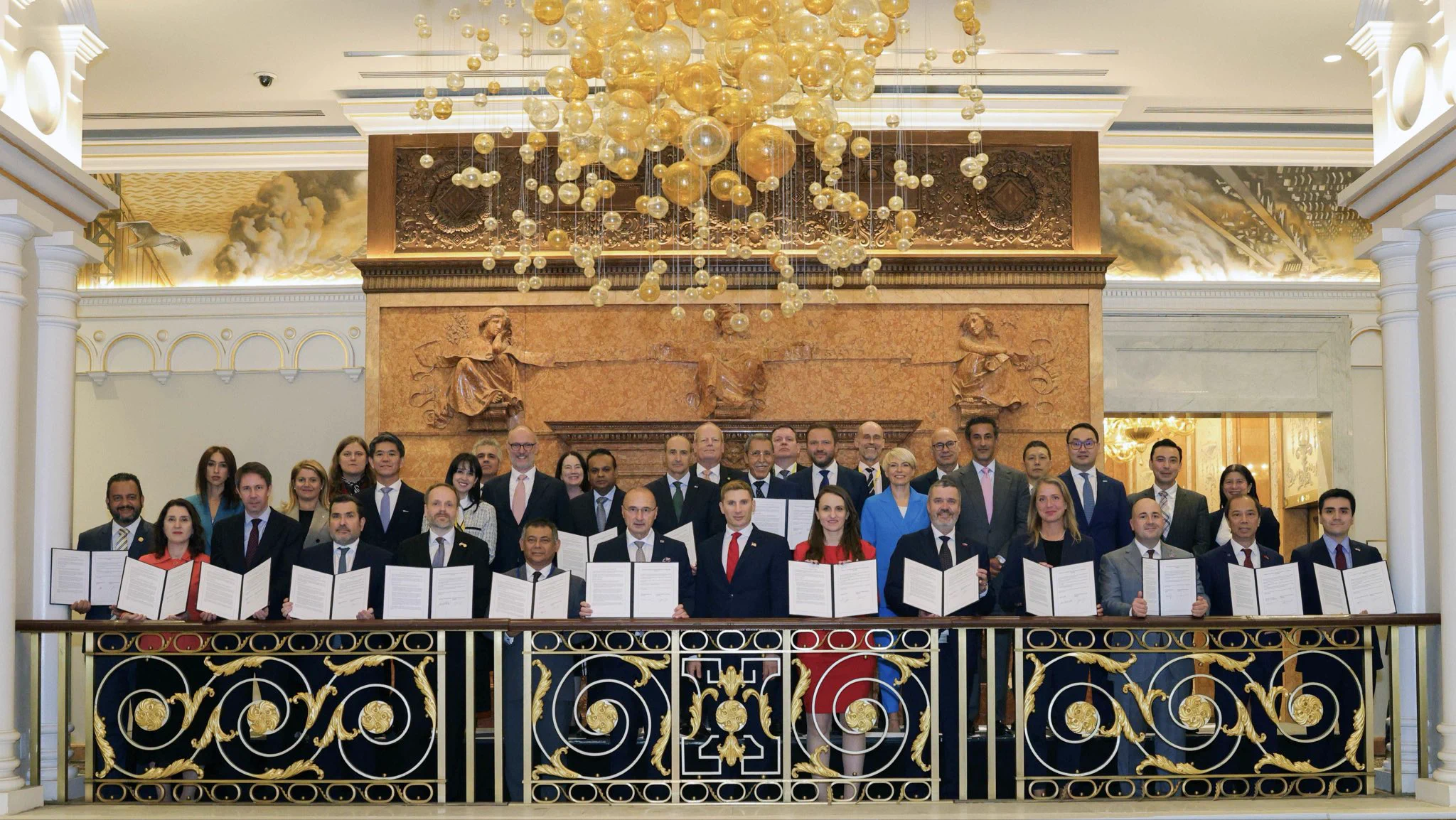
Marrakech – Morocco has joined a United States-led coalition on artificial intelligence, aligning with Washington’s framework for securing the supply chains behind advanced AI.
The State Department’s Economic Affairs account announced the move on October 1, listing Morocco among 19 countries that newly endorsed the Joint Statement on AI Opportunity Partnership. The additions brought the coalition to 54 countries.
The 19 signatories joined during the United Nations General Assembly High-Level Week in September. Alongside Morocco, the new members included Albania, Austria, Croatia, Cyprus, Czechia, the Dominican Republic, Georgia, Iceland, Malaysia, Malta, Mauritius, Peru, Palau, Tonga, Romania, Serbia, Slovenia, and Vietnam.
“19 more countries just aligned with the American tech stack,” the account wrote, framing the expansion as a gain for US firms seeking “more trusted suppliers and more open markets.”
19 more countries just aligned with the American tech stack.
🇦🇱 🇦🇹 🇭🇷 🇨🇾 🇨🇿 🇩🇴 🇬🇪 🇮🇸 🇲🇾 🇲🇹 🇲🇺 🇲🇦 🇵🇪 🇵🇼 🇹🇴 🇷🇴 🇷🇸 🇸🇮 🇻🇳
For U.S. companies, that means more trusted suppliers and more open markets.
Our Super Intelligence partnership is 54 countries strong and growing. pic.twitter.com/PJhZMQYof1
— State Department Economic Affairs (@EconAtState) October 1, 2026
The Joint Statement sets a foundation for cooperation between the United States and strategic partners on what the text calls super intelligence. Signatories commit to a regulatory environment that supports growth and innovation, one meant to empower startups, developers, and the private sector. They also agree to align their super intelligence supply chains with those of the United States and the broader Pax Silica economies.
Washington first launched the Pax Silica initiative to secure supply chains for AI models, semiconductors, and critical minerals. The effort took off in December 2025 with a handful of countries. The second Pax Silica Summit, held in Washington in June this year, produced the Joint Statement on AI Opportunity, which 35 nations signed at the time.
Jacob Helberg, the US Under Secretary of State for Economic Affairs, tied the statement to a contest over capacity. “The future of AI will not be determined by who regulates first,” he argued. “It will be determined by who builds first and builds the most capacity. More energy. More compute. More chips. More talent. More builders.”
The expansion is accelerating amid an increasingly hard-edged strategic contest with China. In July, Chinese President Xi Jinping launched the World Artificial Intelligence Cooperation Organization, or WAICO, pitching open-source technology as a challenge to US influence.
The body signed up 29 member countries and positioned itself as a rival to Pax Silica. Xi cast China as a champion for the Global South, warning against “new historical injustices” from unequal access to the technology.
The competition has pushed Washington to press partners toward a choice. A draft State Department letter reviewed by Reuters warned the statement’s signatories that alignment with the United States cannot sit alongside membership in competing frameworks.
“To be part of everything is to be part of nothing,” the letter read, urging countries to “choose deliberately.” A US official put it plainly: “you can’t have it both ways.”
Beijing has rejected the approach. China’s embassy in Washington opposes politicizing trade and technology, warning that such actions “will only stifle global AI advances and serve no one’s interests.”
The rivalry has intensified as Chinese open-weight models gain ground on US systems from OpenAI and Anthropic.
Even so, the two governments have opened a formal channel. During Xi’s summit with US President Donald Trump at the White House last month, Washington and Beijing agreed to establish the US-China Super Intelligence Dialogue, with the first talks scheduled for November.
Beijing has framed that engagement as a way to keep competition from hardening into rupture. Foreign Ministry spokesman Guo Jiakun called dialogue with the United States an “important pathway” for ensuring AI benefits everyone, describing it as part of building a “constructive China-US relationship of strategic stability” based on “respect, fairness and reciprocity.”
He also pressed Beijing’s preference for a United Nations-centered approach, advocating a central role for the body in shaping “a fairer and more equitable global AI governance system.”
The framework is meant to facilitate exchanges on the risks and benefits of AI and to set up a communication channel for AI-related incidents. According to US Treasury Secretary Scott Bessent, future discussions could also cover protocols for responding to critical threats, including uncontrollable autonomous AI agents and the spread of cyber and biological weapons capabilities to non-state actors.
The channel signals that the contest over AI standards and supply chains, now joined by Morocco on Washington’s side, will play out alongside direct talks between its two principal rivals.
Read also: Morocco, Mistral AI Release First Open-Source Darija AI Tools