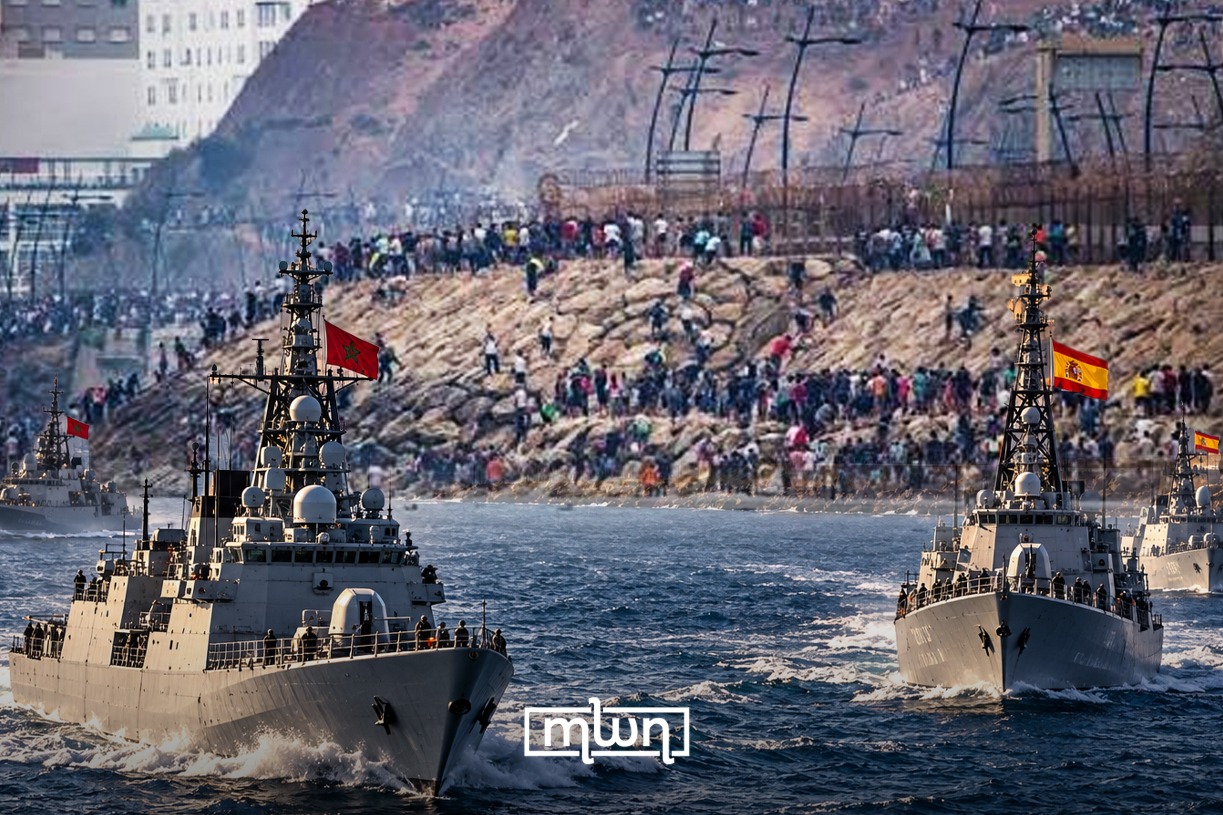
Rabat – The Moroccan naval presence in the waters of the occupied city of Ceuta has sparked Spain’s frustration, a report from El País said.
The report published today stated that Spain reportedly deployed naval vessels in response to Moroccan Navy ships in the waters surrounding the occupied city, also citing the mass crossing that took place in Ceuta in July.
The case dates back to when over 70,000 migrants entered the enclave due to a social media campaign alleging that the borders with Spain were open.
El País, quoting sources familiar with the case, claimed that the situation did not involve only the migrants, alleging that Moroccan warships also entered the waters of the occupied city.
“At least one frigate and several patrol boats belonging to the Royal Moroccan Navy sailed through waters under Spanish sovereignty without requesting authorization,” the report said, citing sources consulted.
The sources claimed that the Moroccan naval presence was “not merely a transit passage or an accidental entry, but an intentional and repeated violation of Spanish territorial waters, an incident with few precedents.”
The report alleged that Morocco’s naval presence continued during the first days of August, causing tensions and nearly causing a collision between military vessels from the two countries.
El País described the Moroccan presence as an “invasion,” despite the geographical position of the occupied city. Moroccan officials, since the breakout of the Ceuta mass-crossing crisis, followed by a smear campaign against Morocco from the far right, have been urging the Moroccan government to revive talks on Morocco’s claims over Ceuta and Melilla and its territorial sovereignty over the regions.
The appeals from many Moroccans and officials sparked frustration among many, including at La Moncloa, which has been repeatedly making allegations and claims concerning territorial integrity and sovereignty over the two enclaves.
The situation, marked by a smear campaign from politicians who have long claimed that Morocco staged the mass migration as an alleged blackmail or hybrid attack, triggered tensions, alongside the Spanish government’s double-faced positions.
While Spain has frequently acknowledged Morocco’s efforts in tackling migration, Madrid has also been bowing to pressure from the left and the PP amid election pledges to safeguard local interests.
Intense public debate and media coverage in Morocco have also raised concerns about Spain’s provocative announcement of King Felipe’s upcoming visit to Ceuta later this week.
Moroccan political analyst and author Samir Bennis has recently criticized King Felipe VI’s approach to the crisis, contrasting it with that of his father, Juan Carlos I, during the 2005 migration crisis.
In one of his latest opinions published by Morocco World News (MWN), Bennis argued that while Juan Carlos chose discreet diplomacy and contacted King Mohammed VI directly, Felipe had opted for public statements that risk aligning the Spanish Crown with the country’s nationalist political discourse.
Summarizing the contrast, Bennis wrote that in 2005, Juan Carlos “picked up the phone,” while in 2026, Felipe VI “took the microphone.” He warned that this approach risks undermining the monarchy’s traditional role as a channel for easing tensions between Rabat and Madrid.
On Friday, King Mohammed VI addressed a clear message to Spain and its politicians, stressing that Morocco’s efforts in tackling migration are a sovereign choice.
The monarch’s remarks in his speech opening the legislative year at Parliament were a response to “irresponsible statements” by certain political and media circles and their blatant exploitation of the situation in Spain.
The King stated that Morocco affirms “that this partnership is a sovereign choice and a voluntary commitment. It will never be subject to any pressure, threat, or blackmail.”
Read Also: From Juan Carlos I to Felipe VI: Two Ways of Managing Crises with Morocco
The King also acknowledged that although cooperation with Spain had yielded positive results, the approach to tackling migration had now become outdated.
While stressing that Morocco’s efforts should not be overlooked, the monarch said that he had to acknowledge with “courage and objectivity” that the current model of cooperation had reached its limits.
“The same assessment applies to our neighbor Spain, with which our partnership has made significant progress across different fields, including the fight against irregular migration,” the King said.