
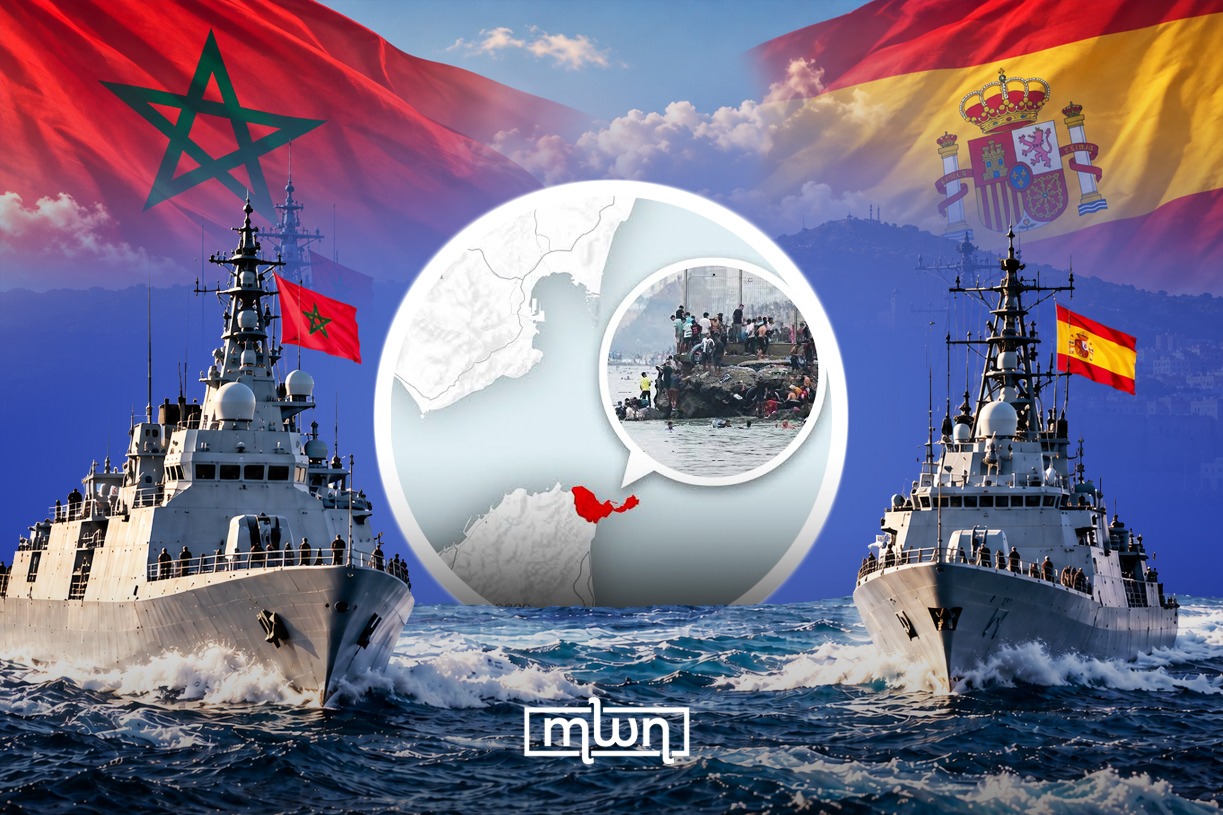
When reading the El País article of October 12 about the alleged violation of Ceuta’s “territorial waters” by the Moroccan Navy, one is left with the impression that something extremely serious occurred, that Morocco may have acted with hostile intentions toward Spain, and that Ceuta possesses a clearly delimited territorial sea. However, when the article is read closely and examined in light of international law and the political and legal realities of the dispute between Morocco and Spain over the maritime areas surrounding Ceuta and Melilla, it proves to be riddled with inaccuracies and insinuations and falls far short of providing sufficient evidence that Moroccan naval vessels actually violated Spanish territorial waters.
The article’s central claim can be summarized in a single sentence: that at least one frigate and several patrol boats of the Royal Moroccan Navy sailed “through waters under Spanish sovereignty without requesting authorization.” The episode is set in the weeks following the mass crossing into Ceuta in July. According to the reporting that has circulated since, Madrid responded by reinforcing its naval presence around the city, including the arrival of the vessel Rayo from Las Palmas on August 3, and by making representations to Rabat at a high level. The same accounts add that a Spanish and a Moroccan patrol boat came close to colliding, and that the article’s sources describe the entries as deliberate and repeated. On October 12, Prime Minister Pedro Sánchez told journalists that he accepted the substance of the report, while noting that communication between the two navies had been “very fluid” and that no similar incident had recurred. A political acknowledgment of this kind, however, is not a legal finding, and the legal question is the one the article never seriously asks.
The missing border
How can the author claim that Morocco violated Ceuta’s territorial sea while simultaneously acknowledging that its waters have not been internationally delimited? At the very least, these two assertions require a legal explanation that the article fails to provide. The absence of a bilateral maritime delimitation agreement does not necessarily mean that Ceuta has no territorial sea, but neither does it justify assuming that any incursion into waters claimed by Spain constitutes a violation of its sovereignty. To establish such a violation, it would be necessary to demonstrate that Moroccan naval vessels entered a maritime area legally attributable to Spain, identifying their exact coordinates and the applicable delimitation criteria. The article offers neither. It rests instead on unnamed sources, whose characterizations of Moroccan intent (“deliberate,” “repeated”) are presented as fact when they are, at best, one party’s interpretation.
To put it plainly, before claiming that Morocco violated Ceuta’s territorial sea, one must first demonstrate that Moroccan naval vessels actually entered waters under Spanish sovereignty. Yet the article itself acknowledges that the waters surrounding Ceuta, like those of Melilla, have not been delimited through an international agreement with Morocco. That is no accident. First, because Morocco does not recognize Spanish sovereignty over either enclave and disputes the maritime claims associated with them. Second, because precisely as a result of this dispute, the two countries have never reached an agreement delimiting their respective territorial seas. This has a direct bearing on how the article’s argument should be judged, and it is a consideration the article overlooks.
No one can deny that Ceuta may, in principle, generate its own territorial sea. But discussing that entitlement also requires taking into account its geographical status as an enclave whose coastline is adjacent to that of a sovereign state, Morocco, which is equally entitled to a territorial sea extending up to twelve nautical miles. Here lies a fundamental detail that the El País article fails to address.
Under Article 15 of the 1982 United Nations Convention on the Law of the Sea (UNCLOS), to which both Spain and Morocco are parties, where the coasts of two states are adjacent or opposite each other, neither state is entitled, in the absence of an agreement to the contrary, to extend its territorial sea beyond a median line every point of which is equidistant from the nearest points on the baselines of the two states, unless historic title or other special circumstances justify a different delimitation.
In the absence of an agreement, as is the case with the maritime areas surrounding Ceuta and Melilla in relation to Morocco, both states must take this delimitation rule into account. This does not mean that neither state can possess a territorial sea, but rather that neither may unilaterally extend it beyond the limits permitted under international law. It is also worth emphasizing that the median line can serve as a legal reference point even without a bilateral agreement. Consequently, the absence of a treaty does not necessarily prevent a determination of whether a vessel has entered waters belonging to another state. What matters is knowing its exact position and examining the relevant geographical and legal circumstances.
Spanish legislation itself is consistent with these provisions. Although Spain’s Law 10/1977 of January 4 on the territorial sea establishes, in Article 3, a breadth of twelve nautical miles for the Spanish territorial sea, Article 4 recognizes that, in relation to neighboring countries, that territorial sea shall not extend beyond an equidistant median line unless otherwise agreed. In other words, Madrid’s own law concedes the very limitation that the article ignores.
This means that even if Morocco and Spain were to reach an agreement on the delimitation of their respective territorial seas, one could not simply assume that Ceuta would enjoy a twelve-nautical-mile territorial sea in every direction. Any delimitation would have to take into account the proximity of the Moroccan coastline and the applicable rules of international law.
The fact that Ceuta, by virtue of its geographical location, may in principle generate its own territorial sea does not automatically mean that Spain can unilaterally determine all its maritime boundaries vis-à-vis Morocco. Nor does it mean that the Moroccan Navy can be accused of violating that territorial sea without demonstrating exactly where its vessels were navigating and why those waters should legally be considered Spanish.
And this is the mistake made by the El País article. Before a violation can be established, it must first be determined whether the vessels entered waters that legally belong to Spain. That is precisely what the article fails to demonstrate adequately. Why has the author not published a map showing the exact positions of the Moroccan naval vessels and the maritime boundary they allegedly crossed, according to the Spanish sources cited? Such information would make it possible to verify whether the alleged incursions actually took place in waters legally attributable to Spain. Without it, readers are asked to take a legal conclusion on trust.
As long as Morocco and Spain have not reached an agreement on the delimitation of the maritime areas surrounding Ceuta and Melilla, a dispute will persist over the extent of their respective claims. Spain’s defense of its sovereignty over both enclaves does not, in itself, eliminate the need to provide a legal justification for the maritime boundaries it considers its own.
Authorization, transit and innocent passage
Moreover, there is another problematic assertion in the El País article. The author states that vessels of the Royal Moroccan Navy navigated “without requesting authorization through waters under Spanish sovereignty.”
First, to argue that Morocco was required to request authorization, it would be necessary to establish both that the vessels were operating in waters legally belonging to Spain and that the activities they carried out required such authorization. The fact that Ceuta is under Spanish sovereignty does not automatically settle the delimitation of all the maritime areas adjacent to the enclave.
Second, geography matters here too. Ceuta sits on the southern shore of the Strait of Gibraltar, one of the world’s busiest international waterways. Under Part III of UNCLOS, the ships of all states, warships included, enjoy the right of transit passage through such straits, a regime more protective than innocent passage because the coastal state cannot suspend it. If the Moroccan vessels were simply transiting the strait, the regime would apply, and nothing in the article is offered to establish otherwise.
Furthermore, even if it were established that Moroccan naval vessels navigated through Spanish territorial waters, international law recognizes the right of foreign vessels, including warships, to what is known as “innocent passage” (Articles 17 to 26 of UNCLOS).
Innocent passage refers to navigation that is not prejudicial to the peace, good order, or security of the coastal state. Article 19 of UNCLOS identifies activities that may render passage non-innocent, including the use or threat of force, weapons exercises, the launching or landing of aircraft or military devices, and certain intelligence-gathering or other activities that may undermine the security of the coastal state.
The El País article does not specify the nature of all the maneuvers carried out by the Royal Moroccan Navy, nor does it provide the information necessary to determine whether any activities were incompatible with innocent passage or endangered Ceuta’s security. Moreover, UNCLOS does not establish a general obligation to obtain prior authorization for every instance of innocent passage by a warship, although some states maintain differing positions on this issue.
That said, the right of innocent passage does not cover every type of military maneuver. To qualify for that right, navigation must comply with the conditions established by UNCLOS, including, as a general rule, the requirement that passage be continuous and expeditious. If Moroccan naval vessels conducted patrols, military maneuvers, or other activities incompatible with that right in waters legally belonging to Spain, the legal assessment would be different. Even then, the Convention’s own remedy is measured; under Article 30, where a warship fails to comply with the coastal state’s rules and disregards a request for compliance, the coastal state may require it to leave the territorial sea immediately. That is a far cry from the language of “invasion” and “violation” that surrounds the episode. But that is precisely why it is essential to establish exactly what the vessels were doing and where they were located.
An allegation, not a finding
Therefore, the claim made by El País that Morocco violated Ceuta’s territorial waters is not legally substantiated by the information provided in the article. To support such an allegation, it would be necessary to disclose the exact coordinates of the alleged incursions, explain the applicable maritime delimitation, and demonstrate that the activities carried out by the Moroccan naval vessels actually constituted a violation of international law.
Under these circumstances, what the article does is fuel suspicions about Morocco’s intentions and contribute to a narrative of confrontation on the eve of King Felipe VI’s visit to Ceuta on October 13 and Melilla on October 14. It will be the first by a Spanish monarch since Juan Carlos I’s visit in November 2007, after which Rabat recalled its ambassador for consultations. The timing of the publication inevitably raises questions about its political context.
For it is one thing to state that, according to the Spanish authorities, Moroccan naval vessels navigated through waters that Spain considers to be under its sovereignty. It is quite another to present that interpretation as a legally established violation of Ceuta’s territorial sea.
None of this is to deny that Spain claims sovereignty over Ceuta, or that Madrid is entitled to defend the maritime areas it considers its own. It is to insist that a claim is not a finding. International law asks a sequence of questions that must be answered in order: where exactly were the vessels, whose waters were those under the applicable rules of delimitation, and what were the vessels doing there? The El País article answers none of them. It supplies no coordinates, no map, no delimitation criteria, and no legal analysis, and it leans instead on unnamed sources and on vocabulary of “violation” and “invasion” that the facts it presents cannot carry.
Ceuta and Melilla remain the most sensitive issue between Rabat and Madrid, and the waters around them are unsettled precisely because the sovereignty dispute has never been resolved. Treating contested waters as settled Spanish territory does not make them so. It only hardens positions and invites the kind of escalation that neither country, nor the many people who live along both shores of the Strait, can afford. If Spain believes its territorial sea was breached, the serious course is to say where, to show it, and to raise it through the diplomatic and legal channels that exist for exactly this purpose. Publishing an unverifiable account on the eve of a royal visit to the two cities is not that course.
Until those basic questions are answered, the claim that Morocco violated Ceuta’s territorial waters remains an allegation, not a fact.
Samir Bennis is the co-founder and publisher of Morocco World News. You can follow him on Twitter @SamirBennis.