
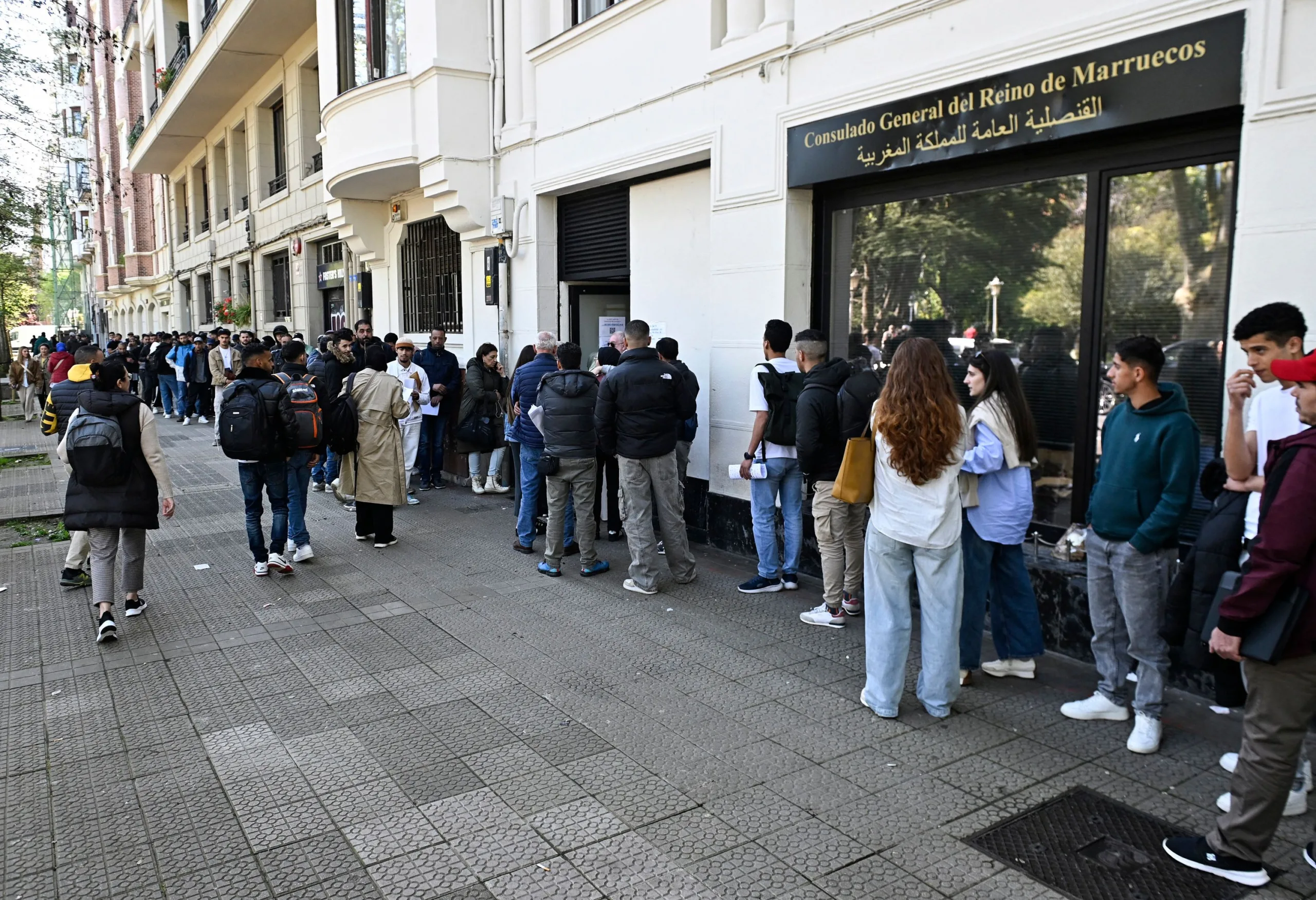
Rabat – Moroccan nationals represent the second-largest group of applicants under Spain’s exceptional regularization process, accounting for 13.3% of all requests submitted nationwide, according to official figures released by the Spanish government in response to a parliamentary question.
Spanish authorities received a total of 1,174,978 applications under the initiative. Colombians, Moroccans, and Venezuelans together accounted for 51% of all requests, according to the government’s data.
Colombians topped the list with 25.9% of applications, followed by Moroccans at 13.3% and Venezuelans at 11.8%.
Other nationalities also featured prominently. Peruvians accounted for 8.8% of applications, followed by Hondurans at 4.8%, Paraguayans at 3.8%, and Algerians at 3.4%. Senegalese nationals represented 2.9% of requests, while Pakistanis and Argentinians accounted for 2.5% and 2.3%, respectively.
Regularization initiative draws opposition scrutiny
The publication of the figures comes amid a political dispute over the regularization process, as Spain’s conservative People’s Party (PP) presses Prime Minister Pedro Sánchez’s government for greater clarity on how authorities handle applications.
The opposition has requested detailed information on rejected applications, deportation procedures that may have been suspended, and the cases of applicants who previously sought asylum or have a criminal record.
In its response, the government said it could not yet provide consolidated figures for these categories as of September 21, since the authorities continued to process applications through the end of the month.
Madrid also outlined the safeguards in place to detect fraud and verify applicants’ documents. The Ministry of Inclusion, Social Security, and Migration handles the examination of requests, while suspected cases of document forgery or fraud go to specialized National Police units, including the Central Unit for Illegal Immigration Networks and False Documents (UCRIF).
Authorities may also refer such cases to the public prosecutor’s office for further investigation.
This dispute reflects broader disagreements over the scope and implementation of the regularization initiative. The government is responsible for processing applications, while the opposition is demanding greater transparency on eligibility, security checks, and the treatment of applicants whose cases raise legal concerns.