Casablanca – Morocco will celebrate Throne Day on July 30, commemorating the accession of King Mohammed VI to the Alaouite Throne in 1999. The national holiday is one of the country’s most important annual events, bringing together official ceremonies, public celebrations, and the King’s address to the nation, traditionally delivered on the evening of July 29.
The celebration has roots that go back to the colonial era. It was first organized in 1933 by Moroccan nationalists around Sultan Mohammed ben Youssef, later King Mohammed V, as a symbol of unity and loyalty to the Moroccan sovereign during the French and Spanish protectorates. A year later, it became an official national celebration through a ministerial decree.
The date of Throne Day has changed with each monarch. Under King Mohammed V, it was observed on November 18. King Hassan II moved it to March 3 after taking the throne in 1961. Since King Mohammed VI became the country’s 23rd Alaouite monarch on July 30, 1999, the celebration has taken place on that date every year.
From historical symbol to annual national milestone
The monarchy considers Throne Day both a symbol of continuity and a yearly moment to assess the country’s direction. On the eve of the celebration, the King delivers the Throne Speech, a nationally televised address reviewing state progress and outlining priorities for the period ahead.
The official celebrations also include the Bay’ah ceremony, where senior state officials, elected representatives, judges, military leaders, and regional governors renew their oath of allegiance to the King in his role as Amir Al-Mu’minin, or Commander of the Faithful. The ceremony became an annual tradition under King Hassan II in 1962.
Royal pardons are also traditionally granted on the occasion, while cities across Morocco hold concerts, fireworks displays, and public festivities.
When King Mohammed VI succeeded his father, King Hassan II, following his death in July 1999, he inherited a country facing economic and social challenges as well as regional disparities. Shortly after his accession, he granted royal pardons to nearly 8,000 prisoners, a move presented as part of an emphasis on reconciliation and humanitarian governance.
Over the following years, Morocco pursued what has often been described as a development-focused model centered on infrastructure, industrial expansion, social programs, and gradual institutional reforms.
More than two decades of reforms and state projects
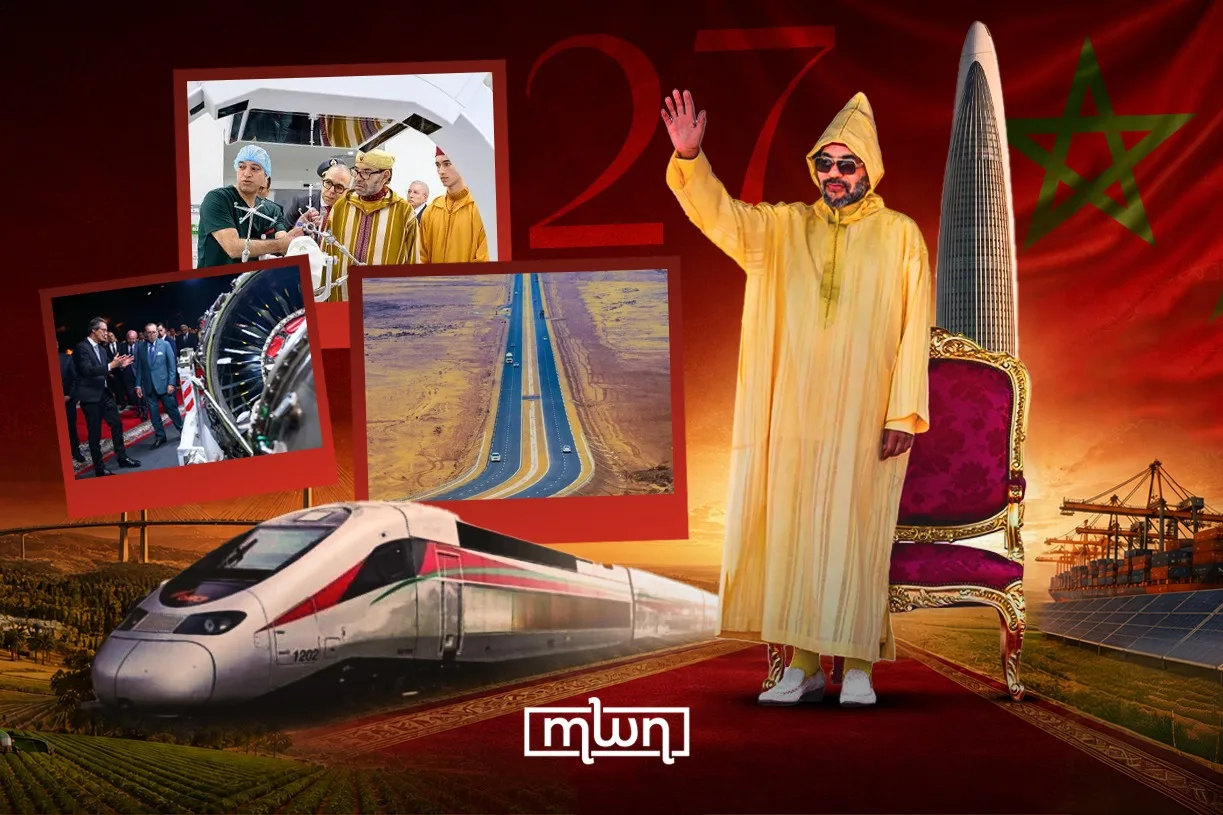
During King Mohammed VI’s reign, Morocco invested heavily in transport and logistics infrastructure. Tanger Med became the largest container port in Africa and the Mediterranean, while Al Boraq became the continent’s first high-speed rail line linking Tangier and Casablanca.
The highway network also expanded beyond 2,000 kilometers, with a target of 3,000 kilometers by 2030. More recently, Morocco accelerated infrastructure projects tied to the 2030 FIFA World Cup, including stadium renovations, airport expansions, and transport upgrades.
The kingdom also advanced its renewable energy transition through projects such as the Noor Ouarzazate Solar Complex, while pursuing a goal of generating more than 52% of its installed electricity capacity from renewable sources by 2030 and expanding its green hydrogen ambitions.
Morocco diversified its economy by developing automotive and aerospace industries, with investments from manufacturers including Renault, Stellantis, Boeing, and Safran helping make automotive exports a key driver of industrial growth.
Social reforms have also marked the King’s reign. The 2004 overhaul of the Family Code, or Mudawana, raised the legal marriage age to 18, restricted polygamy, expanded women’s rights in divorce, and introduced joint responsibility within the family.
Read also: Foreign Officials Cite Long-Term Vision Behind Morocco’s Growing Global Standing
A new revision process continued through 2025 to address remaining legal gaps. Social protection also expanded through mandatory health insurance and direct social assistance programs.
Diplomatically, Morocco continued promoting its Autonomy Plan for the Sahara while advancing initiatives such as the Royal Atlantic Initiative and the Morocco-Nigeria gas pipeline project.
The country also raised its international profile through sport. After becoming the first African and Arab nation to reach the FIFA World Cup semifinals in 2022, the Atlas Lions qualified in 2025 for a third consecutive World Cup. The kingdom also hosted the 2025 Africa Cup of Nations and continues investing in infrastructure ahead of co-hosting the 2030 FIFA World Cup.
The 27th year of King Mohammed VI’s reign was marked by continued momentum across several strategic sectors. Morocco advanced large-scale infrastructure projects ahead of the 2030 FIFA World Cup, with more than MAD 190 billion allocated to transport, airports, railways, stadiums, and urban development, while announcing plans to expand its hotel capacity by 60,000 beds as it targets 26 million annual visitors by 2030.
The kingdom further strengthened its international sporting profile with the Atlas Lions reaching the quarterfinals of the 2026 FIFA World Cup, continued consolidating its industrial and aerospace sectors, and recorded further diplomatic gains on the Sahara issue, including Mali’s endorsement of Morocco’s Autonomy Plan.