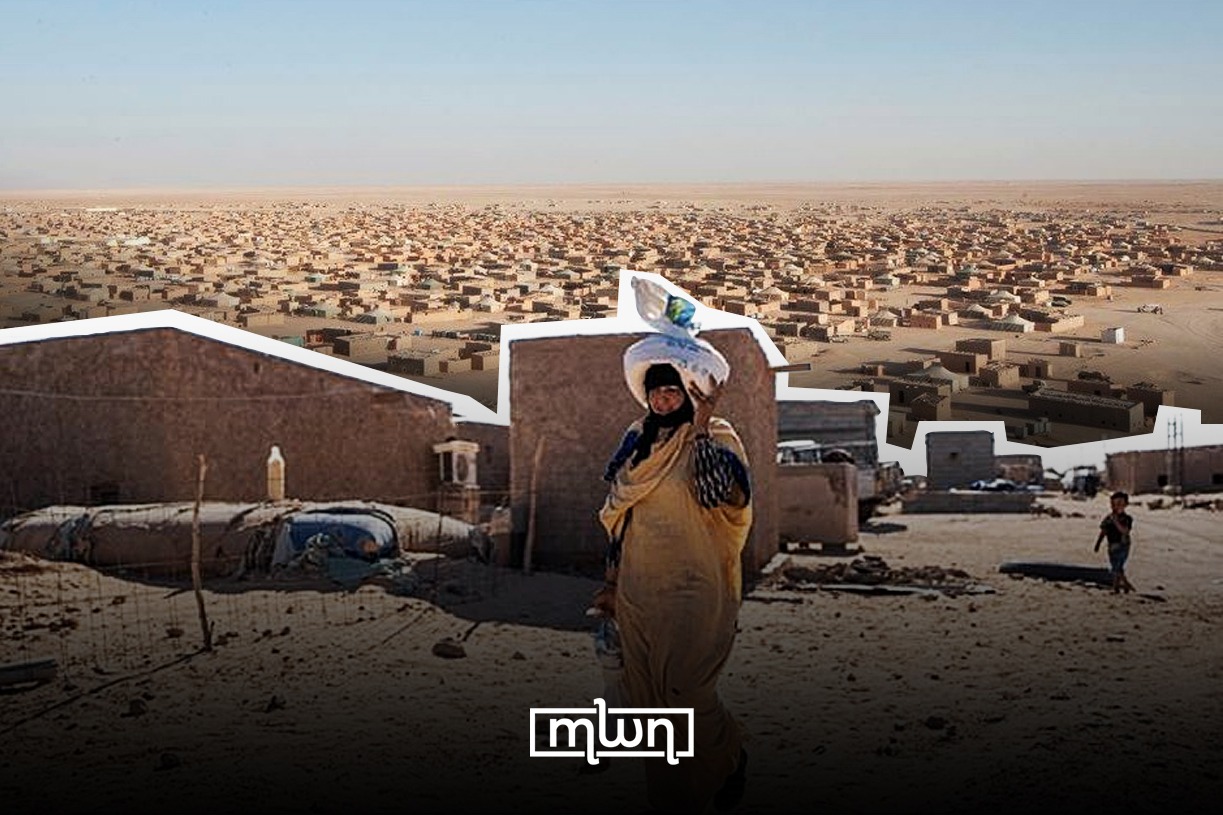
Marrakech – The United Nations High Commissioner for Refugees, Barham Salih, warned the Security Council on Friday that conditions in the Tindouf camps are deteriorating, calling the half-century sequestration of populations on Algerian soil “intolerable” and “unsustainable.”
Salih told the Council that the situation in Algeria’s southwestern region has persisted for more than 50 years. Generations, he noted, have grown up in Tindouf and the surrounding camps “in uncertainty and with limited prospects,” raised behind the closure that Algeria and its Polisario proxy have imposed for decades.
Conditions today are worsening, he cautioned, while humanitarian needs remain “largely underfunded.” After more than half a century, he argued, managing such a situation indefinitely “cannot constitute the ambition to which we must collectively aspire.” The status quo is “untenable,” he charged.
Any solution must come from the people themselves, he added, explaining that this would mean “recognizing the diversity of their aspirations and ensuring that they can make informed and voluntary choices about their future.”
Salih, the former Iraqi president who took up his post at the start of the year, placed free and voluntary choice at the center of any settlement – the very choice Algeria and the Polisario have denied the camps’ inhabitants for two generations.
The artificial conflict sets Morocco against the Polisario separatists, armed, financed, and hosted by Algiers, which shelters the militia on its territory while disowning responsibility for the people trapped there.
Salih’s warning converged with the case Morocco has pressed at the United Nations for years. In Geneva on September 9, Morocco’s permanent representative, Omar Zniber, urged the refugee agency to place “durable solutions” at the center of its budget planning for Tindouf, arguing that decades of funding have entrenched a “costly maintenance regime” that perpetuates the captivity rather than ending it.
Since 2021, Zniber noted, UNHCR has mobilized nearly MAD 900 million ($90 million) for the camps, yet “year after year, everything regressed.” He pointed to a malnutrition rate that has doubled, economic self-reliance that has “vanished,” and access to employment that “remains prohibited,” so that spending grew even as hope declined. The inhabitants are barred from working, barred from leaving freely, and barred from being counted.
Those figures, he charged, “do not describe a protection program” but “a maintenance regime,” costly and inadequate to the needs of the sequestered. International refugee law, he recalled, provides three durable solutions: voluntary repatriation, resettlement in third countries, and integration in the host country – every one of them blocked by the parties that profit from the deadlock.
Zniber tied Morocco’s position to King Mohammed VI’s appeal for a “return in dignity,” which he described as a standing “commitment to welcome, without condition and on a strictly individual and voluntary basis.” Morocco, he added, backs the other two solutions with equal conviction, according to each person’s free choice.
That engagement now sits within “a transformed framework,” Zniber argued. By adopting Resolution 2797, the Security Council “consecrated” Morocco’s autonomy initiative and opened “a political horizon where only a status quo had remained.”
A significant number of donor states, among the budget’s top contributors, are “ready to finance what resolves rather than what perpetuates,” he added, and the target of halving protracted displacement by 2035 is “first a budgetary objective.”
UN warnings put Tindouf’s humanitarian crisis back in focus
The conditions Salih described are documented in detail. The World Food Programme (WFP) reports that 78% of the camps’ inhabitants are food insecure or at risk, that 53.5% of women aged 15 to 49 suffer from anemia, and that acute malnutrition afflicts nearly 11% of children aged six to 59 months.
UNHCR’s 2025 report on Algeria found water provision below humanitarian standards and hygiene coverage incomplete, with malnutrition and anemia worsening. Funding cuts, it noted, struck medical supplies, assistance for people with disabilities, and water and sanitation systems.
UNHCR describes the camps as having very limited livelihood opportunities, harsh environmental conditions, chronic underfunding, and heavy reliance on humanitarian aid. It also reports problems with school infrastructure, teaching quality, absenteeism and dropout rates.
The agency also reported that, as of 2024, neither UNHCR nor Algeria had carried out any formal individual registration of the camps’ population – a census the Security Council has demanded for years and that Algiers persistently refuses, keeping the true numbers hidden.
The camps are run by the Polisario, with Algeria’s state presence deliberately thin, an arrangement earlier US State Department reporting linked to the absence of ordinary police and courts. Inhabitants generally needed permission even to leave the Tindouf area.
At the Human Rights Council in September, NGOs went further, denouncing restrictions on movement and expression, arbitrary detention, torture, and enforced disappearances. Those charges were formally raised before the Council, laid at the door of a militia that answers to no accountable authority.
One of those interventions came from Sahrawi activist Aicha Duihi. Speaking on September 8 for the NGO PDES, she demanded “regular and independent” access by UN human rights mechanisms to Tindouf, warning that prolonged crises must not be allowed to fester as “gray zones” in matters of protection.
The host state, she argued, bears an essential responsibility to guarantee a rights-respecting environment and to cooperate with independent monitoring – a duty Algeria has evaded. “The duration of a crisis,” she cautioned, “should not lead to the prolongation of a protection deficit.”
Development and diplomacy reshape the Sahara debate
The diplomatic ground shifted further in Morocco’s favor during the ongoing 81st session of the United Nations General Assembly. On Friday in New York, US Deputy Secretary of State Christopher Landau, after talks with Foreign Minister Nasser Bourita, affirmed Washington’s commitment to developing the Sahara “under Morocco’s sovereignty.”
The United States, he added, is “eager to work with Morocco and the other concerned actors to resolve this conflict once and for all,” and dismissed a dispute dragged out for more than 50 years as a “status quo [that] cannot be maintained.” He placed the two countries’ relations at “their best level of all time.”
That endorsement built on the Council’s shift last October, when it adopted, at Washington’s initiative, the resolution deeming Morocco’s autonomy plan the “most feasible” basis for a settlement.
The contrast with the Moroccan Sahara is measurable. Morocco launched its Southern Provinces Development Model in 2015 with an initial allocation of more than MAD 77 billion ($7.7 billion), funding the Tiznit-Dakhla expressway, the Dakhla Atlantic Port, desalination, industrial zones, and solar and wind capacity.
The 1,055-kilometer Tiznit-Dakhla road is complete, and the Dakhla Atlantic Port had passed 60% construction by June, according to the Ministry of Equipment and Water.
Political participation tells the same story. In the September 23 legislative election, nationwide turnout reached only 38.08%, yet the Interior Ministry recorded 77% in Laayoune-Sakia El Hamra, 61% in Dakhla-Oued Eddahab, and 53.48% in Guelmim-Oued Noun.
Closing figures from national broadcasters ran higher still by province: 79.52% in Laayoune, 75.36% in Boujdour, 88.88% in Tarfaya, and 80.17% in Aousserd.
For Salih, the conclusion after more than five decades is that indefinite management can no longer substitute for a solution – a judgment that now aligns Rabat, Washington, and the UN’s own refugee chief around a single verdict: the status quo cannot hold, and the captivity in Tindouf must end.
Read also: Necropolitics in the Desert: Tindouf Camps and the Suspension of Life