

















































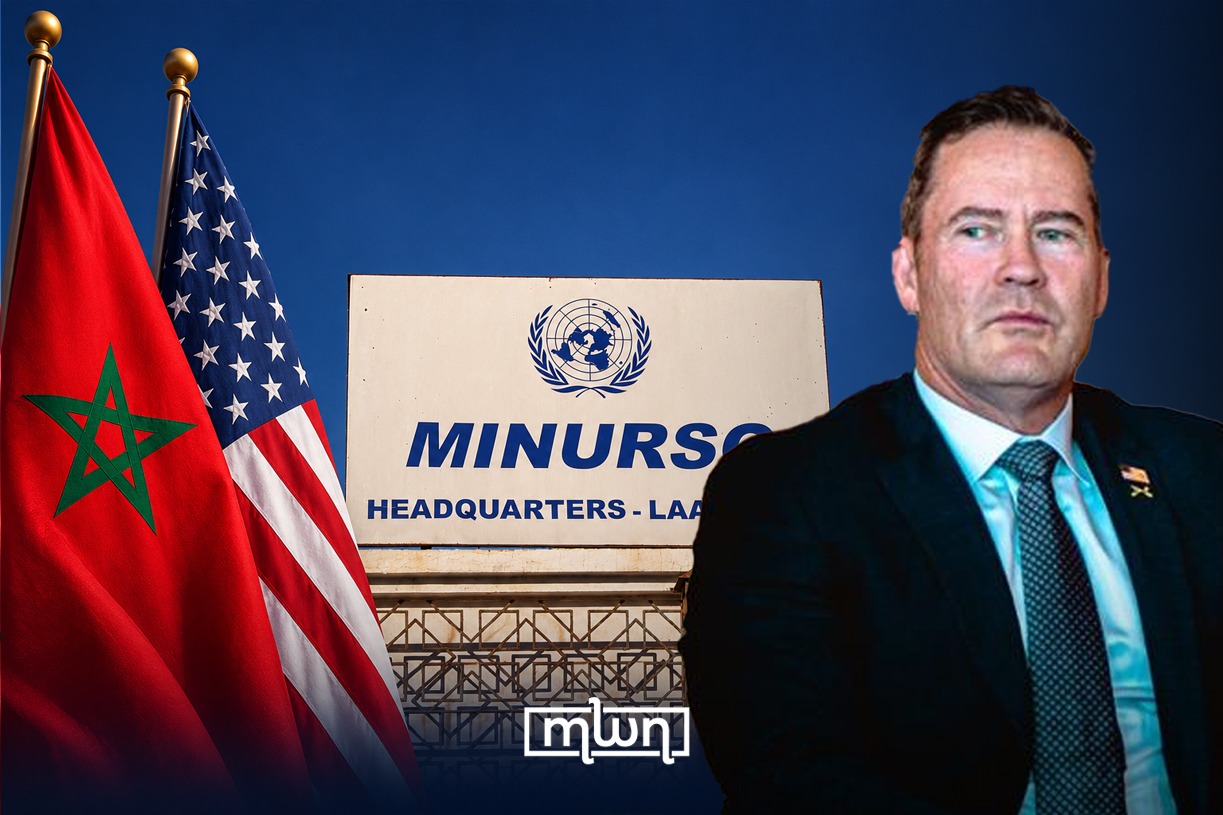
The visit to Rabat of Mike Waltz, United States Permanent Representative to the United Nations, on 16-17 November 2026, took place at a critical juncture in the Sahara dispute. Less than three weeks after the Security Council failed to agree on the renewal of MINURSO’s mandate, the first elements of the mission had begun their withdrawal.
Beyond the end of a peacekeeping mission.
An international framework that had shaped the management of the dispute for thirty-five years was entering a process of institutional liquidation, while the underlying political question remained unresolved.
Yet, the significance of Waltz’s visit extended well beyond the operational consequences of MINURSO’s departure. His meetings with Alexander Ivanko, the UN official overseeing the mission’s withdrawal, and Nasser Bourita, Foreign Affairs Minister of the Kingdom of Morocco, brought together several dimensions of a changing diplomatic landscape: the future of international engagement, the continuation of political negotiations, the humanitarian situation in the Tindouf camps, the preservation of the ceasefire and the wider strategic competition unfolding across North Africa and the Sahel.
The announcement by Minister Bourita that Morocco and the United States had developed proposals intended to accommodate the concerns of the parties involved added a further dimension. It suggested that bilateral coordination was moving beyond the reaffirmation of an established political position towards the elaboration of practical arrangements intended to facilitate a negotiated settlement, within the framework of autonomy under Moroccan sovereignty.
The visit consequently raises a question of broader international significance. When an institutional instrument reaches the end of its mandate without resolving the conflict it was designed to manage, does the international
community simply preserve the previous approach through another mechanism, or does it reconsider the relationship between political objectives, institutional instruments and the responsibilities that remain?
The post-MINURSO equation is therefore not a question of the future of a UN mission. It concerns the capacity of multilateralism to adapt to changing political realities without relinquishing its legal foundations, and the ability of regional actors to move beyond inherited patterns of confrontation towards a more sustainable framework of coexistence and cooperation.
The Security Council impasse and the limits of institutional consensus
The events of 30 October 2026 exposed the limits of international consensus concerning the future of MINURSO.
The American draft resolution received eleven votes in favour but was vetoed by Russia. The Russian alternative, which sought to preserve a more traditional approach to the mission’s mandate, received only three votes in favour, one against and eleven abstentions. It therefore failed to reach the nine-vote threshold required for adoption.
The outcome was not a double veto. It was a twofold institutional failure: the American initiative could not overcome the Russian veto, while Moscow was unable to
assemble sufficient support for its own preferred arrangement.
MINURSO’s mandate expired on 31 October 2026. The Secretary-General subsequently confirmed that the mission’s peacekeeping operations had ceased and that a liquidation period had begun on 1 November 2026. The initial withdrawal of personnel and equipment thus marked the operational conclusion of a UN presence established in 1991.
The significance of this development should not be underestimated. For more than three decades, MINURSO had provided an international presence associated with the monitoring of the ceasefire and the implementation of the original settlement framework. Its departure alters the conditions under which the dispute has been internationally managed, raising questions about the future observation of developments on the ground, the preservation of security and the continuity of international engagement.
Nevertheless, the Security Council’s inability to agree on a new mandate should not be confused with the disappearance of its institutional responsibilities. Nor should the end of a peacekeeping operation be interpreted as the resolution of the political question that gave rise to it.
The central issue is consequently not whether the previous mission can be restored in its former configuration, but whether the international community can develop a more appropriate relationship between the political process, security requirements and the institutional mechanisms available to support them.
American policy and the quest for a new diplomatic framework
Waltz’s statements following his meeting with Minister Bourita provided a clearer indication of Washington’s intentions.
He reaffirmed American recognition of Moroccan sovereignty over the Sahara and reiterated support for autonomy under Moroccan sovereignty as the basis for a lasting settlement. He also made clear that the failure of the American draft resolution had not altered Washington’s political position or its intention to continue diplomatic engagement.
Of particular importance was his reference to the negotiations conducted earlier in 2026, involving Morocco, Algeria, Mauritania and the Polisario Front, under the facilitation of the United States and the UN Personal Envoy, Staffan de Mistura.
His remarks suggested that Washington regards the negotiating process as a continuing diplomatic undertaking rather than one dependent exclusively on the survival of MINURSO. The mission’s withdrawal and the continuation of political engagement are therefore being treated as distinct, although closely related, developments.
Waltz’s meeting with Alexander Ivanko added an operational dimension to this position. The immediate priority, according to the American side, was to ensure the safe and orderly withdrawal of the mission’s 158 unarmed observers and associated personnel and equipment.
The sequence of the two meetings was revealing. The first addressed the practical consequences of the mission’s liquidation; the second addressed the political and diplomatic conditions for continuing the search for a settlement.
This juxtaposition captures the essential dilemma of the post-MINURSO period: how to manage the consequences of institutional withdrawal without allowing the political process to lose its continuity or the security situation to deteriorate.
Washington’s message from Rabat was therefore one of diplomatic continuity in the midst of institutional change.
The transition from political principles to institutional arrangements The significance of Waltz’s visit becomes more apparent when examined against the substantive work undertaken during the 2026 negotiations.
The Secretary-General’s report S/2026/781 records three rounds of discussions involving Morocco, Algeria, Mauritania and the Polisario Front. These took place in Washington on (18–19 January 2026), Madrid, (8–9 February 2026) and Washington again (23–24 February 2026). They were co-facilitated by the United States and the UN Personal Envoy.
The discussions went beyond the exchange of general political positions. They examined questions that would arise in the event of a negotiated settlement, including transitional arrangements, the establishment of a transitional council, resource-sharing, amnesty and reconciliation, disarmament, demobilisation and reintegration, security arrangements and electoral systems.
Morocco presented an expanded version of its 2007 autonomy proposal, developed into a draft autonomy statute and shared with the participants. The UN and US teams also worked on preliminary documents concerning a possible transitional phase and compromise positions on the issues under discussion.
This development is important because it indicates that the negotiating process had begun to address the institutional and practical dimensions of a possible settlement. The question was no longer confined to competing interpretations of self-determination or the presentation of alternative political formulas. It increasingly concerned the conditions under which a negotiated arrangement might function.
Yet, the substantive progress recorded in the discussions did not eliminate the fundamental disagreement over sovereignty and self-determination. These questions remained central to the differences among the concerned parties.
The post-MINURSO challenge is therefore to preserve the negotiating work already undertaken while addressing the political disagreement that has prevented it from producing an agreement.
Waltz’s reference to the earlier rounds of discussions should be understood in this context. The process has generated working material and possible institutional options, but these remain part of an unfinished diplomatic undertaking.
The search for political accommodation
Perhaps the most consequential announcement of the Rabat meetings was Minister Bourita’s disclosure that Morocco and the United States had developed proposals intended to accommodate the concerns of the participants without requiring any of them to accept a humbling political outcome.
This announcement suggests an effort to address a dimension that is often underestimated in the negotiation of protracted disputes: the relationship between the institutional substance of a settlement and the political conditions necessary for its acceptance.
A political formula, however carefully designed, cannot become a durable settlement unless it also addresses the legitimate concerns, expectations and future participation of those involved. The challenge is to identify arrangements that can reconcile the practical requirements of governance and security with the political considerations that have sustained disagreement.
Minister Bourita’s formulation points towards this objective. It indicates an intention to preserve autonomy under Moroccan sovereignty as the central framework while exploring arrangements that could facilitate a negotiated outcome.
An important distinction must, nevertheless, be maintained between the working documents described in the Secretary-General’s report and the proposals announced in Rabat. The former are documented elements of the earlier negotiating process. The latter represent a further diplomatic development, although their precise contents have not been made public.
It has not been established whether these proposals constitute a revised version of the previous working documents, an extension of them or a separate set of political and institutional ideas. Nor has their formal transmission to Algeria and the Polisario Front been confirmed.
Their significance should therefore be assessed with both interest and analytical caution. What can be established is that Moroccan-American coordination has moved beyond the reaffirmation of a political position towards the exploration of practical arrangements intended to facilitate its implementation.
The ultimate test will be whether these proposals can generate substantive engagement among all the participants and contribute to a negotiated process capable of addressing the political and institutional dimensions of the dispute.
The legal and institutional continuity of the United Nations
The most important legal distinction in the post-MINURSO period concerns the relationship between the termination of a peacekeeping operation and the continuing responsibilities of the United Nations.
The Charter does not make the existence of a peacekeeping mission a prerequisite for the Security Council to remain engaged in a situation affecting international peace and security.
Under Article 24, the Council bears primary responsibility in this field. Articles 33 and 34 provide the framework for the peaceful settlement of disputes and the examination of situations that may give rise to international friction. Article 25 establishes the obligation of Member States to accept and carry out Security Council decisions.
These provisions are not extinguished by the closure of an operational mission. The Security Council retains the institutional authority to consider the situation, adopt decisions within its competence and determine whether further action is required.
In the Sahara question context, Resolution 2797 of 2025 is particularly relevant. In addition to extending MINURSO’s mandate until 31 October 2026, it expressed support for the Secretary-General and his Personal Envoy in facilitating negotiations based on Morocco’s autonomy proposal, called upon the parties to engage without preconditions and invited Member States to support the negotiating efforts. It also decided that the Council would remain seized of the matter.
The expiry of the mission’s mandate must therefore be distinguished from the broader institutional framework established by the Council. The latter cannot be assumed to have disappeared simply because the former has ceased to operate.
Equally important is the status of the Secretary-General’s Personal Envoy. The UN Department of Political and Peacebuilding Affairs makes clear that the Personal Envoy’s function is to provide good offices and help lead the political process on behalf of the Secretary-General. This function is institutionally distinct from MINURSO.
A peacekeeping mission is an operational instrument established by the Security Council. The Personal Envoy exercises a diplomatic function entrusted by the Secretary-General. The end of the former does not, in itself, terminate the latter.
The Secretary-General’s statement of 31 October 2026 explicitly reaffirmed this continuity. While confirming that MINURSO’s peacekeeping operations had concluded, he stated that the United Nations remained ready to support dialogue and a peaceful resolution through his Personal Envoy, Staffan de Mistura.
This statement provides the clearest institutional indication that the end of MINURSO is not equivalent to the end of the UN political process.
The legal and diplomatic question is consequently one of institutional adaptation: how can the United Nations preserve the continuity of its political engagement while recognising that the operational framework inherited from 1991 has reached its conclusion?
The General Assembly and the decolonisation dimension
The institutional landscape is further complicated by the continuing consideration of the Sahara issue within the United Nations decolonisation framework.
The said issue remains on the UN list of Non-Self-Governing Territories and is considered by the General Assembly through its decolonisation machinery, including the Fourth Committee and the Special Committee on Decolonization.
This dimension should be distinguished from the Security Council’s primary responsibility for international peace and security.
The General Assembly, under Articles 10 to 14 of the Charter, may discuss questions within the scope of the Charter and make recommendations to Member States or to the Security Council, subject to the Charter’s provisions.
The Assembly’s role is therefore not interchangeable with that of the Security Council. It does not simply assume the latter’s responsibilities following a failure to agree on a peacekeeping mandate. Nor can its recommendations automatically substitute for Security Council decisions.
Nevertheless, the continuation of the decolonisation agenda means that the Sahara question retains an institutional presence beyond the operational framework of MINURSO.
This creates a dual institutional dimension. The Security Council addresses the implications of the dispute for international peace and security and supports the political process. The General Assembly and its subsidiary bodies continue to consider the question within the framework of decolonisation.
The relationship between these two dimensions is likely to become increasingly important in the post-MINURSO period.
It also requires caution. The existence of parallel institutional processes does not mean that they are legally identical, or that one can unilaterally determine the outcome of the other. Their respective mandates, procedures and legal effects must be respected.
The challenge for multilateral diplomacy is to ensure that institutional plurality contributes to a coherent search for a peaceful settlement rather than becoming another arena for competing political interpretations.
Tindouf camps and humanitarian protection, registration and international responsibility
The humanitarian dimension of the dispute acquired renewed prominence during Waltz’s discussions in Rabat.
His remarks on the conditions of Sahrawis living in the Tindouf camps, together with his reference to UNHCR’s role in finding durable solutions, brought questions of protection, registration and freedom of movement into the wider diplomatic debate.
These matters should be examined within their own legal and institutional framework.
UNHCR’s mandate derives from the authority of the General
Assembly and concerns international protection and the search for permanent solutions for refugees. Its responsibilities are distinct from those of MINURSO and are not dependent on the continuation of a peacekeeping mission.
The concept of durable solutions is also specific. Under UNHCR’s established framework, it generally encompasses voluntary repatriation, local integration or resettlement. The selection and implementation of any solution must respect the rights and informed choices of the individuals concerned.
Registration is an essential instrument of protection and humanitarian planning. It can help establish a clearer understanding of the population requiring assistance, facilitate access to protection and services, and provide a more reliable basis for assessing durable solutions.
UNHCR’s reporting on Algeria has noted that formal refugee registration has not been conducted in the Sahrawi camps in Tindouf. This makes the question particularly relevant, although registration must be carried out according to international standards, with appropriate guarantees of access, protection and freedom of movement.
The responsibilities of the different actors must also be carefully distinguished. The presence of the camps on Algerian territory gives the host state an important role in facilitating humanitarian access and the work of
international agencies. UNHCR has its own protection mandate, while the rights and interests of the populations concerned must remain central.
The political status of the camps, the responsibilities of the host state, the role of the Polisario Front and the rights of individual refugees are related but legally distinct questions. They should not be conflated.
The broader issue is one of international responsibility. A humanitarian situation that has persisted across generations cannot remain indefinitely detached from the institutional mechanisms designed to protect refugees and pursue durable solutions.
Waltz’s remarks do not, by themselves, establish a new registration mechanism or resolve the legal and operational questions surrounding the camps. They do, however, indicate that Washington intends to give the humanitarian dimension a more visible place in the wider diplomatic process.
The significance of this development lies in the possibility of reconnecting the humanitarian question with the search for a political settlement, without subordinating the rights of the affected population to the outcome of negotiations.
Algeria’s institutional status and substantive political responsibility
The absence of Algiers from Waltz’s announced itinerary remains a politically relevant element of the visit. Yet the diplomatic significance of that absence should be assessed against Algeria’s actual role in the negotiating process rather than treated as proof of deliberate American exclusion.
Waltz explicitly referred to Algeria’s participation in the 2026 negotiations alongside Morocco, Mauritania and the Polisario Front. The distinction between bilateral diplomatic engagement and participation in a multilateral negotiating format is therefore essential.
More broadly, the Sahara dispute has long been characterised by a distinction between Algeria’s formal institutional position and its substantive political involvement.
Algeria has consistently resisted being treated as a direct party to the dispute. Yet its participation in the negotiations, its strategic relationship with the Polisario Front and the presence of the Tindouf camps on its territory make its engagement indispensable to any comprehensive settlement.
This is not simply a question of diplomatic terminology. It concerns the relationship between formal status, political influence and the responsibilities that accompany participation in a process intended to produce a lasting agreement.
The negotiations of 2026 demonstrated that Algeria could not be absent from the discussion of the practical arrangements required for a settlement. Questions concerning security, transitional governance, reconciliation, resources and the future of the populations concerned necessarily have regional implications.
The same applies to the humanitarian dimension. Any durable solution concerning Tindouf requires the cooperation of the host state, the relevant humanitarian agencies and the actors directly involved.
The issue is therefore not whether Algeria should be included in the political process. Its participation has already been established in the negotiating format. The more consequential question is whether that participation will translate into the political commitments and practical cooperation required to move beyond the existing impasse.
The distinction between institutional status and substantive responsibility should remain central to any serious assessment of the post-MINURSO process.
Russia and the geopolitics of institutional resistance
Russia’s veto of the American draft resolution must be examined within the wider strategic environment of North Africa and the Sahel.
Moscow maintains longstanding relations with Algeria, particularly in defence cooperation, military equipment, energy and diplomatic coordination. Its regional interests
also extend to Libya and the Sahel, where the reconfiguration of political and security partnerships has expanded its presence.
The veto demonstrated Russia’s willingness to oppose an American initiative that sought to alter the framework of international involvement in the Western Sahara dispute.
Yet, the subsequent failure of the Russian alternative to obtain the required support exposed the limits of its position within the Security Council. Moscow was able to prevent the adoption of the American text, but it was unable to assemble sufficient support for its own preferred arrangement.
The distinction between the capacity to obstruct and the capacity to construct is central to understanding the institutional impasse.
Nevertheless, Russia’s position should not be reduced to a single geopolitical motive. Its calculations may involve the defence of its institutional interpretation of the UN process, its strategic relationship with Algeria, its wider regional interests and its approach to American influence in the multilateral system.
Nor should the veto automatically be interpreted as evidence of a comprehensive Russian strategy directed against Morocco. Rabat and Moscow maintain their own diplomatic and economic relationship, which exists alongside their differences over the Security Council’s handling of the Sahara question.
The more important question is whether Russia intends to remain primarily an actor capable of preventing institutional change or whether it will seek to participate in the construction of a diplomatic framework capable of attracting wider international support.
The answer will have implications extending beyond the Sahara, particularly in a region where competing external powers increasingly intersect with fragile political and security arrangements.
The Sahel and the regional dimension of the emerging geopolitical equation The Sahara dispute cannot be considered in isolation from the transformations affecting North Africa and the Sahel.
Political transitions in Mali, Burkina Faso and Niger, the reconfiguration of their external partnerships and the growing involvement of competing international actors have altered the regional security environment.
For Russia, the Sahel offers opportunities to consolidate political and security relationships and extend its strategic influence. For the United States, the changing environment raises questions concerning counterterrorism, regional stability, strategic access and the future of its engagement with African states.
Morocco’s position is shaped by a different combination of diplomatic and economic instruments. Its African policy, Atlantic Initiative, investment partnerships and security cooperation provide it with a regional perspective extending beyond the immediate Sahara dispute.
The Kingdom’s geographical position, Atlantic access and relationships with African, European, American and Middle Eastern partners place it within wider discussions concerning connectivity, economic development and regional security.
The Rabat meetings also highlighted the broader scope of Moroccan-American cooperation. Minister Bourita referred to defence industries, advanced technologies, artificial intelligence, critical minerals and energy as areas of potential development. This suggests that the strategic partnership is not confined to the Sahara question but forms part of a wider agenda of economic and security cooperation.
The interaction between the Sahara dispute and the Sahel’s security crises should nevertheless be approached with analytical precision. They have distinct historical origins, political actors and institutional frameworks. Their relationship lies in the wider regional environment, characterised by fragmented security arrangements, competing external partnerships, limited regional integration and the difficulty of establishing collective responses to transnational challenges.
The post-MINURSO transition may consequently become part of a broader discussion on the future security architecture of North Africa and the Sahel. But that architecture cannot be constructed through the management of the Sahara dispute alone. It requires a more comprehensive approach to regional interdependence, economic connectivity, political dialogue and security cooperation.
Morocco’s strategic autonomy in an increasingly multipolar order Waltz’s visit also raises a broader question concerning Morocco’s position in the changing international order.
The relationship with the United States remains a central component of Moroccan foreign policy. Washington’s reaffirmation of its position on the Sahara, its involvement in the negotiations and the wider areas of bilateral cooperation demonstrate the strategic depth of this partnership.
However, Morocco’s international position cannot be reduced to its relationship with Washington. Its diplomatic engagement with Russia, China, Europe, African states and partners in the Middle East reflects the complexity of an international system in which political alignments are increasingly differentiated.
Strategic autonomy should not be confused with neutrality or equidistance between competing powers. It is better understood as the capacity to defend national interests, diversify partnerships and preserve independent diplomatic choices while engaging constructively with different international actors.
The Russian veto exposed the limits of consensus within the Security Council, but it did not invalidate the bilateral relationship between Morocco and the United States. Equally, the reaffirmation of American support does not remove the importance of Morocco’s relations with other powers.
China’s position during the Security Council proceedings also cautions against reducing the situation to a unified confrontation between an American-led camp and a Russian-Chinese bloc. Its voting behaviour reflected a particular institutional alignment, but does not establish the existence of a common strategy concerning the future of the Sahara.
The emerging order is characterised less by rigid blocs than by overlapping interests, selective cooperation and competition across different geographical and institutional settings.
For Morocco, the central question is how to preserve the freedom of diplomatic action required by this complexity while pursuing a political settlement consistent with its national position.
Conflict management and the transformation of regional relations
The most consequential question emerging from Waltz’s visit is not simply what will replace MINURSO. It is whether the end of the mission’s mandate can become an occasion to reconsider the relationship between conflict management, political settlement and regional cooperation.
For thirty-five years, the international process was largely structured around the management of an unresolved dispute. MINURSO provided an international presence, associated with the ceasefire, and the original settlement framework. Yet, the persistence of the conflict, the absence of agreement on the central political questions and the deterioration of regional relations, have all exposed the limitations of an approach increasingly detached from the political realities it was intended to address.
The Security Council impasse of 30 October 2026 brought these limitations into sharper focus. It demonstrated that the continuation of an institutional arrangement cannot be assumed when the political conditions underpinning it have become increasingly contested.
However, institutional failure should not be confused with the disappearance of international responsibility. The UN Charter, the Secretary-General’s good offices, the Security
Council’s continuing competence, the General Assembly’s decolonisation responsibilities and UNHCR’s humanitarian mandate provide distinct avenues through which international engagement may continue.
The challenge is to ensure that these mechanisms operate coherently, without confusing their respective mandates or allowing institutional fragmentation to reproduce the political impasse in another form.
The discussions in Rabat suggest that Morocco and the United States are seeking to pursue a transition through several interconnected avenues: continued negotiations, proposals within the autonomy framework, attention to the humanitarian situation in Tindouf and preservation of the ceasefire.
The precise content of the proposals, the responses of the other participants and the future institutional role of the United Nations remain to be clarified. These are decisive questions, not procedural details. They will determine whether the diplomatic momentum identified in Rabat can be translated into a viable negotiating process.
Ultimately, the transition requires more than a new institutional arrangement. It requires a political environment in which sovereignty, security, humanitarian protection and regional interdependence can be addressed as interconnected dimensions of a durable settlement.
The post-MINURSO equation and the future of multilateralism
Mike Waltz’s visit to Rabat has provided a clearer indication of the American approach following the Security Council impasse.
Washington has reaffirmed its recognition of Moroccan sovereignty over the Sahara and its support for autonomy under Moroccan sovereignty. It has indicated its intention to continue working with the participants in the political process, raised the humanitarian situation in Tindouf, called for respect of the ceasefire and engaged directly with the UN official responsible for MINURSO’s withdrawal.
Minister Bourita’s announcement of Moroccan-American proposals adds a significant diplomatic dimension. It suggests an effort to move beyond the immediate consequences of the Security Council’s failure and to develop practical arrangements capable of addressing the concerns of the participants within the autonomy framework.
Yet, the wider significance of the visit lies in the questions it has brought into sharper focus: Algeria’s substantive role and political responsibilities, the humanitarian situation in the Tindouf camps, Russia’s capacity to influence the international process, the continuing institutional responsibilities of the United Nations and the strategic competition unfolding across North Africa and the Sahel.
The end of MINURSO does not resolve the Sahara dispute, nor does it extinguish the rights of the population concerned or automatically terminate the United Nations’ political and humanitarian engagement. It marks the conclusion of a particular operational arrangement and the beginning of a period in which the relationship between international responsibility and institutional instruments must be reconsidered.
This is perhaps the broader significance of the post-MINURSO moment. It reveals the limitations of a multilateralism organised primarily around the preservation of inherited mechanisms, while demonstrating the need for institutions capable of adapting their instruments to changing political realities.
Such adaptation, however, cannot mean the abandonment of legal principles or the substitution of geopolitical convenience for international legitimacy. It must rest on the distinction between institutional mandates, respect for the rights of the populations concerned, the peaceful settlement of disputes and the responsibilities of the actors involved.
The future of North Africa and the Sahel will depend not only on the distribution of influence among external powers, but also on the capacity of regional states to overcome inherited antagonisms and develop forms of cooperation founded on mutual recognition, security, economic interdependence and political responsibility.
The post-MINURSO equation is, therefore, larger than the Sahara. It is a test of whether a changing multipolar order can produce a more adaptable and coherent form of multilateralism that is capable of moving beyond the indefinite management of conflicts towards the conditions necessary for their political transformation.