






























































Rabat – The Moroccan government has announced that it will not renew its IMF Precautionary and Liquidity Line (PLL). The deal, signed in 2011, will end in July 2018.
According to the IMF, the PLL “provides financing to meet actual or potential balance of payment needs of countries with sound policies, and is intended to…help resolve crises under wide-ranging situations.”
Morocco appealed to IMF’s financial and structural support in 2011, when, in the feverish and uncertain political situation marked by the Arab Spring, the country sought to maintain investor trust , particularly that of FDI (Foreign Direct Investment).
From PLL to the Flexibility Line
According to La Tribune Afrique, Morocco, feels confident enough to decline IMF’s offer to extend the PLL deal, in part due to the new exchange rate initiated by regime on January 15.
It should be noted that although Morocco contracted the USD 3.47 billion included in the PLL in 2011, renewing it twice in order to readily face any eventual economic crisis or market shock, the government reports that it actually never used the allowance.
On Sunday, 21 January, IMF Managing Director Christine Lagarde arrived in Morocco, where she was due to chair a conference on IMF economic policies in the MENA region. Lagarde, it was reported, came to Morocco hoping to address alleged frustrations brought on by IMF policies in the region andfind common ground with MENA government representatives. The two-day conference was titled “Opportunities for All: Growth, Employment and Inclusion in the Arab World,” with the aim of assessing IMF policyand deriving new pathways for MENA growth.
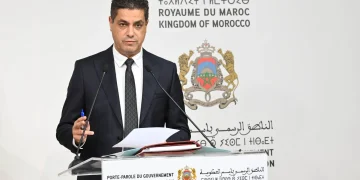
Speaking to the press on the sidelines of the Marrakech conference, Moroccan Finance Minister Mohamed Boussaid explained that the efficiency and the effectiveness with which the country’s current exchange rate regime is implemented are such that the liquidity and precautionary line is no longer needed.
“There is no need to renew it [PLL]. The macroeconomic situation and the present indicators are satisfactory,” Boussaid said, adding, however, that “this does not mean that our good relationship with the IMF should not continue.”
For his part, the governor of Morocco’s Central Bank reiterated the government’s stance on the PLL, underlining that Morocco’s economy is now moving toward a more “flexible line” for “stronger economies,” rather than the “liquidity line” intended for economies in crisis or transition. He added that Morocco’s objective is to maintain eligibility for the IMF’s Flexible Credit Line (FCL), conceived for countries with strong policy frameworks and well-performing economies; this credit line was designed for crisis mitigation or prevention.
As for the IMF delegates, they saluted Morocco’s handling of the PLL. They also praised Morocco’s current exchange rate regime. Jihad Azour, the IMF director for the MENA region, reported, “It is a reform that is doing well. It allows Morocco to attract investors and fully play its financial role in the MENA region.”