Join on WhatsApp
 Join on Telegram
By Zouhair Chbakou- Rabat- Exclusive interview with Ibtisame Lachgar and Soufyane Fares, leaders of the “kiss-in” in Rabat, with Morocco World News about the latest event that took place in front of the Moroccan Parliament in Rabat on Saturday.
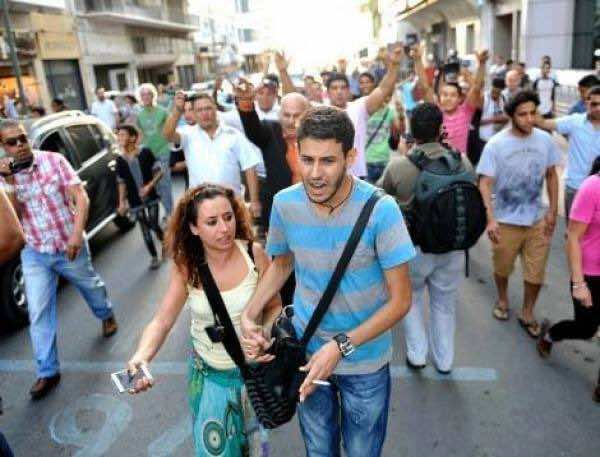
Since the Moroccan authorities arrested a teenage boy and girl for posting on Facebook a photograph of themselves kissing, the incident has caused a huge stir among young people in Morocco, international media, as well as local and international organizations. Social media is ablaze with several young people posting similar pictures of kisses on Facebook, with calls for a public “kiss-in,” in protest to conservatives and the authorities which arrested the two teens. The peaceful kiss-in precipitated a quarrel in the street as a small group of anti-kiss-in protesters shoved some of the couples and threw chairs at the peaceful protesters. Morocco World News interviewed Ibtissame Lachgar, the co-founder of the “Mali” movement and one of the organizers of the “kiss-in” that took place in Paris and Rabat.
MWN: First, your pictures are all over the internet from social networks to numerous Moroccan and foreign online newspapers as well as other foreign TV channels. Let us ask you both, who are Ibtissame Lachgar and Soufyane Fares?
 IbtissameLachgar: I am a human rights activist: I defend women’s rights and individual freedoms as well. In addition to that, I am a psychotherapist. My specialty is in criminology. I have studied in Paris since I received my high school degree in Morocco. I worked in France. I had my own practice for a while, but I stopped practicing on my own because of my work with other associations. In addition to that, I worked in Oukacha prison in Casablanca
Soufyane Fares: I am a university student at the College of Rights and Economics, a human rights activist, a political and social activist in the February 20thMovement, and a member of the “Mali” movement that stands for individual freedom.
MWN: What does activism mean to you? Does it have a mission, a cause, or is it just a cool trend to create controversy and to seek attention, as some people claim?
Lachgar: Being an activist means that I do not tolerate injustice — that is why I am an activist. I defend freedom and justice. But the most important thing to me is that human rights are universal, in my opinion, even though many Moroccan human rights defenders claim that we have our tradition and culture, and Morocco is an Islamic country (which I totally disagree with). I am a humanitarian, as that term is used based on the universal definitions. If we are in Sweden, Senegal, or Morocco, it is the same thing for me. When there is injustice such as in most of the Arab countries and Islamic ones, I demonstrate. That comes from my family heritage. My father was an activist too, so I cannot help but protest or post on Facebook whenever there is an injustice. It is a passion, and I consider myself 100% an activist.
MWN: There has been a lot of speculation on Facebook and in online newspapers about the kiss-in demonstration you organized in Rabat. What exactly happened during the demonstration?
Lachgar: I think everything went well. As you may know, “the kiss-in” demonstration in Casablanca had been cancelled on Wednesday and although the same event in Mohammdia was not cancelled, no one showed up, just the organizers of that event.
When I organized the demonstration in Paris, there were only 15 demonstrators and we did not have any trouble. And I thought about doing it in Rabat. I knew we would be only 5 or 7 couples, only the organizers. People say on Facebook that they will attend, but as you know, Moroccans are fearful of reprisals for public protest. As it turned out, many couples participated. We were surprised that it was such a successful event with all the risk that it entailed plus being staged in front of the Moroccan parliament. Little by little people came, 5, then 10, then 15 couples. Eventually there were 25 couples, but half of them were hidden; they did not want to appear in front of the cameras and most of them left. There were police officers and D.S.T (Moroccan Intelligence Services) members around. I noticed one of them with a journalist who had a camera…they did not interrupt us they just walked around.
After that, we saw “baltajiya” (thugs)– we know them, especially their leaders Amine El baroudi — and we knew that we would have some problems. He (Amine el baroudi) usually insults us and pushes us away whenever we meet together, but this time he sat and waited for two hours till we started. We gathered in front of Balima Square, and one of us had to whistle as a signal to begin the “ kiss-in.” There were not a lot of couples because there were many singles ,but it was not a problem. They were standing close to us and some of them only hugged each other. Only 4 or 5 couples started to kiss. At that moment, Amine El baroudi and some of his companions pushed and insulted us, but at the beginning he was the only one. He always starts first, and then the others come after. He threw chairs at us and he grabbed me by my hair. He pushed others and threw glasses. Police officers remained silent. They did not protect us nor arrest him for being violent. We previously suspected that he works for them, but this time it is was so obvious. He spoke to people sitting in the café to try to get them to stop us, but to be honest no one moved from his chair. Most of his companions were teenagers and one of them was older around 50 or 60 years old.
MWN: As an activist and human rights defender, how do you see the future for individual freedom in Morocco?
Lachgar: I am a pessimist, because over the last 10, 15, or even 20 years Morocco has changed yet the laws have remained the same. Our society is becoming increasingly conservative. That shift started with the increase of radical islamists not only in Morocco but throughout the world fueled by new satellite channels, widespread internet access, and so on. Before, many individual freedoms were tolerated even though the law forbade them; it was hypocrisy but it was tolerated. No one cared if you fasted or not during Ramadan and people would not interfere in other people’s personal life. Now there are many problems from freedom of beliefs, sexual freedom and kissing in public, all taboos in general.
Before, beaches were full of girls in their bathing suits and now there are fewer, and the situation is getting worse. On the other hand, freedom of expression never existed. A t the time of Hassan II, people couldn’t express their point of view freely, but in the beginning of Mohammed VI’s era we started to have more freedom but still not enough, especially in journalism. When it comes to individual freedom, I believe that it will be a daunting challenge. When I started my fight by co-founding the “Mali” association with Zinb el Ghazoui, we were very optimistic at the beginning, but since then things have changed. We know that there are many people who share the same ideology as ours, but they are too fearful to protest, plus the intimidation of the police works against freedoms. It also creates problems with our family and in our work because we do not have the culture of protesting.
Most people that we share the same ideology with, have opened the debate in social networks (which is a good thing to start with) but if we want the change we must go out to the street to protest and that’s how Americans and French got their liberty; they fought for it. I am also disappointed with those who assert that they defend human rights in Morocco because whenever it is about taboo conflicts they tend to back off, claiming that it is too fast for our Moroccan culture to confront its taboos (like abortion for instance) and even human rights associations are frightened. They stand only for freedom of expression because it is less taboo and it doesn’t contain any religious conflict. In short, other countries are improving while we are getting worse.
MWN: Who do you think is behind the attacks against your demonstration?
Lachgar: Amine El Baroudi and his companions are the only ones who come to our demonstrations no matter what the subject is. Before they were a group called “young royalists” but they split up in 2011. I don’t know why. He usually appears alone or with some new companions. He even came for the “sitting of Ali Anouzla.” We know that he is paid by other people; proof is that in 2011 he was interviewed by a TV5 journalist, and she asked him about the rumors of him getting paid. He denied that, but when he went back to his companions inside he asked them to watch out when it comes to money while the microphone was on. And I believe that TV5 still has that record.” El mkhzen” always send other people to disturb us but they never interfere. He threatens activists online and he always gets away with it.
MWN: What reaction have you received after the demonstration?
Lachgar: There have been two clear reactions: positive and negative. The negative reaction has been as in under-developed countries where people are not used to debating issues. They express their disagreement violently. I received 99/100 insults and threats from the negative reaction instead of expressing their disagreement through argument and debate where people accept the difference in views and express their disapproval in a respectful manner. The funny thing is, people use religion and insults at the same time — which is totally contradictory and I guess you heard that in the video. These reactions mean that we lack good education. The education has to be based on critical thinking and the respect of others as human beings who have the right to be different. Strange as it might sound, I received all of these negative reactions from young Moroccans not from the Islamist party or organizations. All the negative responses were entirely from young students.
MWN: Are there more demonstrations coming soon? Other than “kissing in public” are there more subjects about which you would like to demonstrate when it comes to individual freedom?
Lachgar: We won’t have another “kiss-in” demonstration in Rabat. We raised the abortion issue last year and our plan is to continue on this path, as the co-founder of the “Mali” movement. We created a hotline and we have a Facebook page about that subject; we also receive many messages for further information about abortion. Lately, I was in Paris and I worked on this project with the partnership of another association. We posted many posters on Facebook and we made many conferences about this issue (abortion) with the presence of the French Minister who is responsible for women’s rights. And our plan is to publish the posters in Morocco. It will be difficult and it will cause more trouble. Regarding the content of the posters, they will be explaining the dangerous consequences of secret abortion.
MWN: What is your message to human rights activists in Morocco?
Soufyane Fares: Activism is a daily practice, and when we are talking about human rights in their universal definition, activism is related to democracy. Human rights are the basic elements of democracy along with individual freedom to some extent. The problem these days is that there are many associations that defend different subjects, but most of them believe that there are important subjects that we should face first before any other issues. For instance, we should put an end to corruption and divide the institutional responsibilities. I believe that all issues are important and we should tackle them all at once. We cannot, for instance, prohibit an environmental activist or an animal defender from any activities only because there are preliminary issues such as the one that I mentioned earlier. Individual freedom and human rights are just as important as putting an end to corruption.
Edited by Elisabeth Myers
© Morocco World News. All Rights Reserved. This material may not be published, rewritten or redistributed