 Join on WhatsApp
 Join on Telegram
Vancouver – Huntington’s analysis of the International system dubs the world a uni-multipolar system, with one hegemony and numerous superpowers.
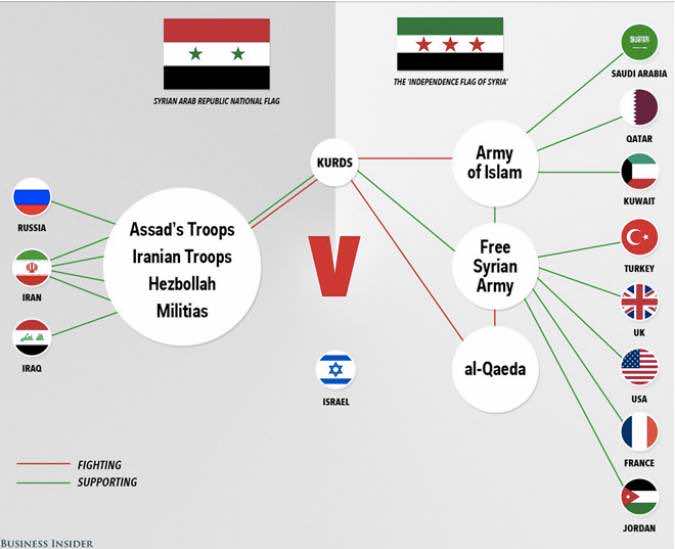
It is fundamental to understand the mechanism of the international system and the roles of the actors with regards to powers in order to understand the policy approaches of these actors towards the Syrian crisis. The crisis in Syria in its third year, has hit the 150,000 casualty mark and remains up to date a very complicated conflict. Brahimi argues that it is now from many ends considered a proxy war, a civil war and a sectarian war. The question of why this crisis that started off as a popular revolt has led to such circumstances arises. I will argue in this paper that Syria has become a sectarian proxy battleground between the Shiite bloc and its supporters (Iran, Syria, Hezbollah and Russia) and the Sunni bloc and its supporters (Gulf Monarchies, Turkey, Jordan, USA).
The waves of the Arab Spring travelled throughout the Arab World. The collapse of Muammar Al Gaddafi, Ben Ali, Ali Abdullah Saleh and Hosni Mubarak did not leave one Arab country untouched. Even the most stable of monarchies such as Jordan and Morocco saw waves of demonstrations and angry protests. In March 2011, social-media planned peaceful demonstrations in Damascus under the slogan of “The Syrian Revolt against Bashar Al Assad” were widespread on the streets. The first wave of demonstrations attracted close to 41,000 demonstrators (Flock).
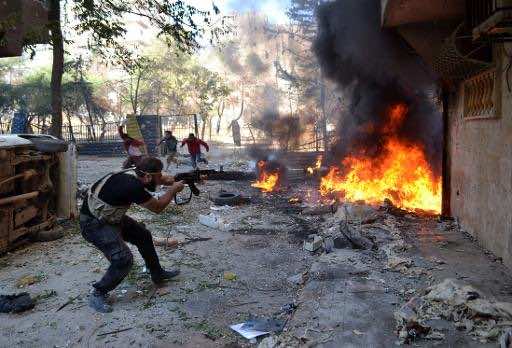
The regime implemented a ban on social media, and monitored all internet activity which resulted in thousands of arrests. Unlike Tunisia and Egypt however, the Military is not an independent body in Syria, and remains loyal to Al Assad. It is from then on that an escalation of violence had occurred, and what had been initially peaceful demonstrations, became an armed conflict between Shiite government forces and proxies, and western backed Sunnite proxies. Not only so, but in Tunisia and Egypt, differing sects came together against the regime, in Syria however, the conflict is becoming a two-sided conflict between a ruling Shiite minority, and Sunni majority.
Sectarian divide has been a subject of attention in Syria since the 20th century. Hafez Al Assad became president of Syria in 1971 when the constitution only permitted for a Sunni muslim to be president (Seale). Al Assad replaced the mandate as soon as he came into power which had led to civil unrest. The Al-Assads have been in power for a staggering 43 years in the Syrian Arab Republic. It is with no surprise that the fall of dictators in Egypt, Tunisia, Yemen and Libya have left many in Syria with inspiration to get rid of the oppressive reign of the Al-Assads.
The beginning of demonstrations resulted in the formation of the Sunnite Free Syrian Army opposition group that decided to hold arms to fight the regime. O’Bagy argues that the Free Syrian Army was plagued with disorganization on and off the battlefield rendering its military operations limited or with no effect against a strong Russian backed Syrian Military. The Free Syrian army however, was not a sole institution, but came under the unification of many Sunnite rebel groups that claimed to be fighting for the Free Syrian Army cause.
Similarly to the Bosnian-Serb conflict, radical Sunnite and Shiite factions were attracted to the battlegrounds to both oppose and support the Assad regime. The escalation of violence quickly attracted other actors into the crisis, all of which are merely involved for self-interest. The Al-Assads along with many senior government officials are of the Alawite faith, a sub-sect of Shiite Islam, which is deemed by extremist Sunnites (such as AL Qaeda and Islamic State of Iraq and the Levant) as infidels. This contributed to reawakening a sectarian conflict that was for long dormant under the shadow of the Arab-Israeli conflict, the Sunnite-Shiite conflict.
Following the collapse of the Soviet Union, the international system became a unipolar system with the United States being the hegemony. The United States was the only superpower with global interests and reach allowing it to impose itself as a predominant force in the military and economic domains, and thus led to the establishment of the Nato Bloc of which Turkey is part of. Ambrosio argues that similarly to the United States’ policy towards the Rwandan genocide, and its acknowledgement of Africa’s complexities, the Middle-East is gradually becoming an extension of Africa in regards to U.S foreign policy. The complexities, costs and casualties faced by the United States in the likes of Iraq and Afghanistan have deemed the Middle-East an unattractive region for them to continue pursuing their interests in the far future, shifting their vested interests towards Eastern Asia. Washington’s strong relations with Israel, however, and its eminent reliance on oil and natural gas forces the United States to remain an actor in the politics of the region in the near future.
The rise of a Shiite Iran after the 1979 Iranian revolution spread fear among the Sunni regional bloc. The breakdown of Saddam Hussein’s strong alliance with the United States to cease Iran’s sectarian agenda in the region saw Iran’s regional role expand. The collapse of Saddam Hussein as president to Iraq left the control of the Iranian agenda in the hands of the United States due to the incompetence of the Gulf Monarchies against Iran (Ambrosio). This allowed Iran to work on its nuclear program, an incentive that would lead to its regional relative hegemony, which if not, does already exist.
Moreover, the Iranian policy towards Israel is very obvious with Iran’s speaker to the parliament’s statement that “Israel is a regional cancer that should be erased” (Benari). The United States’ interests with relation to oil and geopolitical military bases in the Gulf Region saw the establishment of a “uni-bipolar” system in the region, as Ambrosio suggests, a modification to Huntington’s formula, whereas the United States (hegemony) is forced to defend the Sunni Bloc against a threatening Shiite Bloc of Iran, Syria and Hezbollah. The rising of Shiite protestors against the Sunnite Bahraini royal family on an island that hosts the U.S 6th fleet base, has only empowered the presumed regional system, causing major fears among the Gulf Monarchies which witnessed the collapse of Mubarak, a strong US ally. This caused the undermining of U.S regional domination, pushing the Gulf Monarchies to execute different policies, one of which, the proxy game (Ambrosio).
It is no question that the Syrian crisis is a matter of International concern. It is however fundamental to acknowledge that it has transitioned from a popular uprising to a struggle of power between the Shiite and Sunni blocs. The Iranian Islamic Revolution in Iran in 1979 marked the beginning of strong diplomatic relations between Iran and Syria. Both regimes operate on a soviet-like model of government as well as common political policies unified by a similar theocratic approach characterized by Shiite Islam. In addition to so, both regimes have a similar approach towards Israel, a sworn enemy.
Iran views Syria as its only stronghold in the Arab world and its main route to support its proxy army Hezbollah. Hezbollah’s reliance on the Assad regime to acquire military equipment such as Iranian Fateh surface to surface missiles, Russian Yakhont anti-ship missiles, and Russian SA-17 anti-aircraft missiles makes the Assad regimes survival essential for Hezbollah’s military reach (The Meir Amit Intelligence And Terrorism Information Center 2). Hezbollah’s strong military presence in southern Lebanon and strategic proximity to the Golan Heights from within Syria allows Iran to have direct leverage on the west, by its constituted threat on Israel.
The fall of the Assad regime would lead to the weakening of Iranian influence in the region, and can be a direct threat to Hezbollah’s political influence in Lebanon. The main incentive behind Iran’s involvement in Syria is due to its strong feelings towards its fellow Shiite sect. The Iranian involvement in Syria is done through the execution of two strategies according to a report by the Israeli Meir Amit Intelligence and Terrorism Information Center: ” the first, immediate course is intended to prop up the Syrian regime’s ability to survive and continue governing, and entails military, economic, political and propaganda support. The second, planned as both an intermediate and long-term strategy, is intended to make possible for the Shiites and Alawites to defend themselves by founding a popular army, making them important factors in the internal Syrian arena in the post-Assad era” (2).
Iranian involvement in Syria is also attributed to Syria’s containment of sectarian religious venues such as the “Sayeda Zainab” shrine, grand-daughter of Prophet Muhammed, a holy Shiite pilgrimage site. It is reported that Hezbollah and Shiite Abu Fadl Al Abbas Iraqi fighters have secured the previous mentioned venue and continue to do so (The Meir Amit Intelligence And Terrorism Information Center 2).
All in all however, Hezbollah’s quantitative and qualitative involvement is considered primary by political analysts, and is deemed to be positively correlated with the increased threat on the Syrian regime. It is therefore well obvious that the parallel ideologies, interests and identities of the Syrian and Iranian regimes have fuelled the strong relations between Damascus and Tehran in the on-going Syrian crisis (The Meir Amit Intelligence And Terrorism Information Center 2).
To Be Continued …
The views expressed in this article are the author’s own and do not necessarily reflect Morocco World News’ editorial policy
© Morocco World News. All Rights Reserved. This material may not be published, rewritten or redistributed