Rabat – To end unrest in the Rif, a victim of a century of state marginalization and oppression, the government must adopt an inclusive, dialogue-based, and well-researched development program, bringing the Al Hoceima region out of its deeply-rooted poverty.
During the 1912-1956 colonial protectorate, France, for the purpose of domination, had divided Morocco into two parts: Maroc Utile (“Useful Morocco”), made of coastal commercial centers, rich agricultural plains, and areas with mineral wealth, and Maroc Inutile (literally “Use-less Morocco”), that of rugged mountains, rural plateaus and scorching desert territories. This subdivision coincided greatly with an older one: bled l-makhzen (“land under government control”) and bled siba (“land of dissidence”). This second area consisted the poor regions of the Amazigh/Berbers who refused to pay taxes to the central government out of poverty but recognized his religious mantle as the emir al mu’minin (“Commander of the faithful”).
After independence, this subdivision persisted. Today one can distinguish between two Moroccos that are cruising at two different speeds: a Morocco of the “golden triangle” and a Morocco of the “triangle of despair.” The golden triangle extends from Laayoune in the south to Tangier in the north and Fez in the east. All territories situated outside this triangle make up the world of despair, generally the Amazigh/Berber lands, lacking badly resources and infrastructure.
Since independence the government has clumsily and irresponsibly directed all investments, national or international, towards the golden triangle, creating multiple possibilities of work and therefore much wealth and well-being. On the other hand, outside of this triangle, the idle youth is in total despair and families are crushed by poverty and lack of means. As a result, they are full of anger and hate towards the establishment for their lot, which they consider a form of humiliation (Hogra) resulting from lack of interest in them and in their plight.
The drop that over-spilled the vase
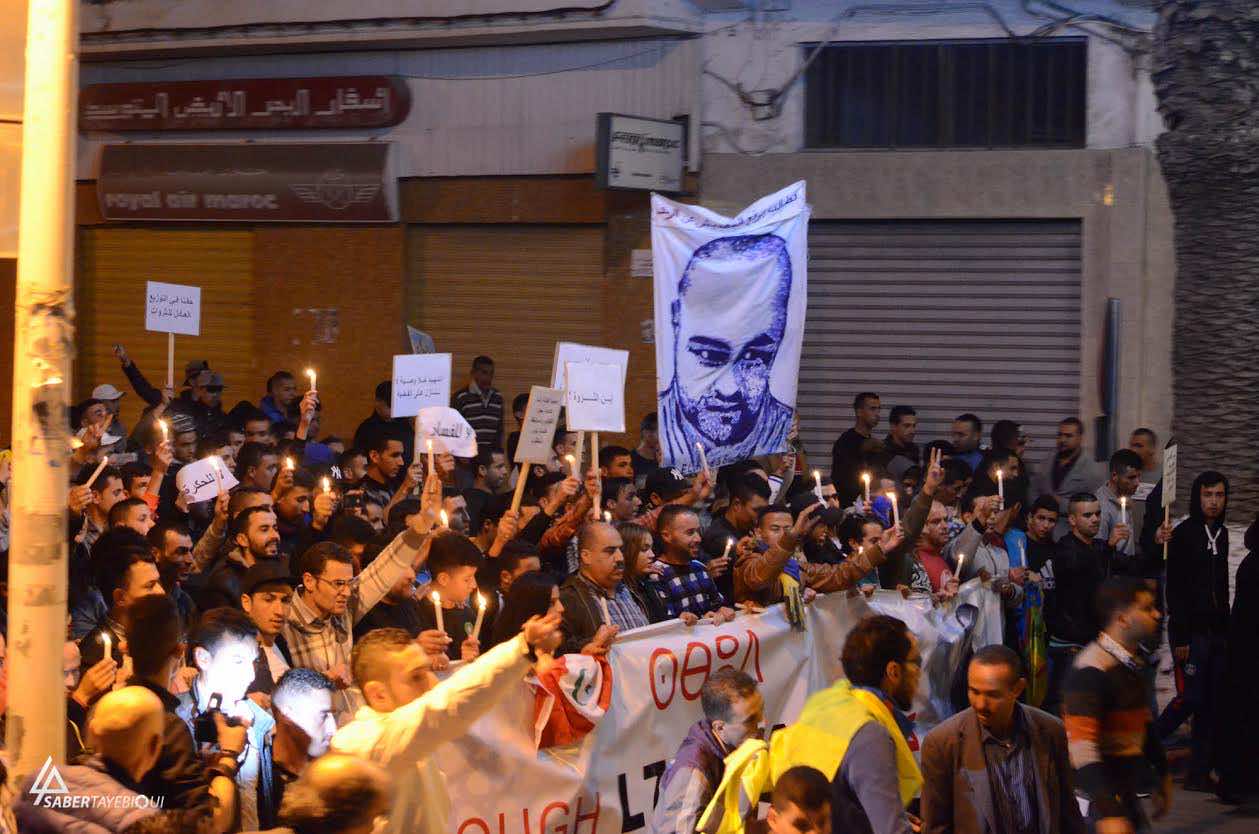
The emotional earthquake that shook Morocco on October 30, 2016 following the death of Mohcine Fikri was undoubtedly a very dangerous event for the future of the country. The political class and the establishment must have drawn the necessary lessons for the future of the country, then. Today, it must be said that the future is very bleak and the so-called “Moroccan exception,” if any, is in great danger of extinction.
The Hirak of the Rif is the natural outcome of the discontent of the Moroccan “triangle of despair” in its totality. The events of Alhoceima could be, to be clear, the Moroccan spring in the making, unless the demands of the population are met at once. This popular movement has exposed the precariousness of the Amazigh/Berbers and the reality of the political game in Morocco. The political parties have all been co-opted by the Makhzen and, as a result, have lost their political “virginity” in the eyes of the population. The people themselves have thus become the legitimate and real opposition on the ground because nature does not like void, and so they went down to the streets to defend their dignity and safeguard their interests and shout out their doldrums and voice their discontent.
The Hirak of the Rif is peaceful and legitimate. The state must imperatively take charge of it: listening, dialogue, intermediation and reactivity and mute the calls of security sirens who want to demonize the protesters and push Morocco into uncertainty. Morocco is a country of dialogue and the middle ground, but it is going very badly now and the monarchy, as in the past, has to put itself at the bedside of the sick poor to nurse them back to good health.
In Morocco today there are two distinct classes: the rich, which is made up of politicians, industrialists, financiers, rentiers, and bourgeoisie, rich as Croesus, and the ordinary people, the grassroots and the destitute who live from day to day in total poverty. A middle class serving as a “shock absorber” between the rich and the poor disappeared from the Moroccan social scene a long time ago.
The fear haunting the people is unemployment and humiliation (7ogra).
During their many electoral campaigns, the PJD and the rest of the political parties make hollow promises to the common people to provide ample employment for them synonymous with dignity.
Generally, all Moroccan political parties make promises without basing themselves on previous planning, scientific studies or academic research. In short, Moroccan political parties have no economic strategy or other program and cannot create the jobs so needed and desired by people to survive in a savage and inhuman liberal economic system. These parties only have political literature that they update in the run-up to the electoral deadlines, hence their popular strident failure in recent years.
Disappointed of the performance of Moroccan political parties, the people do not even deign to vote; the October 7, 2016 general elections saw a 57 percent rate of abstention. This abstention, however, does not address in any case the perpetual complaints of the Moroccan people who suffer of poverty and lack of opportunity.
What to do?
The Hirak is a social and economic protest movement brandishing a legitimate list of grievances of an Amazigh/Berber region battered by political and economic marginalization, but it is also a time bomb that could explode at any moment and destabilize the region, if not the whole country, and initiate the second wave of the Arab Spring.
The people of the Rif are unionists and not separatists. They are proud of their Moroccan identity, no doubt about that. The Ait Ouriaghel tribe defeated Spain under Ben Abdelkrim al-Khattabi over the years 1921-1926, for the greatness of Morocco and the Gzennaya tribe defeated France in the “Triangle of Death” in October 1955, for the country’s independence and the end of the protectorate.
Unfortunately, in spite of the great services rendered to the nation by the Rif region, it was marginalized by Rabat because it had wounded Hassan II in his ego and his own self love, so much so that he had forgotten that he was the king of all Morocco before being the citizen Hassan Ben Mohammed.
To avoid a general explosion and domino effect of the Al Hoceima protest, it is essential to undertake the following steps urgently:
Short term:
- Urgent Royal intervention to defuse the Hirak time bomb
- All-out dialogue with the Hirak and the Rif in its totality
- Adopt a Marshall Plan-like economic package for the Rif
- Establish a think tank of researchers and intellectuals from the Rif to provide the necessary studies on the region (sociology, anthropology, culture, economy, tribal identity, etc.), which is poorly understood by the central government
- Create much-needed university campuses in Alhoceima and Nador
- Repatriate the remains of Ben Abdelkrm al-Khattabi from Cairo and give him an official burial and insert his epic history into the textbooks
- Celebrate annually the battles of Anoual and Dhar Aberran
Long-term:
- Create “Mountain Provinces” in the mountainous regions of the country, with a special budget to undertake equitable regional development
- Create a research center for the development of deep Morocco (the “triangle of despair”)
- Make deep Morocco known at the national level
- Adopt dynamic federalism instead of static regionalism
You can follow Dr. Mohamed Chtatou on Twitter: @Ayurinu
The views and opinions expressed in this article are those of the author and do not represent any institution or entity.
© Morocco World News. All Rights Reserved. This material may not be published, rewritten or redistributed without permission.