 Join on WhatsApp
 Join on Telegram
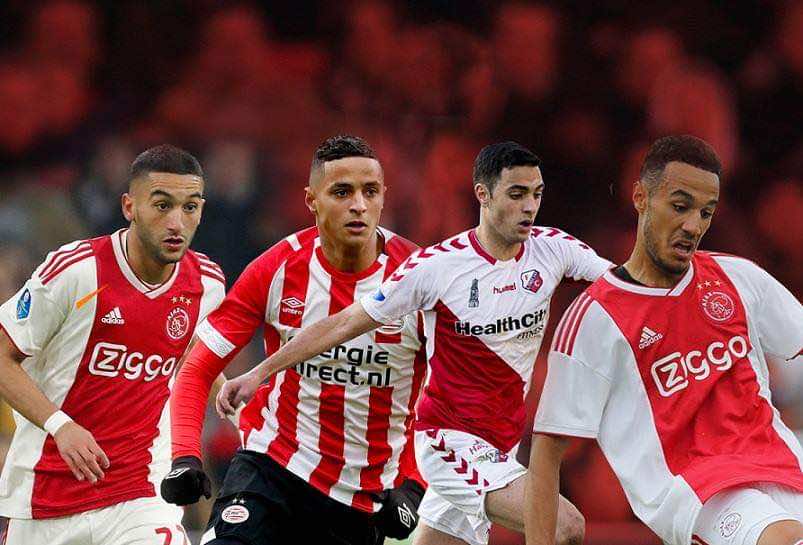
Rabat – Promising footballer Mohammed Ihattaren, born in the Netherlands to Moroccan parents, faces the difficult choice of choosing between the Netherlands’ national football team or Morocco’s Atlas Lions.
Having started his professional career with Dutch side PSV Eindhoven and quickly established himself as “one of Netherlands biggest talents,” Football Oranje reported recently, the 17-year-old Ihattaren is currently the center of “a tug of war” between the Atlas Lions and the Netherlands’ Oranje.
For both teams, the young player could bring dividends to their dreams of prospective glory. Ihattaren, who currently plays for the Dutch under-19 team, can still choose to switch to Morocco for his senior international career.
Choosing between two ‘homes’
According to numerous reports from Moroccan sources, the Royal Moroccan Football Federation (FRMF) hopes to convince him to opt for Morocco.
FRMF’s “mission” is to compel Ihattaren to be part of the dream team competing at the upcoming Africa Cup of Nations (CAN) in June.
Depending on their political affiliations, Dutch media outlets frame the issue from different angles. More liberal-leaning observers often query about whether the problem is with the Dutch football team or society.
Questions of allegiance are bound to be raised and fingers pointed at Ihattaren’s potential “disloyalty” to his country of birth.
The underlying assumption of such considerations generally has to do with the waning glory of the Dutch national squad.
Maybe after all, playing for the Oranje, as the Dutch team is called, is no longer as compelling as it once was, when the Netherlands graciously and confidently swaggered through the footballing world. Not long ago, the Oranje could take on the world’s reigning champions and make them look like amateurs.
Liberal outlets sometimes note the discomfiting looks and phrases that Dutch players of migrant background encounter on a daily basis. The discomfort tends to influence their career-defining choices.
In more right-leaning networks, meantime, questions are bound to be raised of the degree of nationalist or patriotic attachment from “those children of immigrants” who, after reaping all the benefits the Netherlands had to offer, such as education and state-of-the-art sporting facilities, end up opting for their country of origin.
Patriotism is questioned, multiculturalism caricatured, and questions asked as to why the country should keep investing in people of doubtful commitment. People, elated and angry right-wing critics often point out of these players, whose hearts beat for places miles away from the Dutch academies where they spent their formative years.
Identity matters
While it is unclear which side Ihattaren will pledge allegiance to, choosing Morocco would not be as much of a surprise as it would years ago when elite players were more interested in career advancement than in identity or belonging.
Increasingly, choosing origin countries over birth countries has become a routine, a rapid reversal of situations as more Moroccans with dual nationality in Europe feel some missing links in their sense of attachment and belonging.
“The Netherlands I love you; Italy I love you; America I love you; Porto Rico I love you. But I love Morocco the most,” heavyweight legend Badr Hari shouted after securing a major victory in March 2018.
At the 2018 World Cup in Russia, the Atlas Lions’ lineup featured 17 foreign-born players, including 5 Dutch-born.
Reporting on FRMF’s successful campaign in winning the hearts of foreign-born Moroccan talents, the New York Times dismissively wrote that Morocco’s team was essentially an “imported” squad.
The country’s recent successes on the pitch, which some commentators have likened to a renaissance, boil down to the contribution of “players born outside the country and forged in the academies of clubs and national associations scattered across Europe,” according to the Times’ report.
For the Russian World Cup, Morocco’s Dutch importees notably included Hakim Ziyech; Noussair Mazraoui; and the Amrabat brothers, Nordin and Sofyan.
As an increasing number of Moroccans switch their allegiance in favor of the Atlas Lions, Moroccan Netherlands-residing columnist Fouad Laroui remarked recently, the Dutch are surprised and “keep asking ‘but why?’”
Laroui gave the example of Mazraoui, who in 2018 faced a forest of questions from the Dutch media demanding that he justify his decision to choose Morocco over the Netherlands.
Mazraoui declined to pick sides, saying he felt attached to both countries. Upon insistence from interviewers, however, the Ajax player said, “I really like the Netherlands. But since it appears I have to choose, I would go with Morocco.”
Reaction to populism
Beneath the simple-looking move of opting for Morocco, Ihattaren, Ziyech, Mazraoui, the Amrabats, and all foreign-born choosing their origin countries constitute in large part a reaction to a growing pattern: Surging populism and the tense debate about identity and patriotism in a number of Western countries.
Even the Times’ article conceded, albeit marginally, that Europe’s resurgent nativism and nationalism is driving many children of migrants to question their countries’ comfort with having them around.
On the streets, on public transport, and even in stadiums while watching or playing matches, they are constantly reminded that they do not really belong there and that their religious and cultural way of life is not welcome.
When times are rough and the goals are not coming for national teams, players from minority backgrounds take the brunt of the criticism. The racism and Islamophobia-saturated breakup between Mesut Ozil and German football after Germany’s 2018 World Cup fiasco is a textbook example.
In the blink of an eye, the majority of German fans and footballing authorities forgot that Ozil, whose parents came from Turkey, was one of the most defining faces of Germany’s dominance in the world of football in 2014.
After winning the World Cup in July 2018, France’s Africans and Arabs-filled team was celebrated and given the highest of French national accolades.
Many French were quick to opine that the success of Les Bleus, as the team is nicknamed, spoke volumes about France’s successful integration model.
But that World Cup euphoria stood in stark contrast with Les Bleus’ World Cup fiasco in South Africa in 2010. Reacting to a poor performance from Les Bleus in 2010, rightwing philosopher Alain Finkielkraut went as far as suggesting that the players, in majority of migrant backgrounds, were “arrogant and unintelligent thieves with mafia morals.”
Listening to the heart
In origin countries, meanwhile, players feel valued, celebrated, and welcome. Their mistakes are forgotten, or at least tolerated, because no one questions which country their hearts beat for.
In Russia, Morocco lost its first match against Iran. Many had predicted an easy win for the Moroccan Lions. But the game’s only goal was a last-minute own goal by Moroccan striker Aziz Bouhaddouz.
After the game, Bouhaddouz’s error was marginally discussed in the Moroccan media. In fact, rather than humiliate the visibly distraught player, Moroccan fans sent supportive messages. “Mistakes happen to everyone. We are proud of you,” a number of Moroccans wrote.
Such occurrences increase the connection and deep emotional attachment that players already felt.
Families also help in making the difficult choice as parents often dream of seeing their children play for their origin countries. However, the underlying politics of shifting allegiances, in the minds of many elite players, comes down to the daily reminders that identity matters.
“I think with the heart, and the heart was for Morocco,” the New York Times quoted winger Mimoun Mahi explaining his decision to ditch Oranje for Morocco’s Atlas Lions.
Ahead of a continental trophy that Moroccans dream of lifting after decades of underwhelming continental displays, many Moroccan fans and footballing authorities hope that Ihattaren and other talents will, too, listen to their hearts.