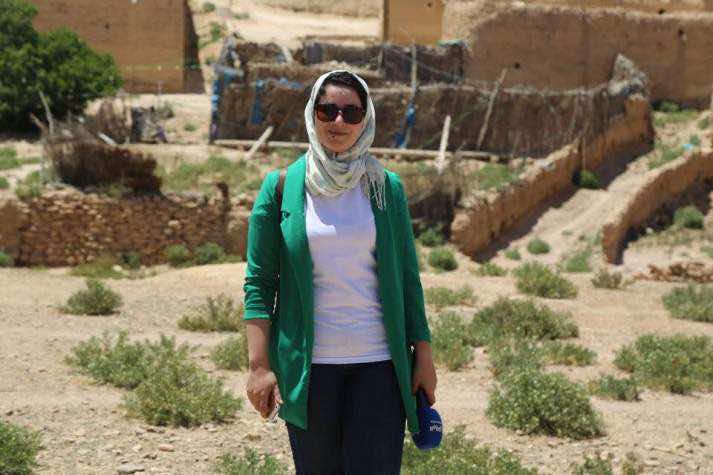
Rabat – Five days after Hajar Raissouni’s arrest, on August 31, new evidence has emerged causing more controversy around the case. A medical report, signed by Dr. Samir Bargach from Rabat’s Ibn-Sina Hospital, confirms that Raissouni underwent an abortion.
Additionally, the medical report claims that this pregnancy and abortion was not Raissouni’s first. According to the report she had undergone a previous abortion six months prior to the alleged procedure that prompted her arrest.
However, newspaper Akhbar Al Yaoum, Raissouni’s employer, drew attention to inconsistencies within the report. According to the medical report, “there is no trace of a tenaculum being used on Hajar’s uterus”. However, the newspaper noted that “abortion is impossible without the use of a tenaculum”.
The new evidence will be presented in the next hearing session, on September 9. Until then, Raissouni, along with the other defendants in the case, will remain in custody.
Raissouni’s arrest dates back to Saturday, August 31. According to Raissouni’s narrative, relayed by Akhbar Al Yaoum, six undercover police officers surrounded her and her fiance, a Sudanese researcher and activist, right after they left a gynecologist’s office in Agdal, Rabat.
The police officers then proceeded to take them both back to the doctor’s office, saying that Raissouni had undergone an abortion, which she denies. Raissouni, her fiance, and the medical staff were all arrested on a range of charges related to illegal abortions.
The defense of the doctor mentioned that the medical check-up done on the journalist when in custody proved that she had not undergone an abortion. “Expertise at the University Hospital Ibn-Sina, at the request of the judicial police, confirmed Raissouni’s medical state,” according to Al Yaoum 24.
Online backlash
The arrest of Hajar Raissouni sparked a lot of controversy, with Moroccan people divided on the motives behind the journalist’s arrest.
Some Moroccan internet users have speculated that the charges against Raissouni are based on a “hidden agenda”. Raissouni’s uncle, Ahmed Raissouni, is the former head of the Movement of Unity and Reform, a branch of the Justice and Development Party (PJD).
The arrest also comes about one year and a half after Taoufik Bouachrine, the founder of Akhbar Al Yaoum where Raissouni works, was arrested for “adultery” and “human trafficking”.
On the other hand, while some Moroccans defend the importance of anti-abortion laws, others believe that it is a personal affair that shouldn’t have been made public in the first place.
Toute l’affaire de #HajarRaissouni me rend dingue, le maroc se transforme en une dictature à la nord-coréenne. Nous sommes d’accord qu’il y a une thérorie du #complot derière cette histoire.
— Stendhalienne (@stendhalienne) September 5, 2019
“The whole case of Hajar Raissouni makes me mad. Morocco is turning into a North Korea style dictatorship. We agree that there is a conspiracy theory behind this story,” posted one twitter user.
Tout mon soutien à #HajarRaissouni, injustement arrêtée pour soit-disant “relations sexuelles hors mariage” et “avortement illégal”. Tout laisse penser qu’il s’agit d’une arrestation politique. S’il vous plaît, lisez ce thread, elle a besoin de soutien. https://t.co/Ga6732Qjgw
— Rachid l’instit (@rachidowsky13) September 4, 2019
“All my support goes to Hajar Raissouni, arrested unjustly for ‘out-of-marriage sex’ and ‘illegal abortion’. Everything leads to think that it is a political arrest.”, commented another twitter user.
Je refuse de savoir si #HajarRaissouni a véritablement subi un IVG ou pas. Je m’en fous de le savoir. C’est sa vie privée. La presse doit pouvoir dénoncer ces pratiques, et parler clairement d’un 2 poids 2 mesures sur l’application de ces lois, à la base très contestées
— Othman Naciri (@othmannaciri) September 5, 2019
“I refuse to know if Hajar Raissouni underwent an abortion or not. I don’t care to know. It is her personal life,” reads a tweet.
Abortion in Morocco
This arrest also reawakened the public debate about abortion laws in Morocco.
It is illegal to carry out an unauthorized abortion as a doctor, and for a pregnant woman to undergo the unauthorized procedure.
However, article 453 of Morocco’s penal code stipulates that abortion is not punishable if it is practiced to preserve the mother’s health in case of a medical threat. In this case, abortion can be openly practiced with the spouse’s authorization.
In 2016, the Moroccan government agreed to legalize abortion in cases of rape, incest, situations where the mother has serious mental health issues, or when the fetus has a serious illness or malformation. However, these changes have not yet been implemented.