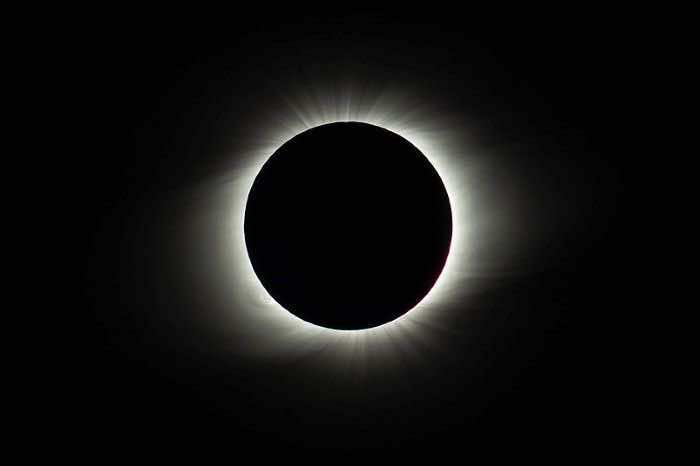
Rabat – With three eclipses happening over Morocco in the summer, Moroccans have a few months to prepare how they will view the important celestial events.
In June and July, Moroccans will experience two “penumbral” lunar eclipses. In a penumbral eclipse, the moon travels through the shadow of the Earth. On June 5, at 8:28 p.m., about half of the moon’s surface will be hidden from a point of view in Marrakech.
One month later, at 4:07 a.m. on July 5, the Earth’s shadow will cover about one quarter of the moon.
Between the two lunar eclipses will be a solar eclipse on June 21, when the moon will block out the light of the sun.
While the total solar eclipse will only be visible on the path of totality between central Africa and southern Asia, much of Morocco will be able to see a partial eclipse at 6:18 a.m.
How you can participate
If you can, travel to the path of totality in June. Those who have experienced a total solar eclipse attest to its tremendously spiritual effect. Although Moroccans will only be able to see a small part of the sun being blocked from their own balconies, the path of totality will travel through the Congo, South Sudan, and Ethiopia.
Enough proactive planning could give Moroccans the experience of a lifetime in June.
In the path of totality, while the sun’s rays that can do the most harm to the human eye are shielded, you can observe the remarkable activity of the sun’s surface. Observers can see unique events such as solar prominences and coronal mass ejections during a total solar eclipse.
Of course, it is never safe to view a solar eclipse without proper eye protection.
What does an eclipse look like?
In a lunar eclipse, the Earth passes between the sun and the moon, and the Earth’s mass casts a shadow across the surface of the moon, seeming to consume it.

When instead the moon comes between the sun and the Earth, our orbiting moon seems to overpower the glowing face of the sun as it blocks out some or all of its powerful rays in a solar eclipse. Depending on the distance between Earth and the moon at the time of eclipse, the diameter of the moon may be large enough to cover one’s entire view of the sun despite its relatively small size.
Only a miniscule fraction of the world is lucky enough to be within the path of totality of any given total eclipse. That is because the point where the moon’s umbra shadow hits earth is very small at any given time.
In the path of totality, however, eclipse viewers are able to experience the out-of-body experience that is watching the moon turn the sky to black in the middle of the day. There, too, is the only place where the sun’s corona can be seen uninhibited.
Read also: ‘Rely on Your Instincts’: Scientist Kamal Oudrhiri at Moonshot Morocco
What have eclipses taught us?
The nature and meaning of eclipses have been studied for thousands of years, with remarkable evidence dating back to the configuration of Stonehenge itself. Astrologists have been using observational comparisons and calculations between celestial objects to refine humankind’s understanding of the universe since before written language.
Modern revelations during eclipse study have been a result of specific observation of the sun’s corona, its outer gaseous atmosphere, which can only be seen during total solar eclipses. Only when the moon totally blocks the sun’s harmful-to-the-eye direct rays is the corona visible.
Solar eclipses allow people to study elements and their behavior in conditions scientists cannot safely recreate on earth: The extreme heat and density of the sun.
By watching the corona through a spectroscope, an instrument that splits light rays into their elemental color spectrum, French astronomer Pierre Jules Cesar discovered helium in 1868. Helium is tremendously important to humanity’s understanding of the properties of both the sun and the Earth, as it was found in radioactive rocks on earth 27 years later.
Another tremendous accomplishment of studying eclipses was the verification of scientist Albert Einstein’s famous theory of general relativity. The theory suggested the gravitational fields of celestial objects actually alter the pathways of light from space that people see by twice as much as scientists had previously thought.
Confirming Einstein’s accuracy allowed modern astronomers to tune the scope they used to view objects with to much more accurately identify their location in space!
The progress that has arisen from studying solar eclipses has not been limited to major scientific epiphanies. Astronomers have also refined their knowledge of values such as the temperature of the sun, the distance to the moon, and the velocity of solar wind.
The impact of human error in understanding the universe
Astronomers both amateur and professional have been inhibited by the precision of available technology throughout history. Those who assembled Stonehenge did not have the telescopes of Galileo’s age to extend their eyesight into the ether. As technologies have developed, people have more sharply pinpointed relationships between celestial bodies’ properties, along with human understanding of Earth’s position in the universe.
Scientists are constantly learning new things from eclipses. They have more finely determined the distance from Earth to both the moon and the sun by gradually eliminating estimations. People learned that the active corona atmosphere seen during solar eclipses actually belongs to the sun, not the moon, as Johannes Kepler mistakenly predicted in 1605.
Humanity has also learned from more obvious mistakes, too.
In 1879, a team of American astronomers “discovered” a new planet between Mercury and the sun that would supposedly account for Mercury’s irregular orbit around the sun. It was not until 40 years later that scientists found a more valid explanation of Mercury’s uniqueness in the verification of Einstein’s general relativity. The planet Vulcan lived an imaginary life for four decades.
With persistent individual observation and challenging of the astronomical values people have accepted, the world will continue to learn about Earth’s relationship to the components of the universe. And today, scientists have more advanced technology to do so than they ever have before.
Read also: Red Moon: Morocco to Witness the Longest Eclipse of the Century Tonight