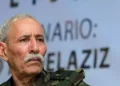
Algerian President Abdelmajid Tebboune has allegedly taken back control of the Western Sahara file from the military, reports Spanish newspaper Atalayar.
In a bid to change the power dynamics within Algeria, the president has decided to remove certain powers from the Algerian military, including the historic military influence over foreign policy and intelligence.
The president has launched a new agency, the Algerian Agency for International Cooperation (AACI), to take over certain responsibilities and powers traditionally held by the military, including the Western Sahara file.
The agency, according to Atalayar newspaper, aims to develop “conditions so that Western Sahara and the political and strategic crisis in the Maghreb region become the prerogative of the Presidency of the Republic.”
Algeria’s military has controlled foreign policy in the North African country since before its independence in 1962. The Liberation Army (ELN) and later the National Popular Army (ANP) have retained control of Algeria’s Western Sahara policy since the file was first opened in 1975.
The new AACI will be headed by Colonel Chafik Mesbah. Tebboune’s decision to name Mesbah as AACI chief raises a number of questions.
Mesbah is a highly educated polyglot who served in the Algerian secret services for 20 years and retains links with the military and the intelligence service.
The colonel, however, is a well known anti-Abdelaziz Bouteflika voice and condemned the Bouteflika regime throughout his career, potentially making him more palatable to Algerians still calling for political change.
Protests against the Bouteflika regime began in February 2019 when the ousted president announced his intent to run for a fifth term of office. Demonstrators took to the streets, calling for a complete political overhaul.
Bouteflika stepped down and several public figures and politicians faced prosecution for corruption, but the Algerian people were not content.
Abdelmajid Tebboune, a former Prime Minister who Bouteflika sacked after three months in office, became president in December 2019 to a mixed reception. Though some Algerians were ready to settle down to stability with the new president, others felt that the change was not enough and that Tebboune was just another side of the same coin.
While Tebboune’s choice for AACI chief could signal an overhaul in both foreign and domestic policy, it could equally signal nothing more than a facelift with the traditional power dynamics and policies continuing unchanged.
So, what does this mean for Western Sahara?
Since 1975, Algeria has backed the independence claims of the self-proclaimed Sahrawi Arab Democratic Republic (SADR) in direct opposition to Morocco’s position on the conflict.
Algeria provides arms and funding to the Polisario Front, the breakaway group that runs the Tindouf Camps in Algeria, and consistently advocates for the group.
Despite its involvement with the breakaway group, Algeria styles itself as an observer and refuses to engage in the United Nations-led peace process as an active party to the conflict.
In the eyes of the world, however, Algeria’s position is clear.
UN Security Council Resolution 2494 of October 2019 references Algeria five times: Three times in the preamble and twice in operative paragraphs.
The text of the resolution outlines the need for Algeria to assume responsibility in the conflict and to engage in the political process as a main party and not an observer.
In recent months, Moroccan diplomacy has made significant progress in the case. A number of countries, including several traditional Polisario allies, have revoked recognition from the self-proclaimed SADR and the strength of support for Morocco’s Autonomy Plan as a practical and fair solution to the conflict continues to grow.
In November 2019 a blow came to the Polisario and its backers in the form of a report in the Wall Street Journal. The article quoted a US official who said Washington would never support the creation of a state in southern Morocco.
Then, as if to heap more woes on the Polisario, a slew of African nations began to open diplomatic missions in Laayoune and Dakhla, Moroccan cities in Western Sahara, in a move to cement Morocco’s recent diplomatic gains.
Liberia, Guinea, the Gambia, and Djibouti have all opened consulates in Dakhla, while Laayoune plays host to diplomatic missions from the Comoros, Gabon, Sao Tome and Principe, the Central African Republic, Cote d’Ivoire, and Burundi.
Algeria, under the leadership of Tebboune, continues to openly oppose Morocco’s sovereignty over the region, releasing regular hostile statements questioning the validity of the diplomatic missions and, through them, Morocco’s territorial integrity.
“This measure of exceptional gravity represents a flagrant violation of the norms of international law… It represents an attack on the rules and principles that should govern inter-African relations,” the Algerian Foreign Ministry said on the opening of the Comoros consulate.
After Cote d’Ivoire opened its consulate in Laayoune on February 18, Algeria recalled its ambassador from Cote d’Ivoire “for consultation.”
The Ivorian Foreign Minister, however, said the opening of the consulate was a “sovereign act.”
“In foreign policy, as in other fields, we are careful not to give moral lessons, nor do we want to be told what to do or not to do,” he remarked in response to the Algerian move.
While Algeria’s recent statements and hostile moves do make the question of a rapprochement between Algiers and Rabat seem unlikely, it is possible that the weight of international opinion may yet sway the Algerian president and the new AACI could serve as a vehicle for a u-turn on Western Sahara policy.
Morocco extends the hand of friendship
The frosty relations between Morocco and Algeria are not all, on the surface, Western Sahara-related.
In 1994, Morocco introduced visa requirements for Algerians after police found that Algerian terrorists led the bombing at the Atlas Asni Hotel in Marrakech.
Algeria responded to Morocco’s decision with the official closure of the borders.
Although Morocco lifted the visa requirement for Algerians in 2004, the borders remained closed.
Morocco’s King Mohammed VI has stretched out the hand of friendship to Algeria on a number of occasions since the border closure and subsequent reopening, making it clear that the country is open to normalizing diplomatic ties and even potentially reopening the borders between the neighboring countries.
The Moroccan monarch sent a message of “heartfelt congratulations” to Tebboune on his election. The cable also called for “new page in relations between the two neighboring countries, based on mutual trust and constructive dialogue.”
The message to Tebboune was not the first olive branch King Mohammed offered Algeria.
In November 2018, the King said Morocco was ready to engage in a frank and serious dialogue with Algeria to break the “political stalemate between Rabat and Algiers, to restore full diplomatic ties, and to reopen the borders between the two countries.”
Tebboune, however, was less open to the idea of a rapprochement.
“There have been events that have caused the borders to close [between Algeria and Morocco]. In my opinion, the main cause of the conflict must be removed and everything else will follow,” he said in December 2019
The Algerian president added that he is “extremely sensitive when it comes to national sovereignty. I forgive no one for interfering or for harming our sovereignty.”
While Tebboune’s apparent unwillingness to engage in dialogue with Morocco, the Algerian foreign ministry’s open opposition to the inauguration of diplomatic missions in Dakhla and Laayoune, and Algeria’s ongoing support for the Polisario make the prospect of a Algiers-Rabat rapprochement seem a distant dream, the launch of the AAIC could still signal a move in the right direction.
Taking back control of the Western Sahara file from the military and launching a new age for Algerian foreign policy could very well be a public relations stunt designed to reflect a shift in power dynamics, but a tangible change in outlook and policy could still follow the facelift and opportunities for Morocco-Algeria relations could still emerge.
Read also: Morocco Won’t Trade Palestine for US Support in Western Sahara