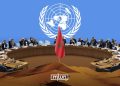
Rabat – The Moroccan Minister of Foreign Affairs, Nasser Bourita, called for the creation of an Arab task force in support of the international efforts to settle the Libyan crisis, namely the 2015 Skhirat agreement.
Bourita presented the proposition on Tuesday, June 23 at the emergency Arab League meeting held at the request of Egypt.
The FM emphasized the importance of opening up the process to all parties to Libya’s conflict for consultation and to bring “their views closer.”
The proposals “open a path that can be followed to contribute to the settlement.”
The Moroccan diplomat stressed the importance of the 2015 Skhirat agreement as the basis to end the Libya crisis.
He indicated the agreement should not be abandoned, especially as there is no viable alternative in place.
“Can the Skhirat Agreement be skipped without an alternative, which would receive at least the same degree of Libyan and international support, knowing that this agreement contains provisions that have become overrun and need to be updated?”
The official warned that sidelining the agreement would pose a serious challenge, as the parties involved “derive their legitimacy” from the Skhirat agreement.
Bourita also recalled Morocco’s approach to the Libyan conflict based on universal aims to preserve the national cohesion of the Libyan people and the country’s territorial integrity and sovereignty.
He also said the country rejects any direct international intervention, including direct Arab intervention in the region.
Foreign intervention could facilitate terrorism in the region
In terms of diplomatic efforts, “Morocco welcomes any efforts or initiatives that are aimed at bringing Libyans closer and pushing for a solution to the crisis that has lasted for nine years,” he concluded.
At the end of the meeting, the Arab League Council reiterated “full support” for the Libyan political agreement signed in Skhirat between Libyan parties in December 2015.
The Arab foreign affairs ministers participating in the virtual meeting stressed the importance of “commitment to the unity, sovereignty, territorial integrity, national integrity, stability and welfare” of the country’s population.
The council also rejected foreign intervention of any kind as it would “facilitate [the] traveling of extremist fighters and foreign terrorists to Libya.”
Foreign intervention would also breach international resolutions.
A political settlement engaging all parties to the Libyan conflict is the “only solution to regain security and stability in the region and to combat terrorism,” the council said, sharing “serious concerns.”
“The external military escalation exacerbates the crisis in Libya and threatens the security and stability of the region as a whole, including the Mediterranean region.”
Like Morocco, the council supports the centrality of the UN-led political process to find a solution for the conflict.
The emergency meeting comes in an escalating context after Egypt’s latest threats of “direct intervention” in Libya, citing the importance of preserving Egypt’s national security.
Last week, Egyptian President Abdel Fattah El Sisi warned that if forces supporting the UN-recognized Government of National Accord (GNA) “advanced on the strategic city of Sirte – some 450 kilometers east of the capital Tripoli – it could provoke a ‘direct’ intervention by Cairo,’” Al Jazeera reported.
Al Sisi ordered the country’s soldiers to be ready to intervene inside and outside of the country to protect its borders, criticizing Turkey’s intervention in Libya.
GNA issued a statement to decry Egypt’s comments, stating that Cairo’s move was a “hostile act and direct interference, and amounts to a declaration of war.”
The party said whatever the dispute between Libyan factions, “we will not allow our people to be insulted or threatened.”
Morocco has long reiterated the centrality of the Skhirat agreement. Bourita recalled Morocco’s steadfast position on the matter during a June 7 phone conversation with the Minister of Foreign Affairs of Libya in GNA, Mohamed Taher Siala.
During the phone conversation, Bourita said the political agreement signed in the Moroccan city of Skhirat is the main reference for any political solution for the Libyan crisis.