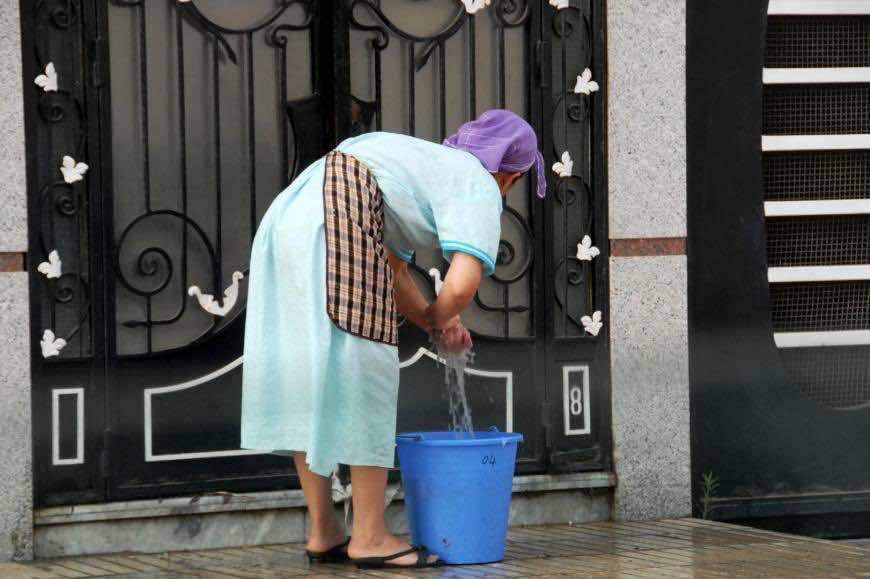
Morocco’s Law 19-12, regulating the work of domestic workers, went into effect in October 2018. The legal text provides domestic workers with the right to have an employment contract. It also requires employers to register the workers with the National Social Security Fund (CNSS).
However, two years after Law 19-12 went into effect, the number of domestic workers who benefit from the legal text’s advantages remains very limited.
Minister of Labor Mohamed Amekraz announced that, as of August 2020, approximately 2,574 domestic workers have a contract with their employers and 2,228 are registered with CNSS.
While there is no accurate census of domestic workers in Morocco, estimates of their number are much higher than the figures the minister presented. Thousands of domestic workers across the country are still working informally and do not benefit from basic labor rights, such as paid leaves or medical insurance.
While some employers could be deliberately exploiting the informal setting to avoid paying taxes and social contributions, others might simply be unaware of the administrative procedure they need to follow to register their workers with CNSS.
This guide presents the main steps employers in Morocco must follow to protect the rights of their domestic workers.
Step 1: Employment contract
The first step is the signature of an employment contract between the domestic worker and their employer. The contract must fit several criteria to become formal. CNSS provides a template for the contract on their website’s download page, under the domestic workers’ section.
Besides personal information about the employer and the domestic worker, the contract must determine a start date and an end date, if the position is not permanent. It must also include the nature of work the domestic worker will provide, the duration of their trial period, their weekly working hours, their salary, and their day of rest.
Law 19-12 sets a legal limit for each of the contract’s clauses. The trial period must not exceed 15 days. The weekly working hours must be 48 or fewer for workers more than 18 years old and 40 hours maximum for workers aged 16 to 18. Finally, the salary should not be lower than 60% of Morocco’s Interprofessional Guaranteed Minimum Wage (SMIG), which currently stands at MAD 2,638 ($286) per month.
The contract must contain the notarized signatures of both the employer and the domestic worker. The employer should prepare three copies of the contract, one for themselves, one for the worker, and one for the local labor inspection office.
Step 2: CNSS registration
The second step is the employee’s registration with CNSS. To obtain the right to register domestic workers with CNSS, the employer must submit an application folder that contains several documents.
The required documents include a copy of the employment contract, an application form, a copy of the domestic worker’s identity card and CNSS registration card, a copy of the employer’s identity card and bank details, and the receipt obtained after delivering a copy of the contract to the local labor inspection office.
If the domestic worker has never registered with CNSS prior to this step, the employer must provide additional documents. They include a CNSS registration form, two identity photos of the worker, and a copy of their identity card.
The registration step must take place within one month after the employer and the domestic worker sign their contract. Any delay in the registration could lead to penalties and fines against the employer.
Step 3: Monthly contributions
After registering the domestic worker with CNSS, the employer has to pay monthly contributions. The employer can make the payment online or through a bank transfer. It is also possible to give CNSS authorization to automatically deduct the contributions from the employer’s bank account.
CNSS calculates the contributions based on the salary mentioned in the employment contract. The contributions include family allowances (6.4% of the gross salary), short-term social contributions (1.05%), long-term social contributions (7.93%), medical insurance (2.26%), and a professional training tax (1.6%).
The employer must make the payments before the 10th of every month. Any delay will lead to penalties.
While Law 19-12 represents an important achievement towards preserving the rights of domestic workers in Morocco, its efficiency depends on the engagement of employers and the awareness of laborers.
Morocco’s Ministry of Labor hopes that the number of domestic workers who benefit from legal and social advantages will continue to increase, as both workers and employers become more aware of their rights and obligations.