





























































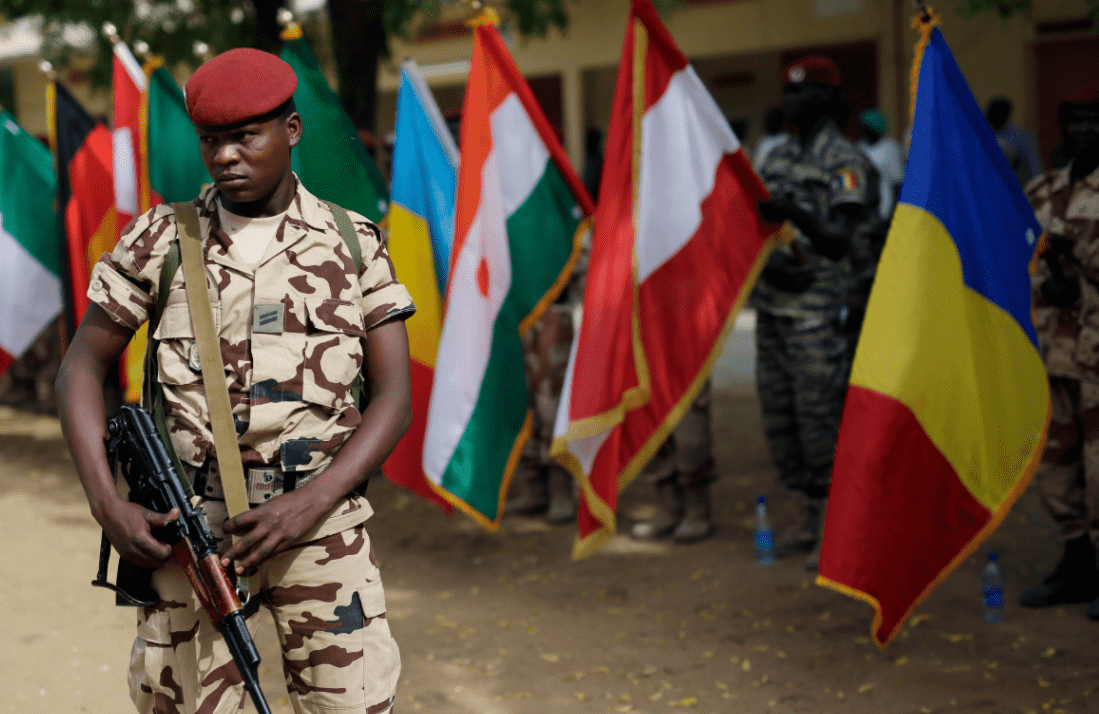
Rabat – Leaders in Chad are ensuring Western powers of its continued cooperation amid a national crisis following the death of its president.
The country of Chad has long struggled with armed insurgents and now faces a battle-hardened rebel force who gained experience fighting for Khalifa Haftar in Libya.
The country’s long-term President Idriss Deby wanted to raise morale among Chad’s troops fighting in the country’s north after retaining the presidency in the April 11 elections, in which he ran virtually unopposed.
Chad’s president likely saw the symbolism in returning to the battlefield in northern Chad, where he had made a name for himself prior to seizing power in 1990. Deby would have become one of the longest-ruling global leaders after winning his sixth term, yet it was not meant to be.
The presidentially-led military operation met with fierce resistance from the rebel force, resulting in severe injuries and the subsequent death of Deby on April 20. The sudden demise of its 30-year ruler plunged the country into a political crisis while its military continued to clash with insurgents on the Chad-Libya border.
Political crisis in Chad
The sudden death of Deby sparked a renewed political crisis in the Chadian capital N’Djamena. Deby’s rule was marked by several attempted coups and threats from foreign-trained forces that leaked through the country’s porous borders.
Chad is a country marked by continued crisis. The country’s political system is weakened by prevalent corruption and a system of patronage and nepotism that has only worsened since the country started producing oil in 2000.
Amid foreign threats and domestic instability, President Idriss Deby provided a sense of continuity and stability for foreign powers with regional ambitions.
That confidence evaporated on April 20, as Deby’s demise left much unclear about who was in charge in N’Djamena, which is the headquarters for France’s 5,000 Sahel-based troops.
Chad’s military leadership has since attempted to project continuity by announcing an 18-month transitional period where a military council will rule the country.
The move raised eyebrows as the announcement came along with the military council suspending the country’s constitution and dissolving both houses of parliament. The council replaced the country’s constitution with a set of military-dictated rules and announced that Derby’s 37-year-old son Mahamat Deby would rule as interim president.
The choice of Deby’s son as interim president is likely a symbolic gesture to the West. An undemocratic and unconstitutional move, the appointment mirrors the West’s long-running support for Chad’s leadership despite its undemocratic practices.
Chad’s strategic importance
Foreign powers’ interest in Chad stems from its strategic location in Africa as well as its colonial ties to France.
Chad borders several countries marked by violence and instability in past decades. To the north lies Libya, where a brutal civil war provided employment and experience for young Chadian men who fought on both sides of the drawn-out conflict.
Chad further borders the lawless regions of northeastern Nigeria where repeated clashes with the Fulani herdsmen and Boko Haram are a constant source of instability. Chad additionally has crisis-ridden Sudan to the east, Niger to the west, and the Central African Republic to the south, with only Cameroon to the southwest enjoying relative stability.
Surrounded by countries in various stages of crisis, Chad’s President Deby used the country’s location to promote its role as a valuable partner of the West. Chad’s colonial links with France have continued post-independence, with the French Barkhane anti-insurgency operation being permanently headquartered in N’Djamena.
For the US, Canada, the UK, and others interested in maintaining a military presence in the Sahel region, Deby was a welcoming host for foreign troops while maintaining a well-trained national army.
Yet, the end of Libya’s bloody civil war meant battle-hardened Chadian soldiers returned south on Chad’s election day on April 11.
They returned as insurgents of the Front for Change and Concord in Chad (FACT). Chad’s military was confronting the invading rebels when an armored vehicle carrying the president was destroyed, according to a FACT commander’s statements to ABC News.
Continued Western partnership
While Western diplomats have emphasized their preference for a constitution-driven transfer of power, in practice it appears the partnership is continuing unabated.
France’s President Emmanuel Macron described Deby’s death as “the loss of a courageous friend” and announced he will attend his funeral. Deby’s death comes following months of increasing French involvement in Chad, including launching direct airstrikes against FACT rebels in direct support of the president amid his reelection campaign.
Chad-expert Marielle Debos told VOA News that “the French launched the airstrikes themselves, and they did not even try to make it seem as if they were not interfering with Chadian politics.”
Observers saw French military support against FACT rebels as France propping up Deby’s regime by helping destroy a threat in the north, which would have theoretically allowed Deby to concentrate his attention on maintaining his 30-year grip on Chad’s presidency.
In the end, France’s neocolonial meddling in Chad could not save Deby, leaving a political void amid a continued crisis on the country’s northern borders. As long as the bulk of Chad’s military is preoccupied fighting rebels in the north, the likelihood of a coup in the capital grows.
Rebels advance on the capital
And so, the US and France announced their continued support for Chad’s new interim president despite the country’s military council’s brash abandonment of Chad’s constitution and legislative branch.
”They remain a committed partner,” US Africa Command announced following Deby’s death. “Chad has lost a great soldier and a President who worked tirelessly for three decades for the security of the country and the stability of the region,” France’s Macron stated.
With FACT rebels advancing deeper into Chad, a new crisis could soon emerge as they approach the capital. The rebels have vowed to march on N’Djamena, yet the political assurances Chad’s military council have given are likely to mean the rebels will face more than domestic forces.
The closer rebels get to the capital, the larger the chance they will face the combined military might of the French and the US as they are likely to once again intervene to prop-up an undemocratic regime that serves Western strategic purposes with little regard to the wishes of the people of Chad.
Western security-oriented experts consider the issue a choice between propping up an undemocratic ruler or “allowing” a rebel force to take over. The option of supporting a true democratic movement in Chad, backed by international support, is remarkably not one of the options under consideration.
This is not Hong Kong, or Myanmar after all, where pro-democracy movements receive daily coverage and support from the West. Instead, Western powers appear acutely aware that more democracy likely means a diminishing of its regional influence in former French Africa.
It appears that once again Western powers choose regional influence in former colonies over a true pursuit of the democratic ideals they espouse. Whether this will save or doom crisis-ridden Chad remains to be seen.