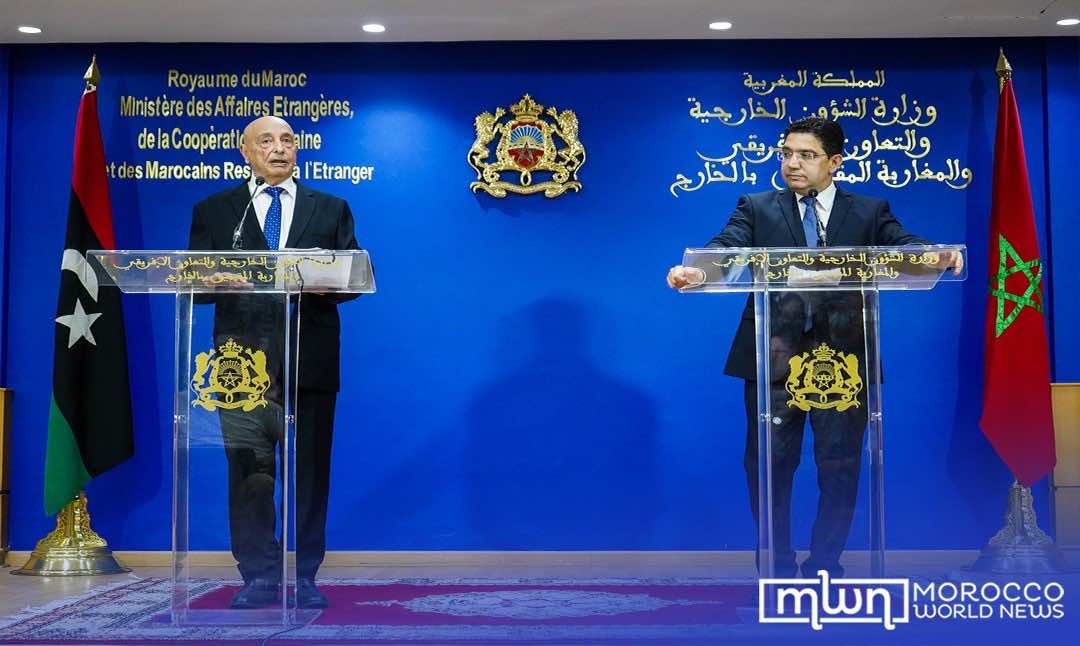
Aguila Saleh, the speaker of Libya’s House of Representatives, visited Morocco today as part of the ongoing bilateral dialogue between Rabat and Tripoli.
Morocco’s Minister of Foreign Affairs Nasser Bourita received Aguila Saleh.
During the meeting, Saleh reiterated Tripoli’s gratitude for Morocco’s unwavering support in working towards a lasting agreement and finding a peaceful solution to the Libyan conflict.
“Morocco is an influential country. It is also following and monitoring the Libyan conflict without personal interest,” Aguila Saleh said in the press conference.
The Libyan politician said that Morocco’s goal is to see the Libyan conflict concluded.
He also warned against parties seeking to hamper upcoming elections in Libya, describing them as “criminals.”
For his part, Bourita also renewed Morocco’s support for lasting peace in Libya.
He highlighted that Morocco’s diplomatic core under royal instructions has engaged in all required efforts to support Libya in finding a solution to its conflict.
He said the stability of Libya is one of Morocco’s primary concerns, saying “Libya’s territorial integrity and stability is important for Morocco.”
In response to questions about whether Morocco received an invitation to the Berlin conference, Bourita said that being invited does not change anything regarding Morocco’s pioneering role in the UN-led political process to help Libyans find a solution to the conflict.
Morocco’s current stance regarding Germany, Bourita added “was not for earning an invitation to the second Berlin conference.”
He said that the question of why Morocco was invited to the first conference but was invited to the second one should be addressed to German officials instead.
Bourita emphasized that Morocco’s support is for one goal: Supporting Libyans to find a solution to the conflict.
UN officials along with Libyan representatives have long expressed satisfaction with Morocco’s support for a solution to the Libya crisis.
Morocco’s government renewed its position earlier in June after the visit of delegations from both Libyan fractions to Rabat.
The speaker of the Libyan High Council of State, Khaled El Mechri, and the speaker of the Libyan House of Representatives, Aguila Saleh Issa, met with Moroccan officials as part of the constant dialogue between both parties.
During the meetings, Moroccan officials renewed Morocco’s commitment and involvement in strengthening dialogue between the Libyan parties to reach a final settlement to the crisis.
Al Mechri emphasized Morocco’s key role, recalling that Rabat’s support has been “decisive in bringing together points of view between the different parties and the outcome of consensus likely to pave the way for a final political settlement of the Libyan crisis.”
Aguila Saleh made similar remarks during his visit to Rabat, commending Morocco’s efforts that, according to him, helped in the formation of a single executive authority consisting of a presidential council and a government of national unity that is now operational in Libya.
In April, US Secretary of State Antony Blinken thanked Morocco for its integral role as a mediator in the Libyan conflict and its commitment to continue to strengthen security in the face of terror threats in North Africa and the Sahel.
The visit from Aguila Saleh comes just one day after the conclusion of the second Berlin conference on Libya.
During the event, political representatives from several countries were invited to Berlin to discuss future solutions to Libya’s conflict.
The concluding sentiment of the event was that the situation in Libya “has improved significantly since the Berlin Conference” that was held in 2020.
The second conference, which Morocco did not attend despite Germany’s invitation, included high representatives from Italy, UK, US, Egypt, France, Algeria , and Tunisia, among others.
Recently, reports emerged about Germany’s invitation to Morocco to attend the second conference this year.
On Wednesday, Secretary Blinken shared a picture on Twitter of the conference room, which included Morocco’s flag among a display of the conference’s participants.
Morocco’s Ministry of Foreign Affairs, however, did not release any statements about the country’s participation in the event.
The final list of participants also did not include Morocco in the list of confirmed attendees.
Last year, Morocco was astonished after its exclusion from the first Berlin conference at a time when it garnered international support for its key role in convening opposing parties in the conflict to a roundtable discussion.
Morocco’s exclusion from the first Berlin conference was one of the reasons the country cited in a statement in May, when it decided to recall its ambassador from Germany.
In the statement, the Moroccan Ministry of Foreign Affairs criticized Germany’s decision to exclude Rabat from the Berlin conference, despite its key role as a mediator in the conflict.
“For all these reasons and due to this constant and unacceptable hostility, the Kingdom of Morocco has decided to recall the Ambassador for His Majesty the King to Berlin for consultation,” the Moroccan ministry argued.