Rabat – North African countries, especially Morocco and Algeria, have seen a dramatic rise in temperatures this summer, resulting in wildfires across the two countries, destroying hundreds of hectares of forest land and killing several people.
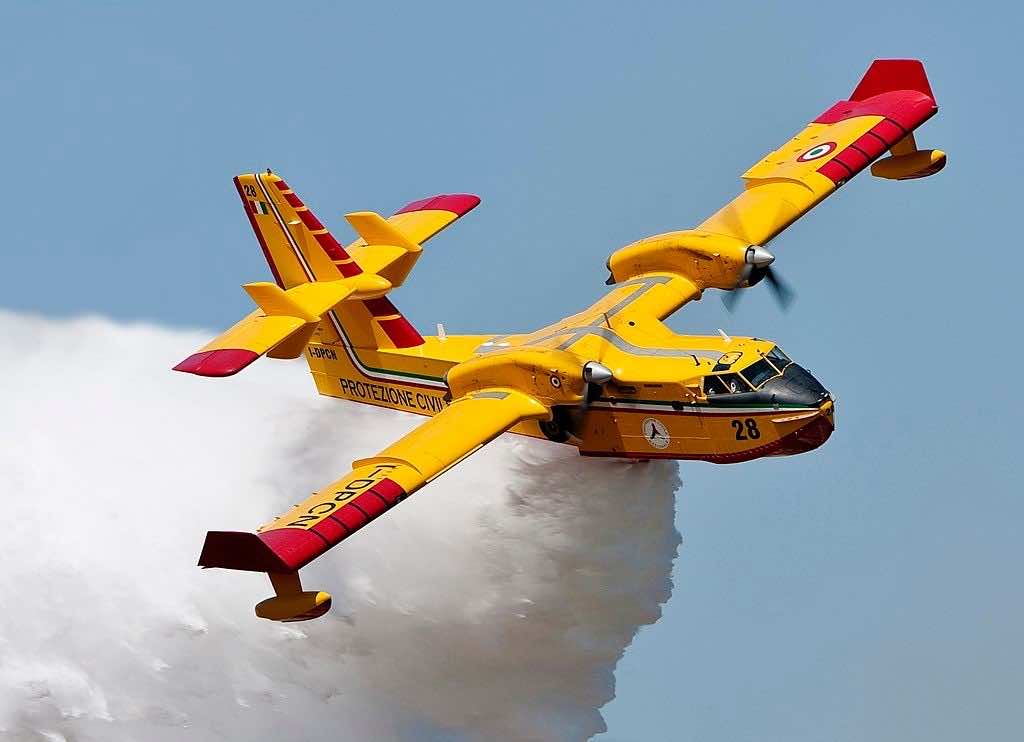
These circumstances are in line with a global trend of rising temperatures and severe climate change, but have brought to light Moroccan efforts to combat the fires, the most significant being the Royal Air Force’s fleet of Canadair CL-415.
The Superscooper: A History and Overview
Canadair (which had been bought out by Bombardier at this point) designed the CL-415 in the early 1990s as a successor to the CL-215, a model of fire extinguishing planes (also known as water bombers) which had been in use since the late 60s at that point.
The aircraft conducted its inaugural flight on December 6, 1993 with the first orders being delivered to carriers a year later.
Bombardier soon started receiving orders for the plane from several countries, and by 1996, 37 aircrafts were operating in Canada, Italy, and other European countries. The Canadian Aerospace manufacturer also announced that it would reveal a six-phase upgrade plan for the aircraft, in an effort to increase its capabilities.
In 2016, Viking Air, another Canadian aircraft manufacturer, announced that it would be acquiring the certificate to manufacture and design improvements to the CL-415, an agreement which went through on October 3, 2016, and saw Viking manufacture an upgraded version of the plane called the CL-515.
Aside from its official model name, the CL-415 is also known as the “Superscooper”, an appropriate name owing to the aircraft’s ability of scooping more than 6,000 liters with an average fill time of only 11 seconds. Since this water is often picked up from natural water reserves, the plane was also constructed with material that can resist corrosion in order to facilitate the use of saltwater.
This capacity, paired with the plane’s improved cockpit and speed, made it an advanced fire fighting “flying boat”, useful for fighting forest fires. Some later iterations of the aircraft, such as the CL-415GR feature even higher capacities and speeds, making them even more useful.
The plane’s capabilities have proved to be useful in other fields as well, as its developers developed multi-role models that can help in search and rescue operations in addition to the original purpose of firefighting.
The CL-415 in Morocco
Out of the 164 disclosed purchases of Canadair’s firefighting aircrafts, Morocco operates 8 as part of the Royal Air Force’s fleet, with three of them being upgraded CL-515 models.
In fact, Morocco has added more of the Canadair planes to its fleet as recently as earlier this August, in a deal that was reportedly worth $162 million (MAD 1.5 billion).
This says something about the continued relevance and usefulness of these planes, especially in the face of the growing threat of wildfires. But what does this fleet mean for Morocco’s position in the fight against climate change, or in regards to its geopolitical position and circumstances?
Nationally of course, this means a better way of fighting the ever-increasing effects of climate change. This year, wildfires consumed more than 200 hectares of forests in the Chefchaouen region, and experts agree that this year’s record-breaking temperatures are only the beginning of the problem.
Of course, the ideal solution to these problems would be preventative, not corrective, but such solutions will take significant coordination on a global level to achieve, and a good case could be made for the argument that it might be too late to prevent all the effects, and that we should start thinking about how to combat them.
It is therefore safe to assume that the coming years will see more incidents similar to the Chefchaouen wildfires, likely on an even bigger scale, and that’s when the fire fighting capabilities of Morocco will be truly tested.
Even with its fleet of Canadair planes, the Moroccan authorities were barely able to fight the fire, and nearby countries have had even bigger wildfires this year, which is likely part of the reason why the Royal Air Force decided to expand its fleet.
A local official said that the recent purchase will help Morocco be more able to mobilize faster to fight similar threats in the future, especially seeing as Morocco has regions that are quite dense with forest land.
Regionally, Morocco’s fire fighting ability has more significant implications, especially with the developments associated with Algeria’s own wildfire troubles.
Climate change and its adverse effects could serve as an incentive for Morocco’s neighbors to cooperate more, as regional and global cooperation will prove essential to control natural disasters at such a scale.
Recently, we saw Morocco’s capability to play a significant role on the regional level when it offered to help Algeria with combatting its own wildfires. Although Algeria did refuse the offer, Morocco still had the capability of providing aid, indicating that it could play a big role in fighting such disasters in the future.
This could also be the event needed to bring the two countries closer together, and create a united force which would be in the best interest of both nations, although that is becoming a more distant possibility, taking into mind the recent diplomatic developments.
At the end of the day, Morocco will probably be looking to buy more CL-415s to bolster its own capabilities and protect its territory, but it will also be trying to use the planes to play a bigger role on the regional level.