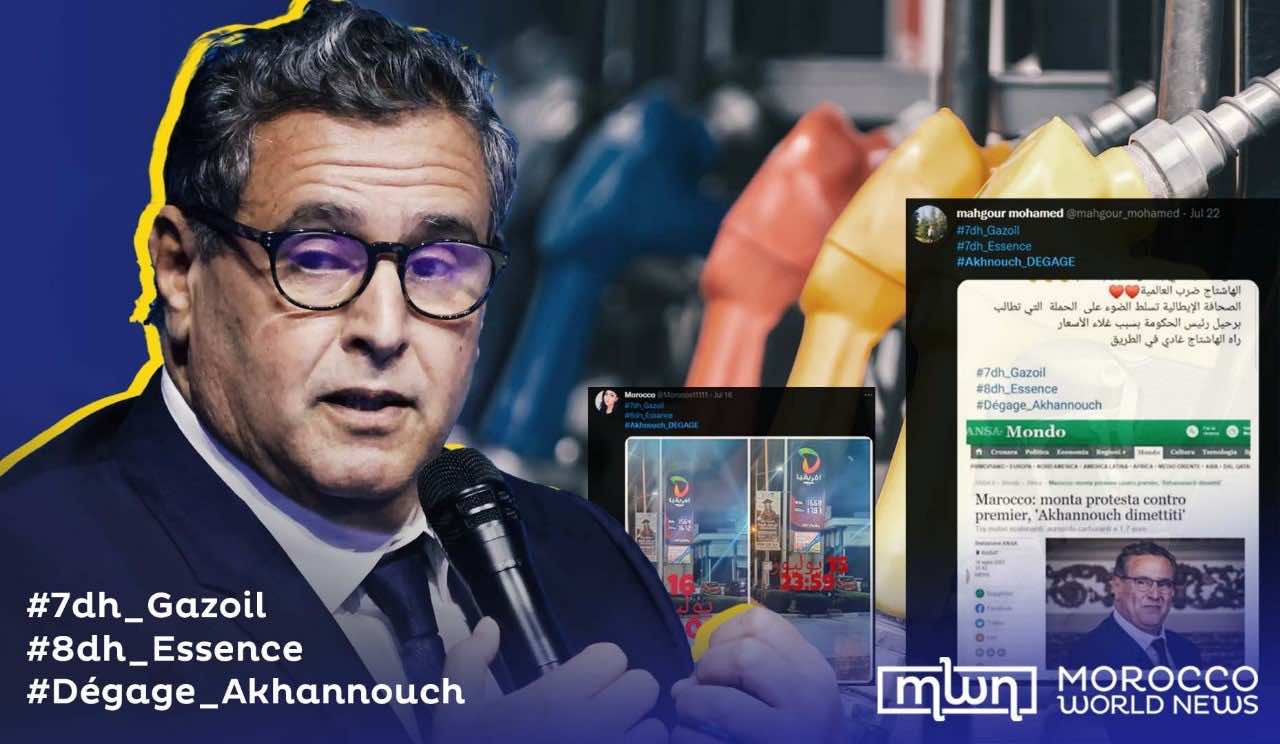
Rabat – Hundreds of thousands of Moroccans have responded to an analyst’ claim that fake accounts are behind the viral online campaign demanding social change in Morocco amid an unprecedented spike in prices.
In a series of tweets on July 17, British digital media analyst Marc Owen Jones suggested that the anti-government campaign raging on Moroccan social media platforms might have been manipulated.
“It would appear that the degage Akhannouch hashtag is manipulated, but by whom and for what purpose is not clear,” said one of Jones’s tweets.
Read Also: British Analyst Stirs Backlash for Questioning Hashtag Demanding Akhannouch Resignation
The remarks have stirred a backlash on Moroccan social media. Thousands of visibly frustrated Moroccan netizens have been posting both angry and sarcastic tweets to rebut Jones’ claim that the “Degage Akhannouch” and “Akhannouch out” social media campaign might have been initiated by fake accounts managed by Akhannouch’s political rivals.
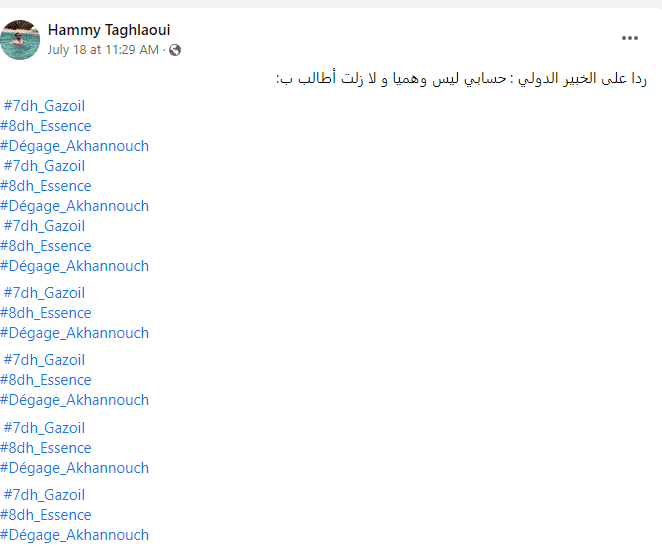
Among the most trending messages in response to Jones is the post “My account is not fake and I am still demanding: decreased fuel prices, and the resignation of Aziz Akhannouch.”
Used by thousands of netizens, the post and other similar anti-government messages are gaining wide currency on Facebook, Twitter, and other platforms.
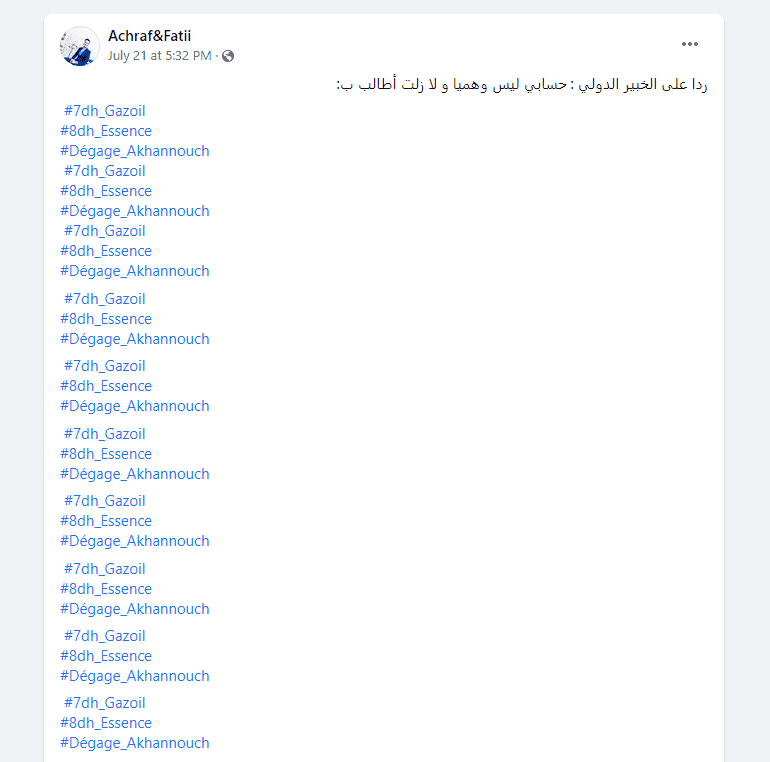
On Facebook alone, over 566,000 people are using the “#Degage_Akhanouch” (Akhannouch out) hashtag to express their frustration with the Akhannouch-led government’s mishandling of the severe cost of living crisis facing Moroccan households.
Gasoline and diesel are currently sold at MAD 15 and 16 per liter, respectively. Over a million Facebook users have urged the government to decrease the prices to MAD 7 and MAD 8.
Faced with growing calls to either resign or more effectively tackle the country’s cost of living crisis, the Moroccan government has repeatedly argued that it has had its hands tied by the global economy’s deteriorating context.
Invoking the “actual context” of the world’s economy to account for the unprecedented rise in commodity prices, the government has nonetheless vowed to take appropriate measures to lower the prices of some basic goods. But it is unclear whether the government plans to meet campaigners’ demands regarding fuel prices.
Legitimate campaign
Commenting on the viral campaign targeting Aziz Akhhanouch and his government amid a profound socio-economic crisis in Morocco, Mohammed Jadri, an economic expert and professor at the Hassan II University in Casablanca, said that “freedom of expression is guaranteed by the provisions of the Moroccan constitution.”
He told Morocco World News that social media platforms have in recent years become important hubs where Moroccans flock to vent their frustration and make demands that can lead to changes in the government’s social and economic policies.
The economist acknowledged that the rise in fuel prices is linked to an international context that has seen an unprecedented wave of inflation.
But, Jadri argued, there are other factors that have exacerbated the dire situation of Moroccan households.
Pointing to the lack of infrastructure to refine oil in Morocco, he cited the country’s “very weak storage capacities” and “pressured tax system” as some of the main reasons behind the notable decline in the purchasing power of Moroccan citizens.
While speaking approvingly of the anti-government campaign dominating the conversation among several Moroccan netizens, he argued that their ceiling — the resignation of the government or the capping of prices to MAD 7 and 8 for gasoline and diesel — is “very high.”
For the economist, a more rational demand would be to campaign for diesel and gasoline to be set at MAD 10 and MAD 11 per liter, down from the current, prohibitively high prices of MAD 15 and MAD 16.
The government is now more than ever obliged to find a solution to enact legislation urging actors in the energy sector to increase their storage capabilities and to reconsider the tax system, the economist argued. Now is the time for “the Competition Council to fully play its role” as the agency responsible for pricing regulation in Morocco.
Lack of communication from the Government
According to Jadri, another key factor fueling Moroccan netizens’ frustration is the lack of communication from the Head of Government, Aziz Akhannouch.
He said that Akhannouch has been facing communication issues since the formation of the new government in October 2021.
“He must communicate more with citizens and explain to them reasons in detail, otherwise silence fuels rumors,” the economist emphasized.
He added that the fuel “cartel” needs also to increase communication capabilities to explain the reasons why fuel prices are increased at the global level and their impact on consumers instead of just introducing changes without communicating any reasons.
While joining the anti-government campaign, the Party of Progress and Socialism (PPS), currently the main opposition party at the Moroccan parliament, has also notably demanded more communication and clarification from the government.
“The government is required to reveal the mechanisms, approaches, and procedures adopted in how changes in the petroleum products in the international market reflect on the prices of fuel,” the party said in a recent communique.