Moroccans and travelers alike are familiar with Morocco’s banknotes and coins, up from the blue 200 MAD bills and down to the shiny yellow rials, or 10 cents. Their birthplace is Dar As-Sikkah, a pristine compound in Sale near the capital Rabat established in 1987 by the late King Hassan II as part of Bank Al-Maghrib, the Moroccan central bank.
A Morocco World News reporter took an inside tour of Dar As-Sikkah and witnessed the printing and minting of Morocco’s currency.
Top security
Considering the astounding amount of money in Dar As-Sikkah at any moment in time, the security is understandably tight. Visitors must apply through an institution, arrive with presentable clothing, turn in their IDs, leave their phones outside, and pass through security.
Other measures include a rotating door that, if activated, can trap a running criminal in its clutches.
Once inside, the printing room is a breathtaking sight. From the terrace, visitors can watch a vast expanse of whirring machines churn out large sheets of connected 200 MAD bills, with layers of quality control including artificial checks and human-eye examination.

Large sheets of 100 MAD banknotes
The large sheets are then cut into individual bills through another set of elaborate machines, before being packaged for transportation. The number of bills produced each day varies depending on the economy’s needs, but new bills are always being printed as old ones are collected and destroyed.
The guide Said Ezzahraoui, a previous aerospace engineer who now works at Dar As-Sikkah, explained several counterfeit measures on the bill. For example, the crown should shift color with viewing angle and the king’s jacket should be raised in texture, in addition to other features such as micro-printing and security threads.
While Americans generally hold up $100 bills to the light and British people scratch £50 bills with a special pen to verify their authenticity, Moroccans generally don’t check the bills they receive because counterfeiting is very rare in Morocco, Ezzahraoui explained.
This is largely due to the relatively small worth of a 200 MAD bill, making the cost of counterfeiting not worth the gain. Each year law enforcement inevitably finds the rare illegal operation, but the overall amount is declining each year.
The life and death of bills
A different section of Dar As-Sikkah is dedicated to the minting of coins. Here, loud metallic clinks replace the soft pss-pss of papers. It’s a satisfying feeling to stick one’s hand into one of the machine’s endless outpour of dazzlingly shiny one-dirham coins.
Coins are pressed with ridges along the rims to prevent erosion of its surface. This is because coins will remain in use forever, unlike the banknotes that are constantly being checked for quality and taken out of circulation.
Dar As-Sikkah produces a new series of banknotes every 10 years, Ezzahraoui explains. As such, the most common banknotes is the 2012 series with King Mohammed VI but the public can also find older bills such as the 2002 series with both King Mohammed VI and King Hassan II.
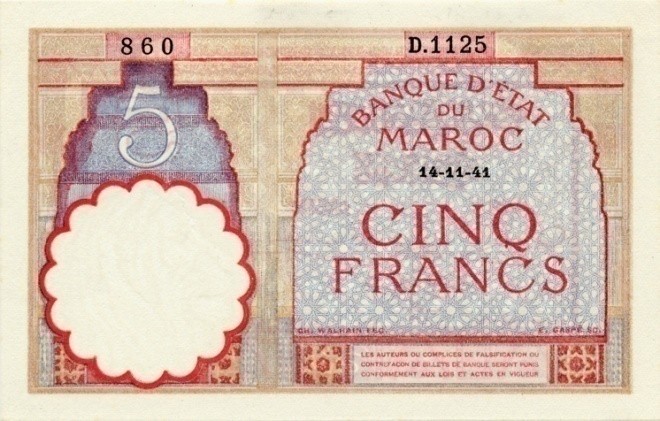
An old banknote of five francs.
According to the Bank Al-Maghrib Museum, the use of coins as currency in present-day Morocco started as early as the fifth century B.C., but the first Moroccan banknotes were the rials printed in 1911 by the State Bank of Morocco. Beginning in 1920, the State Banks issued Moroccan francs as Morocco was under the French Protectorate. Following the country’s independence, Bank Al-Maghrib was established in 1959 and adopted the new currency, Moroccan dirhams.
Meanwhile, a section of Dar As-Sikkah that is not open to tours also produces Moroccan passports and other security documents.
Stepping back into the lobby of Dar As-Sikkah, visitors will be able to look at the display of old bills used throughout Moroccan history in a new light. They will leave with a new understanding of money — and perhaps a handful of shredded old bills as souvenirs.