 Join on WhatsApp
 Join on Telegram
Rabat – Although the entire month of Ramadan is holy, Muslims eagerly await Laylat Al-Qadr – a night believed in Islamic tradition to be better than a thousand months – during which sins are forgiven, prayers are granted, and God’s mercy is abundant.
Laylat al-Qadr, also known as the “night of Decree/Power,” is when the angel Jibril first revealed the Quran to Prophet Muhammad, making it a special occasion for Muslims to recite and study the Quran.
“Indeed, We sent the Qur’an down during the Night of Decree. And what can make you know what is the Night of Decree? The Night of Decree is better than a thousand months,” says Surat Al-Qadr , the 97th chapter of the Quran.
Islamic scholars have various theories regarding the night of decree. Some claim that it is the time when a person’s destiny for the upcoming year is decided.
Although the exact date is unknown, the night of power occurs during the last 10 days of Ramadan and is generally believed to take place on the 21st, 23rd, 25th, 27th, or 29th day of Ramadan.
According to Islamic tradition, Prophet Muhammad provided signs that could be used to identify the night of power. One sign of the day of the night of power is the sun rising early in the morning without emitting any rays.
Laylat al-Qadr is also described as a pleasant and calm night, with rain falling either during the night or during the day of that night.
Engaging in Deep Prayer and Spirituality
Since Muslims believe the night of power to be far more significant than a thousand months, they go to great lengths to worship and seek Allah’s blessings on this night.
Many Muslims spend their nights in prayer, especially Qiyam al-layl, which is defined as spending the entire night or a part of it in prayer, reading the Quran, remembering Allah (dhikr), or engaging in other acts of worship.
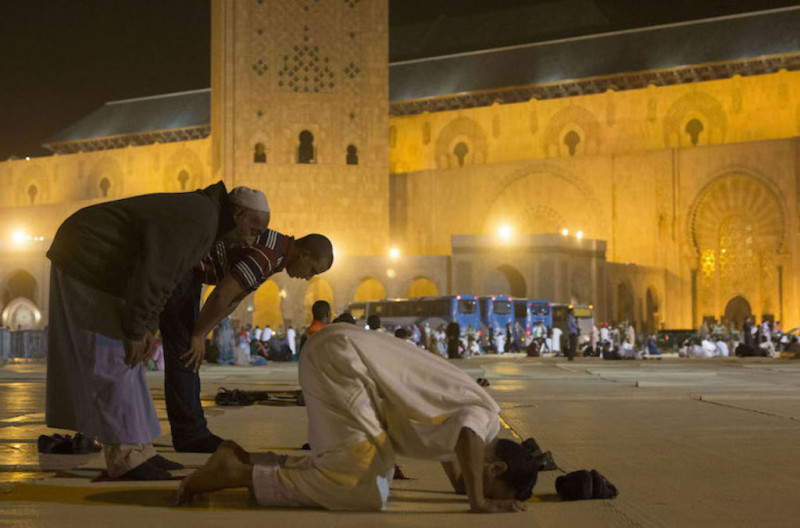 Muslims praying
Muslims also engage in supplication as it is believed that whatever they wish for is granted during these nights and that Allah forgives the sins of all those who seek forgiveness sincerely.
The night of power is also a time when Muslims strengthen their faith. On this night, Muslims ponder their lives, seek divine guidance, and reinforce their belief.
It is also customary to give Sadaqah (charity) on each of the last 10 nights of the month of Ramadan because it is thought that any good deeds carried out on the night of power are multiplied many times over.
According to Islamic Relief Worldwide, “The rewards of giving sadaqa during Ramadan are multiplied by 70 and the reward for any righteous act during Laylatul Qadr is equivalent to having performed the same act for over 83 years!”
Moroccan Children celebrate their first day of Fasting
Most Moroccan families celebrate Laylat al-Qadr by gathering for dinner after Taraweeh Ramadan prayers and serve Moroccan couscous.
Other Moroccan families celebrate their children’s first fast. Children who have not reached puberty are exempt from fasting during Ramadan. However, some families encourage kids to fast for the first time ever on Laylat al-Qadr.
On the 27th night of Ramadan, girls go to a Negafa (stylist) who will dress them up with makeup, fine traditional clothing, and gold adornments, as well as apply henna to their hands. Meanwhile, boys will typically dress in a djellaba and wear a Balgha (Moroccan traditional leather slipper).
To mark this special day, families take their children to photo booths to take pictures.
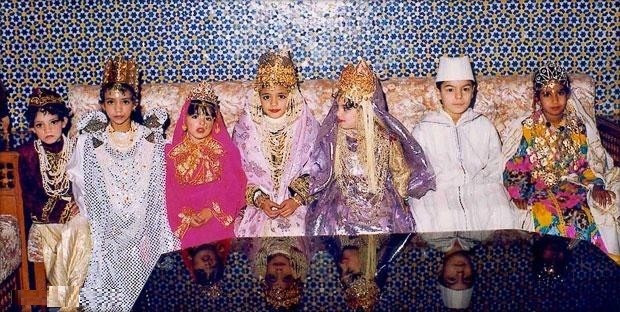 Children celebrating Laylat al-Qadr
For many Muslims, Ramadan, particularly the night of power, is an opportunity to enhance one’s willpower and begin a journey of spiritual and moral growth through meditation, prayers, and good deeds.
As research has indicated over the years, religion and spirituality play a significant role in preserving psychological health because they help people develop healthier relationships with others, with themselves, and with the world around them.
According to a 2022 study, spirituality is associated with better health outcomes. “For healthy people, spiritual community participation–as exemplified by religious service attendance – is associated with healthier lives, including greater longevity, less depression and suicide, and less substance use,” said the study.