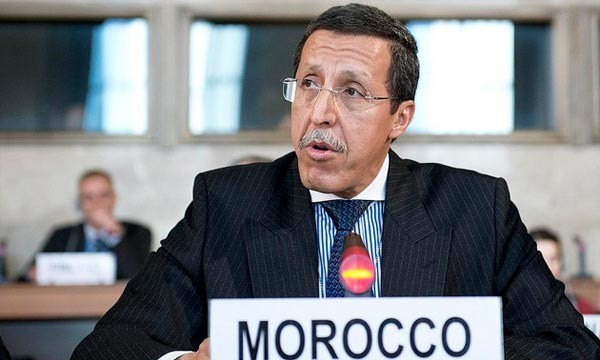
Rabat – The decolonization of Western Sahara has been definitively sealed since 1975, under the Madrid Agreement, Morocco’s Ambassador to the UN Omar Hilale said this week.
Hilale’s statement came as a response to yet another provocative intervention from Algeria’s permanent representative to the UN, Amar Benjama, who contested the Moroccanness of the Western Sahara.
While addressing the assembly at the annual seminar of the UN Committee of 24 (C24), Hilale said: “To those who support the UN political process and the SG’s Personal Envoy, Staffan de Mistura, I reaffirm Morocco’s resolute commitment to this process in order to achieve a realistic, pragmatic, lasting solution to the regional dispute, in accordance with Security Council resolutions, including resolution 2654.”
Hilale continued to explain that the issue at hand is not that of decolonizing Western Sahara, as historically, Morocco’s southern provinces claimed independence in 1975 under the Madrid Agreement. The agreement was deposited at the UN Secretary-General and endorsed by the General Assembly the same year.
The issue of Western Sahara today is that of preserving the territorial integrity of Morocco, he stressed.
As for the parties involved in the dispute, who advocate for self-determination and exploit resolution 1514, he called them to account for their culpable silence on other UN resolutions, particularly resolutions 1541 and 2625, which are aimed at preserving the territorial integrity of states.
The Moroccan diplomate further denounced the “biased and ideological” reading of the principle of self-determination and of resolution 1514.
Recalling the significant strides Morocco has made in supporting its territorial integrity, Hilale expressed Morocco’s gratitude and appreciation to the overwhelming majority of the members of the Committee of 24 for their support for the Moroccanness of the Sahara and the Moroccan-backed Autonomy Initiative.
“Territorial integrity takes precedence over the right to self-determination,” he stressed adding that “the principle of self-determination is a positive right, which only came into being in 1960, thanks to resolution 1514,” whereas the principle of territorial integrity has existed for as long as mankind has existed, since states were founded. “It is therefore a right that has existed for centuries.”
“We cannot claim” to apply this principle to one so-called people and deny it to others. International law is universal and must apply to all, he insisted.
Responding to the Algerian diplomat’s question about the “obstacles” to a political settlement of the Western Sahara issue, Hilale noted that Morocco has always supported the political process and the UN SG’s Personal Envoy, and accepted the Security Council’s resolutions.
Calling out Algeria’s double standard on the Western Sahara issues, Hilale asked rhetorically, “Who officially rejects the Security Council resolutions? Who refuses to return to the round-table process? Who objects to the census of the Tindouf camps’ populations? Who shelters on its territory a separatist group armed against its neighboring country? Who rejects to adopt the principle of good neighborliness? Who refuses the peaceful settlement of disputes through dialogue advocated by the United Nations Charter?”
Hilale also expressed his fervent hope that the dispute could be settled within the framework of the UN political process supported by the international community. He stressed that the Moroccan autonomy initiative is the only solution to the dispute, which “will enable our brothers and sisters in the Tindouf camps to return to their homeland, Morocco.”
Agreeing with one speaker that the question of the Moroccan Sahara should no longer be discussed within the framework of the C24, the ambassador pointed out that the Security Council does not consider it a question of decolonization, but of peace and security, within the framework of Chapter VI of the United Nations Charter.
The diplomat also recalled that the question of Western Sahara is a political dispute to which Algeria is a party, hence why the country is mentioned five times in the latest Security Council resolutions.
This dispute will be settled when Algeria returns to the round table, in accordance with resolution 2654, and with full respect for Morocco’s territorial integrity, Hilale said.
Despite housing and arming the Polisario Front, an armed militia claiming to be the official representative of the self-styled Sahrawi Arab Democratic Republic (SADR), Algeria refuses to step forward and acknowledge its agency in the regional dispute.
Algeria maintains itself as merely an “observer state” or a “concerned neighbor” and claims that a solution to the territorial dispute should be negotiated between Morocco and the Polisario Front. Meanwhile, Algeria continues to maintain a hostile stance against Morocco and unilaterally decided to sever diplomatic relations with Morocco in 2021.
Algeria’s so-called “neutral” stance has been contested over the years by international organizations, with the UN repeatedly calling on the country to participate in the political process in attempting to reach a lasting resolution to the dispute.