 Join on WhatsApp
 Join on Telegram
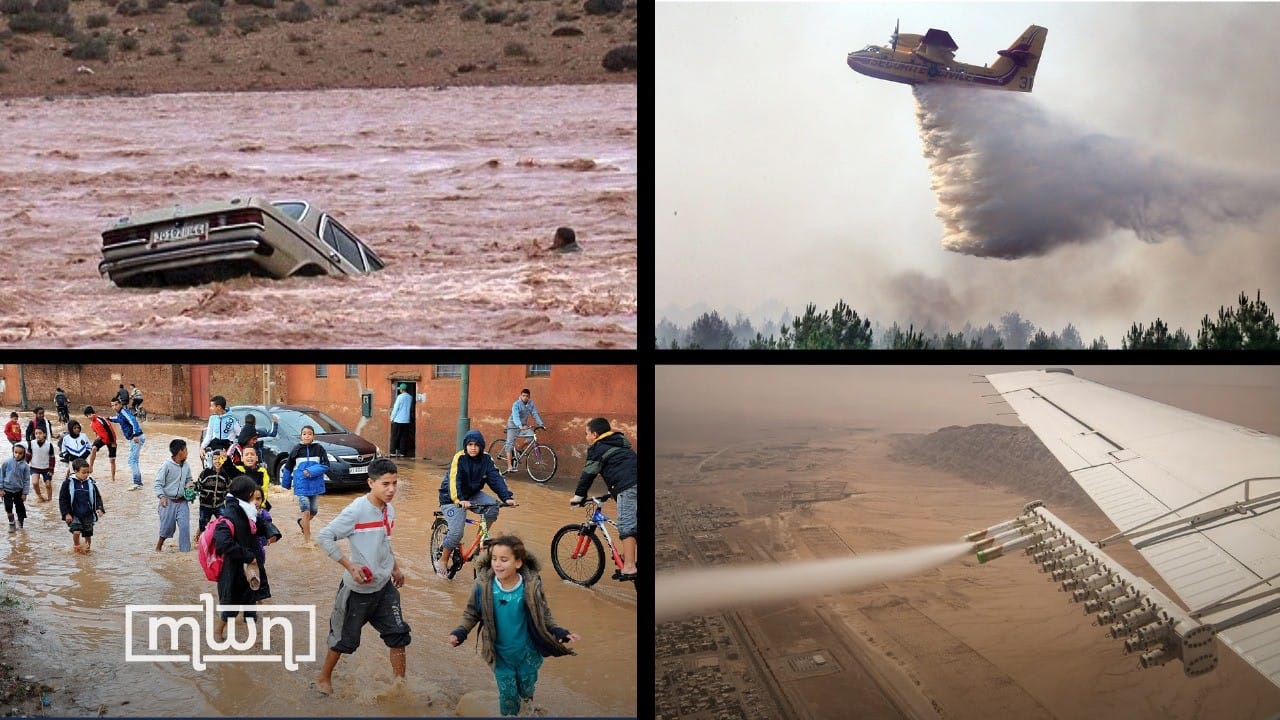
Doha – The Directorate General of Meteorology has refuted claims that Morocco’s artificial rain program, which uses cloud seeding technology, was responsible for the recent deadly floods in the country’s south and southeast regions.
This statement comes after several reports suggested that the program, known as Al-Ghaith, contributed to the heavy rains and subsequent flooding.
In a statement to Morocco World News, a source from the meteorological directorate emphasized that the artificial rain operations under the Al-Ghaith program follow a precise scientific protocol and international standards.
“The weather situation is carefully monitored and analyzed, and cloud seeding operations are avoided in extreme situations that could pose a danger,” the source stated. “During the extreme weather conditions experienced in the Atlas regions and the southeastern slopes, cloud seeding was not carried out.”
Southern and southeastern Morocco, as well as the Atlas regions, have since Friday been strongly affected by a highly unstable tropical air mass due to the exceptional position of the Intertropical Convergence Zone (ITCZ) in the southern regions.
This led to the rise of moist tropical air masses towards the north, which met with cold air masses coming from the north, resulting in the formation of unstable and violent clouds.
These clouds caused strong thunderstorms and heavy rainfall, leading to flash floods in several areas of the country’s southeast and east of the Atlas Mountains.
On Friday, more than 47 mm of rain was recorded in Ouarzazate in less than three hours. Significant rainfall was also recorded over a 24-hour period from Saturday at 6 a.m. to Sunday at 6 a.m., with the highest amount of 170 mm recorded in Tagounite, Zagora Province, and 90 mm in Mhamid El Ghizlane.
Read also: Very Strong Thunderstorms, Winds Continue Amid Ongoing Flash Floods
In Errachidia Province, 76.4 mm was recorded in Ait Taouss and 65.8 mm in Ir Kissani. In Tata Province, 50 mm was recorded in Akka and 53.5 mm in Foum Zguid; Zagora recorded 65mm. In Figuig Province, meanwhile, Talsint registered 83 mm while Aboulhal and Ain Chouater registered 84 mm and 53 mm respectively. Afella Ighir in Tiznit Province registered 80 mm.
These thunderstorms were accompanied by strong winds that raised dust in some eastern and southeastern regions of the country, as well as in the Atlas Mountains. Strong gusts of wind were also recorded, reaching speeds of 100 km/h in Ouarzazate, 81 km/h in Errachidia, 76 km/h in Marrakech, 72 km/h in Midelt, and 65 km/h in Nouasser.
The floods from these torrential rains have claimed at least 11 lives in the provinces of Tata, Tiznit, and Errachidia in southern Morocco, according to a preliminary death toll provided by authorities on Sunday.
At least nine others are missing after floods swamped many villages in the area. The floods also destroyed 40 homes and damaged 93 roads, as well as electricity, water supply, and phone networks.
Morocco’s Al-Ghaith program for artificial rain enhancement was launched in 1984 following a devastating drought that affected the country between 1979 and 1983.
The program aims to increase rainfall and snowfall, enhance water security, support the agricultural sector, and improve economic and social conditions while mitigating the effects of drought.
It involves the use of two aircraft for cloud seeding, as well as 20 ground-based sites equipped with cloud seeding generators across the country.