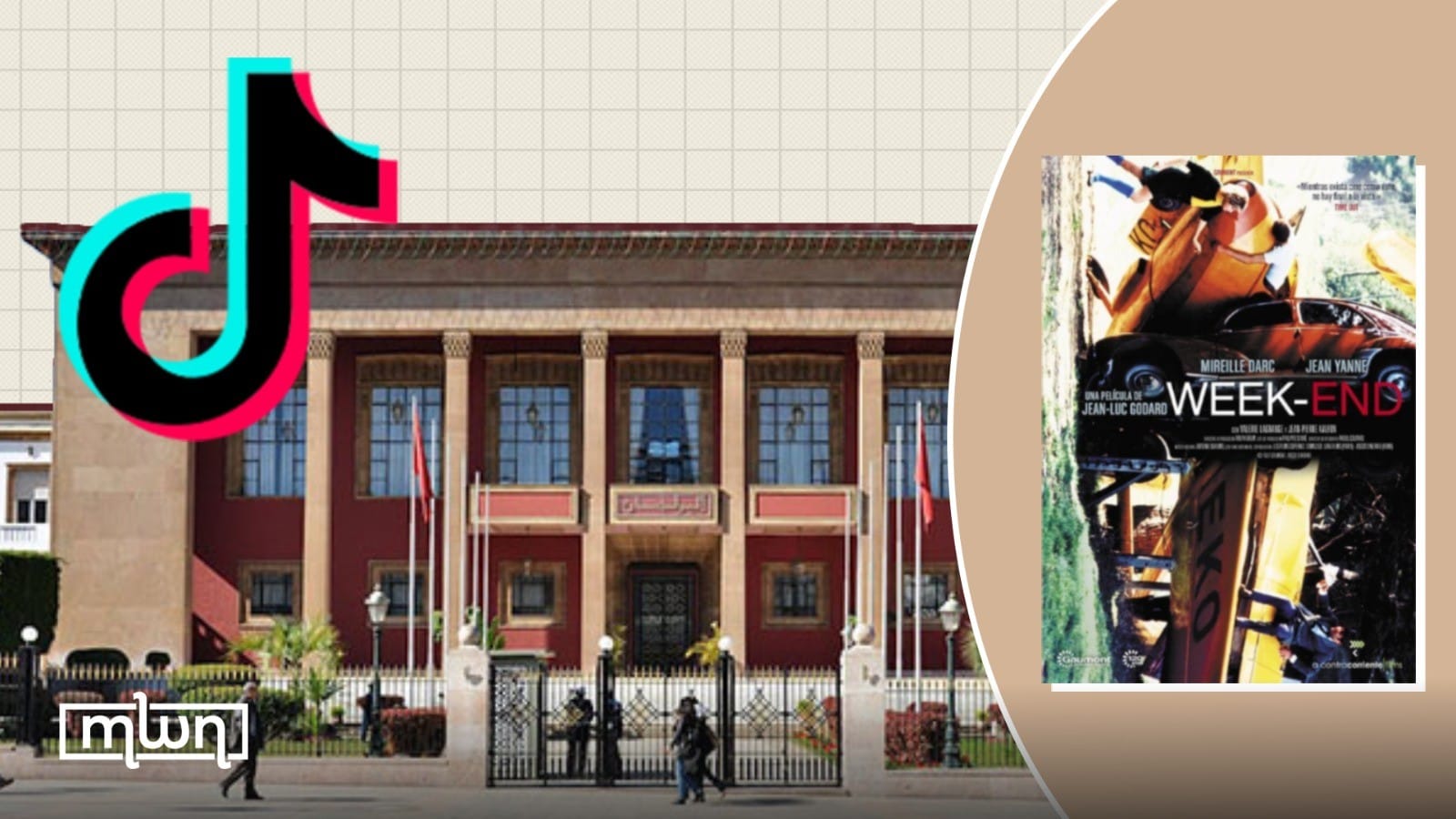
Ifrane – Jean-Luc Godard’s “Weekend” is not just a film but a profound social commentary on the dangers of pervasive consumerism that continues to resonate in today’s world. Released in 1967, Godard’s satirical masterpiece critiques the moral decay brought on by an obsession with materialism—an issue that has not only persisted but has evolved with the advent of digital platforms like TikTok.
Godard made it clear that his intent with “Weekend” was not to seek fame or financial success but to challenge the consumerist attitudes of his era. Through a series of darkly comedic and shocking scenes, the film vividly illustrates how the relentless pursuit of wealth and material goods can strip away fundamental human values like compassion, empathy, and love.
This article explores how Godard’s critique is relevant today, linking the film’s narrative to contemporary debates about the influence of social media on societal values and providing a nuanced analysis of how consumerism’s insidious effects have transcended decades and found a new, digital arena in the 21st century.
“Weekend”: the plot and themes
The narrative of the film unfolds through a sequence of episodic scenes that highlight the destructive impact of consumerism on human relationships and societal norms.
One of the most striking examples in the film is the subplot involving Corinne and Rowland, a bourgeois Parisian couple who plot to murder Corinne’s father for his inheritance. This narrative thread exposes the corrosive effects of materialism on personal relationships, revealing how the relentless pursuit of wealth can erode fundamental human connections and moral responsibilities. The couple’s contemplation of killing each other once the inheritance is secured further underscores their complete moral bankruptcy, driven by an insatiable greed1
Another significant moment in the film is the infamous eight-minute traffic jam scene, shot in a single continuous take. This scene, devoid of dialogue, serves as a powerful metaphor for the paralysis of human interaction in a consumerist society.
The cars, symbols of consumer culture, create a literal standstill, halting progress and stifling communication. It is only when the vehicles cease to function that the people trapped within them begin to engage with one another, participating in simple, communal activities like chatting and playing games. This temporary reclaiming of human connection, triggered by the failure of consumer goods, starkly contrasts with the antisocial behavior fostered by a society obsessed with material wealth2.
The film’s critique reaches its peak in a particularly chilling scene where Corinne, after surviving a gruesome car accident, screams in terror—not for the mangled bodies of the injured and deceased around her, but for her lost Hermès handbag. This moment vividly encapsulates the dehumanizing effect of consumerism.
Corinne’s panic over a luxury item takes precedence over any sense of empathy or compassion for the human suffering surrounding her. Her indifference to the injured and dead highlights how deeply consumerist values have permeated her consciousness, eclipsing basic human decency and compassion. This reaction reflects her complete lack of capacity for empathy; she is so consumed by materialism that her only concern is for her possessions, not for the human beings who lie suffering beside her3.
A critique of the times: May 1968 and its connection to “Weekend”
The themes explored in “Weekend” are deeply intertwined with the socio-political climate of France in the late 1960s, particularly the May 1968 movement. This period was marked by widespread social upheaval, with students, workers, and intellectuals rising against what they perceived as the oppressive structures of capitalist society.
The May 1968 protests, which involved over 20,000 people, were driven by a desire to challenge the consumerist and capitalist values that had taken root in post-war France.
The movement called for a radical rethinking of society, advocating for humanistic values over materialistic ones, and sought to dismantle the cultural and political norms that prioritized profit over people.
Godard’s “Weekend” reflects this revolutionary spirit, capturing the chaos and ideological clashes of the period and using its anarchic, surreal style to critique the very values the movement opposed4.
Consumerism and social media – a modern-day struggle
While “Weekend” critiques the consumerist culture of 1960s French society, its themes resonate just as strongly in today’s world, where pervasive consumerism continues to erode empathy, compassion, and love. The rise of digital technology has only amplified this trend, providing new platforms for individuals to showcase consumerist behaviors.
Social media, in particular, has become a powerful tool for monetizing attention, often at the expense of ethical standards and human decency. Platforms like TikTok encourage users to engage in increasingly sensational or unethical behaviors to attract views and generate income, pushing ethical boundaries further.
A modern-day example that mirrors the themes of “Weekend”is the case of a Moroccan TikToker who exploited her mother-in-law’s dying moments to solicit financial aid. In a shocking display of inhumanity, the young woman filmed her mother-in-law’s final moments, later posting the footage on her YouTube channel under the false pretense that the elderly woman was still alive and in need of medical funds.
This blatant exploitation, where the pursuit of quick profits overshadowed all human values, mirrors the critiques Godard made of a consumer-driven society. It starkly illustrates how the relentless desire for wealth and fame can erode moral and ethical standards, echoing the same societal issues Godard highlighted over half a century ago.
Another incident that further reflects Godard’s critique occurred in Morocco with the infamous case of “Mi Saadia,” a well-known TikToker. The public was outraged when a video capturing the live-streamed death of “Mi Saadia” surfaced on social media. The daughter of the deceased was harshly criticized for broadcasting such a private moment, with many condemning her actions as a blatant disregard for the sanctity of death and a shameless attempt to gain online traction.
Critics accused her of shamelessly exploiting a personal tragedy to gain social media fame and financial profit. Prominent figures, such as Moroccan actress Nargiss Hallak, voiced their frustration, highlighting how social media has become a disturbing avenue for exploiting personal tragedies. This incident, like those depicted in “Weekend,” shows how the drive for digital fame and wealth can lead individuals to forsake basic human decency.
The repercussions of TikTok – a Moroccan and global debate
As the impact of social media on societal values becomes increasingly evident, the Moroccan Parliament is now revisiting discussions about a potential ban on TikTok, a platform at the center of these controversies. When Parliament reconvenes in October, the Education Committee of the Moroccan House of Representatives is set to reintroduce a bill proposing to ban TikTok.
This proposal is a response to escalating worries about the platform’s influence on societal values, especially among the youth, with many arguing that the content often displayed on TikTok undermines social norms and promotes unethical behaviors.
While freedom of speech and expression remains a cornerstone of democratic societies, there is a growing recognition that social media platforms like TikTok may need regulation or even bans due to their negative impact on societal values and behaviors.
The ease with which these platforms allow the spread of content that prioritizes sensationalism over substance and ethical considerations has raised concerns about their influence, particularly on impressionable young people. The debate in Morocco reflects this tension, highlighting the challenge of balancing the protection of free expression with the need to mitigate the harmful effects of social media on cultural and social norms.
In Morocco, the Minister of Justice, Abdellatif Ouahbi, has acknowledged the complexities of imposing such a ban, given the global reach and influence of these platforms. However, the discussions in Morocco indicate a growing desire to address the perceived negative impact of social media on cultural and social norms. As Moroccan lawmakers debate the future of TikTok, the focus will likely be on finding a balance between preserving social values and managing the pervasive influence of digital media.
The discourse over TikTok is not limited to Morocco; it reflects a broader global concern about the impact of social media on societal values. Countries like India, Nepal, and the United States have also expressed concerns about TikTok’s influence and have considered or enacted measures to restrict or ban the platform.
Where do we go from here?
The film “Weekend” is not merely a critique of consumerism but a prophetic examination of the moral and ethical decline that accompanies a society obsessed with material wealth. The film’s portrayal of a culture consumed by greed and self-interest resonates profoundly in today’s digital age, where platforms like TikTok have amplified these issues on a global scale.
The incidents in Morocco, where TikTok users have exploited personal tragedies for financial gain, mirror the very themes Godard explored—highlighting how the pursuit of fame and fortune can erode human values and degrade societal norms.
As Morocco debates a potential ban on TikTok, this modern context underscores the enduring relevance of Godard’s message. It challenges us to reflect on the ethical implications of our own consumer-driven behaviors and consider how we might foster a more compassionate and empathetic society in a world increasingly mediated by technology.
References
1. Douglas, Morrey. Jean-Luc Godard. Manchester: Manchester UP, 2005. Print.
2. Drabinski, John E. Godard Between Identity and Difference. London: Continuum International Group, 2008. Print.
3. Douglas, Morrey. Jean-Luc Godard. Manchester: Manchester UP, 2005. Print.
4. Steinfels, Peter. “Paris May 1968: The Revolution That Never Was.” The New York Times. 11 May 2008. Web.
5. Dixon, Wheeler Winston. The Films of Jean-Luc Godard. New York: State University of New York, 1997. Print.
6. Neurpert, Richard John. A History of the French New Wave Cinema. London: University of Wisconsin, 2007. Print.
7. Silverman, Kaja. Speaking About Godard. New York: New York UP, 1998. Google Books.
8. Weber, Anja. Le Mouvement D’étudiants En Mai 1968 En Allemagne Et En France. GRIN Verlag, 2004. Google Books.