
 Join on WhatsApp
 Join on Telegram
In 2007, Bill Gates predicted the advent of a new technological era where
the personal computer will “rise from the desk” to allow us to
interact with the physical world remotely. This prediction came true with the
Fourth Industrial Revolution (Klaus Schwab
2016), which began in the middle of
the twenty-first century and is characterized by the merging of the digital and
physical worlds. This revolution is marked by the rapid development of
disruptive technologies such as artificial intelligence, robotics, the Internet
of Things, automation, 3D printing and data science, which are profoundly transforming the
organization of society, the economy and global geopolitics.
Major powers, such as the United States, China, and Russia, are engaged in
an intense competition for technological dominance, driven by the quest for
“technological sovereignty.”
This frantic race for power creates major challenges for the Third World in
general and Africa in particular, with risks of worsening inequalities,
technological dependency and economic marginalization caused by the
fragmentation of supply chains. These factors risk limiting the autonomy and
growth opportunities of the Third World in the world economy.
The fragmentation of the international division of labor, induced by automation
and techno-nationalism, could further marginalize third world countries. The
relocation of industries to developed countries, motivated by the search for
greater technological sovereignty, could deprive developing countries of
employment opportunities and economic growth based on manufacturing industries,
according to Glenn Diesen (2021).
However, it must
be noted that the Fourth Industrial Revolution represents both a threat and an
opportunity for the Third World and Africa because of the technological leap that makes it
possible to bypass certain traditional stages of development, the emergence of
inclusive and sustainable economic models, and the empowerment of populations
through digital technologies and access to information would all be positive
effects if used wisely. escient (Rwanda, Costa Rica etc) .
The Fourth Industrial Revolution is redefining the geopolitics of the great
powers by changing the source of power and the way states interact within the
international system. Technological sovereignty, i.e. the ability of a state to
master these technologies, becomes crucial to assert its autonomy and influence
on the international scene
Like other regions of the world, Africa is called upon more than ever to
navigate this complex context by adopting solid and adapted geo-economic
strategies.
Africa and the geopolitical landscape of fourth industrial revolution
As a key driver of the fourth industrial revolution, the global shift to
renewable energy is redefining international power dynamics, with Africa
playing a central role in this transformation. The continent’s abundant
reserves of critical minerals and renewable energy resources position it as a
linchpin in the energy transition, unlocking opportunities for economic growth,
geopolitical influence, and regional industrialization. However, realizing this
potential is challenged by governance issues, external competition, and
socio-environmental risks.
Africa: A Strategic Resource Hub
Africa is endowed with critical minerals essential for renewable energy
technologies, which are increasingly vital for the global shift towards a
low-carbon economy. Key reserves include among others :
Cobalt: Over 70% of the global supply originates
from the Democratic Republic of Congo (DRC), a crucial component in
lithium-ion batteries. Emerging deposits in Morocco gaining attention from
global and middle range competitors.Platinum and Manganese: South Africa and Zimbabwe are leading
producers, essential for catalytic converters and energy storage
technologies.Graphite: Significant reserves in Mozambique and
Tanzania are critical for battery production.Lithium: Emerging deposits in Morocco, Southern
Africa are also gaining attention from global markets.Rare Earth Elements (REEs): Although less abundant than in China,
Africa’s REEs remain strategically important for wind turbines and
electric vehicles.
These resources render Africa indispensable to industrialized nations
striving to secure supply chains for critical minerals. The concentration of
these resources in specific regions like the DRC increases their geopolitical
importance and vulnerability.
Africa a Battlefield for External competition on Rare Earth Elements
The energy transition is not limited to the substitution of energy sources.
It can also lead to new types of conflicts related to land appropriation, the
use of space, the distribution of costs and benefits of renewable energy, and
the control of infrastructure. These conflicts can manifest at various levels,
from local communities to international relations.
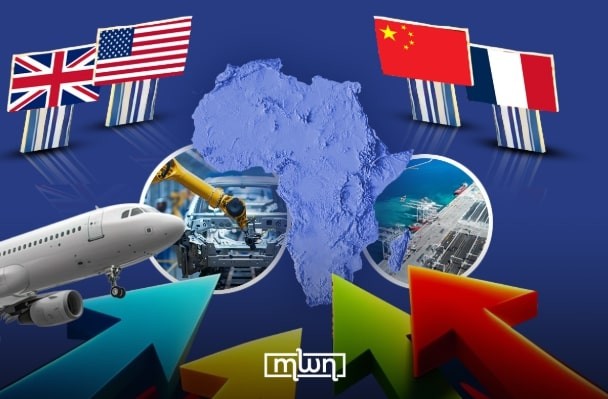
Indeed, Africa’s resource wealth has attracted competing global powers
eager to secure access to critical minerals:
China: Through its Belt and Road Initiative
(BRI), China has established dominance in African mining operations,
controlling significant portions of cobalt production in the DRC while
investing heavily in infrastructure and mineral processing facilities
across the continent.The West: The United States and European Union have
launched initiatives like the Prosper Africa Initiative to counter Chinese
influence. However, these
efforts often lack sufficient funding and comprehensiveness.Other Players: Russia has sought to expand its influence
through private military contractors and bilateral agreements, particularly
in Northern and Western Africa.
The geopolitics of rare earths elements reflects intense competition between China,
the United States, and the European Union, each adopting distinct strategies to
address their economic and security priorities. China, holding a near-monopoly
on production, dominates the entire value chain through protectionist measures
such as export quotas, restrictions on foreign investments, and taxes. Its
control of the market, reinforced by coercive economic policies, grants it a
strategic role in global supply. Meanwhile, the United States focuses on
strengthening domestic production, diversifying supply sources, and forging
economic partnerships to reduce its dependence on China, leveraging sanctions
and regional agreements as diplomatic tools.
Amid this Sino-American rivalry, the European Union adopts an approach
centered on diversification, recycling, and the development of clean
technologies to minimize its dependence and promote a multipolar system based
on international norms. Despite their differences, these three actors recognize
the critical importance of rare earths for economic development and national
security while striving to reduce their vulnerability to a single source. This
race for control of strategic resources highlights global challenges of
scarcity and interdependence, which will shape the balance of power in the
years to come.
This competition highlights Africa’s critical role as a strategic
battleground in the renewable energy transition, with significant implications
for global power dynamics.
Fourth Industrial revolution
an opportunity for Unlocking Africa’s Development Potential
Africa’s vast resource base holds immense potential for driving regional
industrial growth and economic diversification, notably by processing key
minerals locally and establishing battery manufacturing industries, Africa can
significantly increase the value derived from its resources.
Furthermore, with it’s abundant solar and wind resources, Africa has the
potential to become a global leader in green hydrogen production. By combining
its mineral wealth with a robust renewable energy infrastructure, Africa can
develop a sustainable industrial ecosystem that drives long-term growth.
Several sectors have significant potential for the development of TRCs in
Africa:
ü Agro-industry, wood, leather, cotton and related
products
With a large workforce and a competitive advantage in certain crops and
commodities, it faces challenges related to fragmentation and lack of added
value.
ü The pharmaceutical industry: It has a
high growth potential, but is under-equipped and dependent on imports.
ü The automotive industry: With the
potential for job creation, it is dominated by semi-knockdown (SKD) models. We
should quickly move to completely knocked down (CKD),
especially in electric vehicles that
present an opportunity for innovation.
ü Electric batteries: Being at the heart of the electric mobility
industry, battery manufacturing is for Africa what refining is for
oil-producing countries because of its wealth in essential critical minerals
such as cobalt, copper and lithium. The potential to develop a regional battery
industry is more than ever on the agenda. Countries such as Morocco, DRC,
Zambia and other SADC members could join forces in this area.
Geopolitical Tensions in the Battery Industry: An Opportunity for Africa
The battery sector is facing
increasing volatility, where the distinction between winners and losers remains
blurred. Mining companies like BHP and Glencore are benefiting from rising
demand, but China’s dominance in chemical processing is causing geopolitical
tensions. In response, Western companies are exploring alternatives and
investing in their own processing capabilities. (“The search for
winners in the new battery era”, FT and The Manila Time, August 28, 2023)
Battery manufacturers, mainly from
Asia such as CATL, LGES and BYD, are competing in fierce competition, with CATL
in the lead. However, these players risk seeing their know-how transferred to
car manufacturers, with some like GM and Volkswagen and BMW developing their
own battery systems to ensure their independence. Others, such as Nissan, opt
for external sourcing, treating batteries as standardized products.
Finally, the concentration of
resources in China reinforces geopolitical issues and stimulates efforts to
diversify supplies.
Faced with this tough competition, Africa can
play the role of connector and attract the main players to locally process
critical minerals for the two- and four-wheeled electric mobility sector.
It is safe to say that the electric vehicle (EV) sector represents a unique
opportunity for Africa, due to its reserves of strategic critical minerals for
this sector (cobalt, lithium, copper, etc.).
Regional Cooperation: An Imperative for Africa
Regional cooperation is essential for the development of regional value
chains (RVCs) and the exploitation of Africa’s geo-economic potential.
An eloquent example of this cooperation is the joint initiative of the
Democratic Republic of Congo (DRC), Zambia and Morocco, supported by the
Economic Commission for Africa (UNECA), to develop a special economic zone
dedicated to the battery and electric vehicle value chain.
Countries such as the DRC and Zambia face major geopolitical challenges,
including great power competition for control of critical minerals, where China
plays a leading role in the processing of these resources. To navigate this
complex landscape, African countries need to diversify their investment sources
while strengthening their position in global value chains. It also requires
improved governance in the mining sector and increased investment in
infrastructure.
The development of this sector faces several obstacles, such as the lack of
a coherent continental strategy for green minerals, difficulties in attracting
investment, insufficient infrastructure, as well as market control by global
players. In addition, the lack of skills, weak domestic demand and
environmental issues related to mining further complicate the situation. To
overcome these challenges and realize its potential, Africa needs to
industrialize by adding value to its resources through processing and
manufacturing capabilities, while leveraging the African Continental Free Trade
Area (AfCFTA)
The Actors of the Development of a Battery Industry in Africa
UNECA plays a key role in the electric vehicle initiative in the DRC and
Zambia, acting as coordinator, technical advisor, financial facilitator and
promoter of the project. It has organized two business forums on the battery value
chain, promoting policy dialogue on industrial development in this field. In
addition, UNECA supported the establishment of the African Centre of Excellence
for Battery Research and Innovation (CAEB) and collaborated with the European
Union to evaluate the necessary training programmes
The governments of the DRC, Zambia and Morocco are at the heart of the
project, supported by financial institutions such as the African Development
Bank and Afreximbank. The local private sector is also involved in mobilizing
national savings, while international partners such as the European Union and
the United States collaborate on various aspects of the project. This diversity
of actors underlines the importance of close cooperation to establish a strong
regional value chain for batteries and electric vehicles
It should be recalled in this regard that the Technical Unit of the
Agadir Agreement, bringing together Morocco, Tunisia, Egypt, Jordan, Lebanon
and Palestine, had carried out an in-depth study on the automotive industry to
strengthen cooperation and maximize investment opportunities in this strategic
sector. However, due to competition between member countries, this project did
not come to fruition. This example illustrates that political will and
ownership of the project by States and the private sector are essential
conditions for effective industrial cooperation.
– To establish a competitive battery industry in Africa, several key
actions may be considered based on the opinions of several experts in the field
that we share:
Regaining control of mineral resources: African countries must ensure that they
manage and exploit their own resources.Renegotiate existing agreements: It is crucial to gain better access to
the raw materials needed for battery production.Improving knowledge of mineral resources: A better understanding of available
resources is essential to optimize their use.Raising ethical standards: It is imperative that mining revenues
contribute to human development and that the illegal trade in minerals be
combated (on December 17, the DRC filed a complaint against Apple
subsidiaries in France and Belgium following
accusations that Apple buys minerals because of the purchase of minerals from the unstable
east of the country illegally sold by the separatist movement of the
M 23).Mobilize finance: Investments in energy and transport
infrastructure are needed to support industry.Build strategic partnerships: Collaborating with universities and
technology companies will drive innovation and skills development.Pooling of
resources and triangular cooperation
Encourage the pooling of resources in
training through triangular cooperation between supplier countries, receivers
and multilateral institutions (AfDB, IDB, etc.), as in the IDB’s Reverse
Linkage program. This mechanism promotes the transfer of know-how between
member countries, such as the ongoing partnerships between Morocco, Zambia and
the DRC in the field of batteries, or the partnership between Morocco, Niger
and IBRD to strengthen agricultural productivity and improve soil fertility.
By implementing these recommendations, Africa could not only develop a
robust battery industry, but also maximize the added value of its natural
resources.
What future for Africa?
Africa’s future is uncertain, but the continent has a real opportunity to
position itself as a major player in the new world order. Fourth Industrial
Revolution and the use of geo-economic instruments offer Africa new
prospects for development and empowerment. However, to seize these
opportunities, Africa must overcome many challenges and adopt a strategic,
collaborative and coordinated approach. Africa’s success will depend on its
ability to invest in industrialization, economic diversification, regional integration,
and international cooperation. The effective implementation of the AfCFTA, the
development of strong RVCs and wise management of its natural resources will be
the keys to success for Africa.
Africa has significant
geo-economic potential, but its realisation will depend on its ability to
implement ambitious policies and overcome the challenges it faces. By combining
a regional integration strategy, economic diversification and a more assertive
presence on the international scene, Africa can establish itself as a key
geo-economic player.
Africa should therefore value its resources and rely above all on itself
and its skills while establishing equitable partnerships with world powers. It
is also essential to avoid any new form of dependence and plundering of
resources, particularly with regard to emerging players.
The success of such a geopolitical vision for Africa relies heavily on
political leadership that can transcend internal divisions and unite states
around a common strategy. By adopting harmonized negotiating positions, African
countries could significantly influence the process of future international
norm-setting and policy-making. A united and resilient Africa is essential to
effectively navigate a changing multipolar global landscape.
In its quest, Africa could
draw inspiration from the strategies of some Asian countries to strengthen
their positions on the world stage. Here are some areas to focus on:
Self-sufficiency and Industrial Sovereignty: Strengthen economic and military capabilities
to guarantee autonomy.Institutional Strategies: to play an active role in international
organizations to influence global decisions.Hedging Policy and Bamboo Diplomacy: Africa should maintain balanced relationships
with all major powers to diversify partnerships and maximize
opportunities. Inspired by Vietnam’s multilateral approach to global
challenges and its flexible stance of non-alignment, Africa can leverage
great power rivalries to secure concessions and benefits. By employing
skillful diplomacy, the continent can attract investment and foster
development while safeguarding its autonomy.Indonesian policies relating to strategic
minerals: Indonesia is
advancing policies to harness its rare earth elements (REEs), including
bans on raw mineral exports to boost local refining and attract foreign
investment, reducing reliance on China. Simultaneously, it is exploring new
REE deposits aiming to strengthen its position in global markets and
support its ambitions in electric vehicles and renewable energy.
·
Lastly, Africa should adopt a collective bargaining approach wherever
possible, including the potential formation of cartels for rare and critical
minerals, akin to OPEC. Such initiatives could bolster Africa’s influence in
global markets, aligning with efforts by countries like Indonesia, which is
exploring cartels for nickel, cobalt, and lithium, and the “Lithium
Triangle” nations—Argentina, Chile, and Bolivia—currently discussing a
lithium cartel to regulate production and stabilize prices.
By integrating these
strategies, Africa will be able to better navigate a complex and competitive
international environment.