
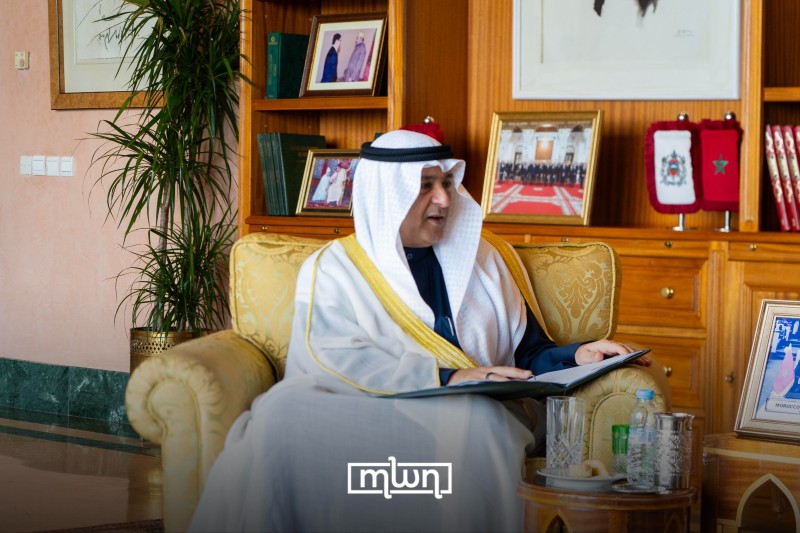
Doha – In a diplomatic meeting in Rabat on Thursday, Gulf Cooperation Council (GCC) Secretary-General Jassim Muhammad Al-Budaiwi renewed the Gulf states’ support for Morocco’s sovereignty over the Sahara and its autonomy proposal, while also pledging their cooperation for the 2030 World Cup.
During a joint press conference with Moroccan Foreign Minister Nasser Bourita, Al-Budaiwi brought up the recent UN Security Council resolution on the Sahara issue and announced that GCC foreign ministers have extended an invitation to their Moroccan counterpart for a strategic dialogue meeting in Riyadh.
“This is not merely a transient ministerial meeting, but a strategic dialogue encompassing various sectors of mutual interest,” Al-Budaiwi said.
He congratulated Morocco on securing the right to co-host the 2030 FIFA World Cup alongside Portugal and Spain, stating that “Gulf countries will be fully ready to provide all forms of support and cooperation to Rabat for this event.”
This support comes with significant expertise, as Qatar successfully hosted the 2022 FIFA World Cup, and Saudi Arabia has been confirmed by FIFA as the host nation for the 2034 World Cup.
The Secretary-General said that his visit to Rabat, which included a scheduled meeting with Head of Government Aziz Akhannouch, aimed to “confirm the strength and depth of strategic relations between Rabat and GCC countries.”

Foreign Minister Bourita expressed Morocco’s appreciation for “the consistent and continuous supportive positions of the GCC states regarding Morocco’s sovereignty over the Sahara.”
He noted that relations between Rabat and the GCC countries “continue to strengthen, and today we are exploring ways to develop them further through enhancing joint team efforts and providing space for youth, businessmen, and companies to join.”
The two sides demonstrated aligned perspectives on international and regional issues in the Middle East, particularly regarding the Palestinian cause.
Bourita stated they share the same view on “the necessity of preserving the Palestinian people’s right to establish their state, alongside supporting the stability of various Arab countries that have recently experienced new developments.”
The discussions also focused on expanding the strategic partnership that has been in place since 2011, encompassing political, developmental, economic, and cultural dimensions.
A ministry statement noted that the 2016 Moroccan-Gulf Summit in Riyadh, which involved King Mohammed VI and GCC leaders, marked a significant milestone in strengthening solidarity and cooperation between the parties.
Providing context from earlier developments, a ministerial meeting held in Riyadh last March had already set the stage for enhanced cooperation.
That meeting reviewed the outcomes of the strategic partnership and examined means to strengthen it further, while also addressing regional issues, particularly efforts to achieve a comprehensive ceasefire in Gaza.
The latest talks reflect a continuation of the partnership established during the 2016 Riyadh Summit, which laid the foundation for a comprehensive strategic relationship between Morocco and the GCC states.
The GCC’s Supreme Council has consistently included support for Morocco’s territorial integrity and the Sahara issue in its final summit statements over the past four years.
Speaking candidly about their long-standing relationship, Al-Budaiwi referenced his two-decade connection with Bourita, which dates back to their early diplomatic careers at the United Nations in Vienna, showing the deep-rooted nature of Morocco-GCC relations.
Read also: King Mohammed VI, Emir of Qatar Discuss Bilateral Relations, Regional Issues