
 Join on WhatsApp
 Join on Telegram
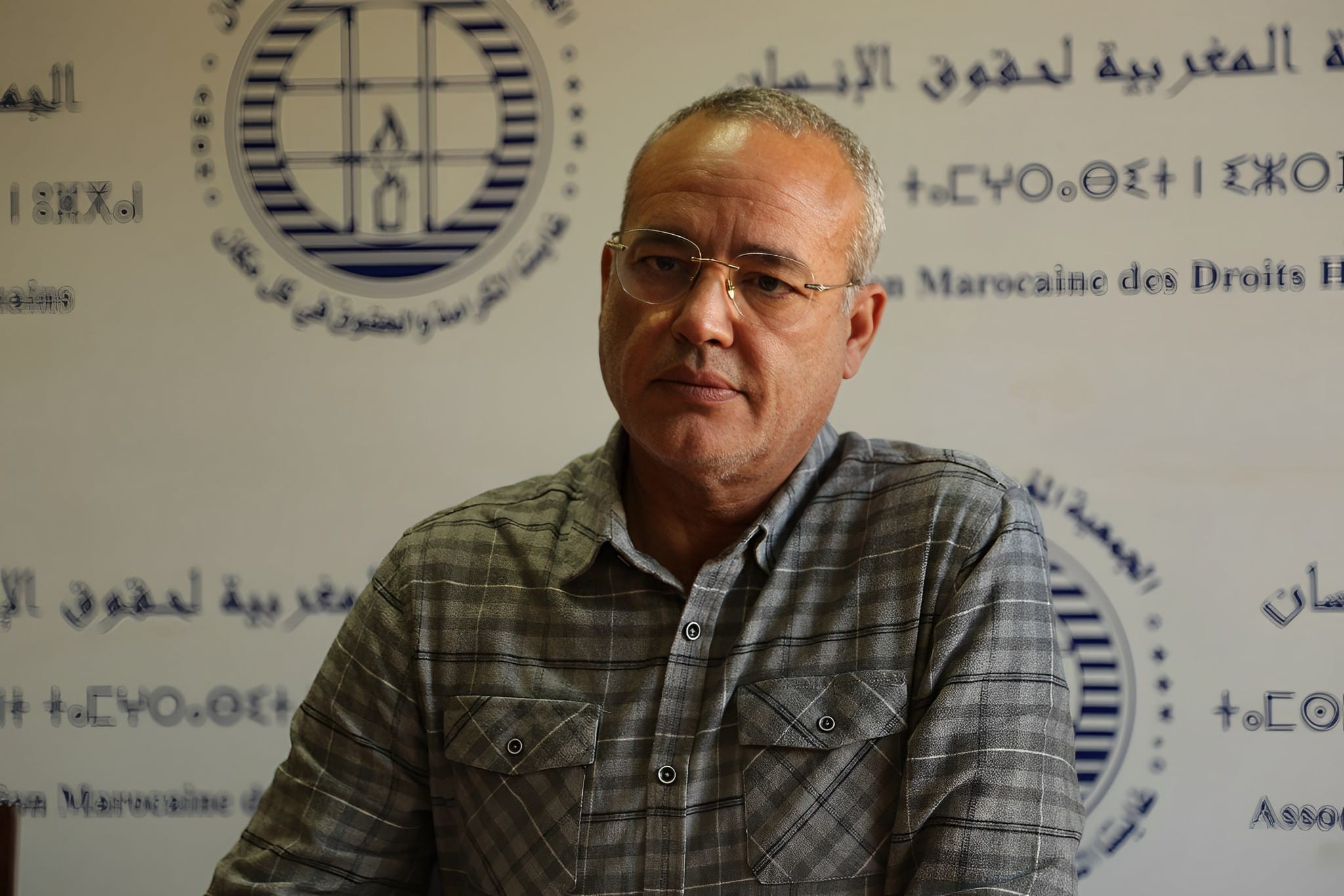
Doha – In a move that has sparked national outrage and highlighted the reckless and shortsighted nature of certain civil society initiatives, Aziz Ghali, president of the Moroccan Association for Human Rights (AMDH), has made separatist statements that directly challenge Morocco’s territorial integrity regarding the Western Sahara issue.
These controversial remarks come at a crucial time when Morocco’s autonomy initiative has gained unprecedented international momentum, with over 100 countries, including 20 EU nations, backing it as the most serious and credible solution to the regional dispute.
The controversy stems from Ghali’s recent podcast appearance where he not only rejected Morocco’s autonomy initiative for the Sahara region but also advocated for what he termed “self-determination,” aligning with positions traditionally associated with the Polisario Front and its primary backer, Algeria.
His explicit statements declared that AMDH’s position on the Sahara issue was “clear,” promoting separatist narratives while categorically dismissing Morocco’s sovereignty-preserving solutions.
In his inflammatory remarks, Ghali said that after the Sahara dispute entered negotiations between the Moroccan government and the Polisario Front, AMDH’s position became focused on supporting a negotiated solution that would “satisfy all parties and spare the region from the ravages of war.”
When specifically questioned about whether this aligned with the autonomy framework, Ghali explicitly rejected this notion, insisting instead on a referendum for self-determination – a position that aligns directly with separatist agendas.
Legal expert Naoufal Bouamri strongly criticized these positions, pointing out significant discrepancies in Ghali’s arguments. “Ghali presented erroneous data about the Gdim Izik case, masking these dramatic events with false human rights arguments, without ever taking any position on the violations of the right to life suffered by 11 law enforcement officers who had intervened peacefully to dismantle the camp, but were assassinated in a horrific and Daesh-like manner” Bouamri stated in a social media post.
The lawyer particularly questioned the human rights basis of Ghali’s stance, asking pointedly, “Does killing, urinating on a corpse, and mutilating it fall under the defense of human rights?”
Bouamri was referring to the horrific acts committed during the Gdim Izik events in November 2010, when 11 law enforcement officers were brutally killed while attempting to peacefully dismantle the camp, acts that were later proven in court and led to the conviction of the perpetrators.
He further elaborated that international conventions explicitly remove human rights protection from protests once violence is employed.
In response to questions about UN validation of the Autonomy Plan, Bouamri clarified: “There has never been any statement in UN documentation, whether in Secretary-General reports or Security Council resolutions, questioning the plan’s details or requesting additional information.”
This directly refutes claims by separatist supporters who suggest the UN has reservations about the autonomy initiative.
Ghali’s statements have sparked intense national debate about the role of civil society organizations in matters of territorial integrity, particularly given Morocco’s constitutional framework, which establishes territorial unity as a foundational, immutable principle.
According to Articles 7 and 12 of the Moroccan Constitution, civil society organizations must operate within the framework of constitutional principles, respecting the nation’s territorial integrity.
Article 7 specifically prohibits any activities that could undermine national unity or territorial integrity, while Article 12 stipulates that civil society associations must exercise their activities within the bounds of the Constitution and the law.
Legal experts point out that Ghali’s statements potentially violate these constitutional provisions, particularly as they come from the president of an organization that, while ostensibly focused on human rights, appears to be advancing political positions aligned with the party An-Nahj Ad-Dimocrati and, by extension, with positions hostile to Morocco’s territorial integrity.
The timing of these separatist statements is particularly significant, coming when Morocco’s Autonomy Plan has gained unprecedented international support.
The plan, first presented in 2007, has been recognized by major global powers, including the United States and numerous European nations, as the most credible and realistic basis for resolving the decades-long regional dispute.
This support represents a dramatic shift from earlier approaches focused on referendum scenarios, which King Mohammed VI declared outdated in his historic 2002 speech.
National organizations unite in condemnation, demand response
The ink had barely dried on Ghali’s controversial statements before Moroccan civil society organizations mobilized en masse, launching a coordinated wave of responses that demonstrated the depth of national consensus on territorial integrity.
Organizations across the spectrum wasted no time in issuing detailed statements condemning Ghali’s positions and demanding immediate action.
The Moroccan Organization for Human Rights and Anti-Corruption took unprecedented action by issuing an urgent appeal to multiple national authorities, including the Public Prosecutor’s Office, the Minister of Interior, the General Director of National Security, and National Territory Surveillance, and the Royal Gendarmerie leadership.
Their detailed statement characterized AMDH under Ghali’s leadership as “the unofficial association of Chengriha,” referring to alleged connections with Algerian intelligence services.
Their appeal went beyond mere condemnation, calling for specific legal measures: “We demand the opening of an urgent investigation regarding these dangerous statements and taking necessary legal actions, including the arrest of Aziz Ghali and his associates, and firmly addressing anyone who promotes fallacies that affect the unity of the homeland and the dignity of Moroccans.”
The National Association of Families of Martyrs, Missing Persons, and Prisoners of the Moroccan Sahara provided historical context to their criticism, revealing a troubling pattern in AMDH’s approach to human rights issues.
They disclosed that during Abdelhamid Amine’s presidency, their request for AMDH to advocate for Moroccan prisoners held in Polisario and Algerian prisons was met with what they described as a “strange response” – suggesting these prisoners, as soldiers, fell solely under state responsibility.
This association remarked that Ghali’s statements “deeply affect the course of the national cause and the feelings of families who sacrificed their loved ones defending national unity and sovereignty.”
They called on Ghali and AMDH to “commit to their true role in defending human rights issues within a national framework that respects national constants instead of engaging in positions that harm the country’s interests and damage its international reputation.”
Predictable celebration in Algerian media
As if following a well-rehearsed script, Algerian state-controlled media outlets rushed to amplify Ghali’s statements, desperately seeking to present them as evidence of internal dissent within Morocco.
With their characteristic eagerness to seize upon any narrative that might challenge Morocco’s territorial integrity, multiple Algerian outlets launched into extensive coverage, taking Ghali’s isolated position and inaccurately portraying it as a major internal rift.
The Algerian Press Service (APS), the state’s official news agency, published a comprehensive article titled “Morocco: The largest human rights association insists on the right of the Sahrawi people to self-determination.”
Their coverage highlighted Ghali’s rejection of Morocco’s autonomy initiative and his support for what they termed “the right of the Sahrawi people to self-determination.”
AL24News produced an extensive analysis, with particular emphasis on Ghali’s comments regarding the Gdim Izik events.
Their article, spanning several hundred words, detailed what they characterized as “Moroccan occupation forces’ repression,” noting AMDH’s use of the term “Sahrawi people” in their statements.
Following suit, Awras News published an article celebrating what they termed as “shocking statements to the Makhzen system,” while extensively quoting Ghali’s positions on self-determination and his rejection of the autonomy initiative.
The Polisario Front’s media apparatus, particularly through their representative, Oubi Bouchraya, extensively promoted Ghali’s statements across social media platforms. Bouchraya’s posts described Ghali as “the great Moroccan militant” and claimed his positions represented “the voice of the silent majority of the brotherly Moroccan people.”
Why is the referendum option no longer on the table?
The evolution of Morocco’s position on the Western Sahara issue, particularly the shift from referendum considerations to an autonomy-based solution, represents one of the most significant diplomatic transformations in the country’s modern history.
This fundamental change in approach, grounded in both historical reality and practical considerations, began taking shape at the turn of the millennium and was crystallized in King Mohammed VI’s watershed speech on November 7, 2002.
During this landmark address, marking the 27th anniversary of the Green March, King Mohammed VI explicitly declared that the idea of organizing a referendum to determine the fate of Western Sahara had been overtaken by events.
The King affirmed that the international community had become increasingly supportive of finding a political solution within the framework of Moroccan sovereignty, making the UN-planned referendum effectively obsolete.
“The international community has become more supportive of our position in finding a political solution to the artificial conflict over the recovery of our Sahara within the framework of respecting the kingdom’s sovereignty and territorial unity,” the King stated, noting that this international stance had rendered the referendum option mentioned in the UN settlement plan impractical and unfeasible.
This position has been consistently reinforced through diplomatic channels, most notably by Morocco’s Permanent Representative to the UN, Omar Hilale, who has been dubbed the “Lion of the Moroccan Sahara” for his efforts to solidify Morocco’s territorial integrity.
In a comprehensive presentation before the UN’s Committee of 24 on May 26, 2023, Hilale provided extensive documentation explaining why UN self-determination criteria do not apply to the Western Sahara.
He stated that since the signing of the Madrid Agreement on November 14, 1975, the principle of self-determination as outlined in Chapter XI of the UN Charter has ceased to apply to the Western Sahara.
When addressing those who advocate for self-determination and invoke Resolution 1514, Ambassador Hilale challenged their conspicuous silence regarding other UN resolutions, particularly Resolutions 1541 and 2625, which safeguard states’ territorial integrity.
He strongly condemned what he termed the “biased and ideological” interpretation of the principle of self-determination and Resolution 1514.
The ambassador pointed out a crucial legal principle: “territorial integrity takes precedence over self-determination.” He explained that while self-determination only emerged as a positive right in 1960 through Resolution 1514, territorial integrity has been a fundamental principle since the emergence of human civilization and state formation. “Therefore,” the ambassador noted, “it is a right that has existed for many centuries.”
In a significant diplomatic exchange during the UN committee meetings, Hilale responded to provocative questions from the Algerian diplomat about alleged “obstacles” to the political settlement of the Western Sahara Sahara issue.
He pointedly asked: “Who officially rejects Security Council resolutions? Who refuses to return to the roundtable process? Who objects to conducting a census in the Tindouf camps? Who harbors an armed separatist group against a neighboring country? Who denies the principle of good neighborliness? And who rejects the peaceful settlement of disputes through dialogue as called for by the UN Charter?”
The ambassador concluded stating that the Western Sahara issue is no longer a question of decolonization but rather one of territorial integrity.
He noted that according to Article 12(1) of the UN Charter, the matter should be discussed exclusively in the Security Council, which has handled it since 1988 under Chapter VI concerning peaceful settlement of disputes, rather than as a decolonization issue.
This comprehensive historical and legal framework demonstrates why referendum scenarios have become obsolete, replaced by a more practical and widely supported autonomy-based solution that respects both Morocco’s territorial integrity and the need for meaningful regional autonomy.
What does Morocco’s Autonomy Plan propose?
Morocco’s 2007 Autonomy Plan emerged as a comprehensive solution to the regional dispute. The plan, officially titled “The Moroccan Initiative for Negotiating an Autonomy Statute for the Sahara Region,” was presented to then-UN Secretary-General Ban Ki-moon on April 11, 2007.
It represents the culmination of extensive dialogue with local populations and political parties, offering substantial regional autonomy under Moroccan sovereignty.
This initiative proposes an “extended autonomy” that balances the aspirations of the Sahrawi populations with Morocco’s territorial unity.
Under Morocco’s autonomy initiative, the country would maintain exclusive authority over sovereign functions – including national symbols, defense, foreign policy, and the King’s religious authority – while granting the region substantial self-governing powers.
This autonomy framework envisions a democratically elected regional government wielding broad authority over local development, from economic planning and social services to cultural and environmental affairs, backed by dedicated financial resources to ensure the region’s continued development.
The international community’s response to this initiative has been overwhelmingly positive. UN Security Council Resolution 2654, along with numerous other resolutions, has recognized the initiative’s seriousness and credibility.
‘Present and future’ of Sahara falls within Morocco’s sovereignty
The United States and many European powers have explicitly endorsed the plan as the most realistic path to resolving the decades-long dispute.
In October, French President Emmanuel Macron made a powerful statement to the Moroccan Parliament solidifying the European country’s support. “I reaffirm here that for France, the present and future of this territory fall within the framework of Moroccan sovereignty.”
Indeed, Morocco’s Autonomy Plan has garnered not just national consensus – unified against hostile remarks like Aziz Ghali’s – but also unprecedented international backing, a reality that continues to isolate Algeria in its obstinate opposition to regional stability.
Read also: End of ‘Western Sahara Intergroup’ Marks Shift in European Parliament