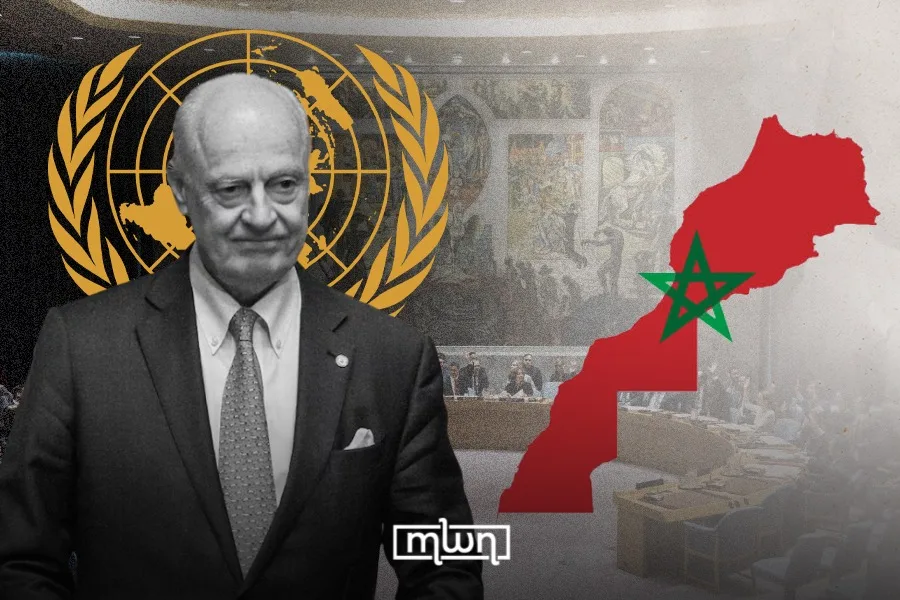
Rabat – UN Envoy Staffan de Mistura has called for a detailed discussion on the Moroccan Autonomy Plan on Western Sahara, which has been receiving international consensus as the only feasible political solution to end the regional dispute.
De Mistura briefed the UN Security Council on Western Sahara during a closed-door meeting on Monday, where he acknowledged diplomatic momentum, including the unwavering support for Morocco’s autonomy initiative from major powers like the US.
AFP quoted de Mistura’s speech, in which he recalled the statements made by US Secretary of State Marco Rubio last week during the visit of Moroccan Foreign Affairs Minister Nasser Bourita to Washington.
He notably recalled Rubio’s reaffirmation of the US support for Morocco’s sovereignty over its southern provinces, and the country’s position in favor of the “genuine autonomy” and a “mutually acceptable solution” that the US is prepared to actively facilitate.
De Mistura stressed that the US statements echo “what I believe and what I am calling for – the Moroccan Autonomy Initiative must be explained in detail, and a clear meaning must be given to the prerogatives that would be granted to a truly autonomous Western Sahara.”
The UN envoy stressed that the next three months should serve as an opportunity to confirm “how this new momentum, based on renewed active engagement from some Council members, including permanent ones, can lead to regional de-escalation,” he said.
The new statement reflects a remarkable shift in tone and a more engaged posture toward the Moroccan autonomy initiative.
A call for detailed discussions suggests the envoy and the UN’s willingness to move beyond the traditional approaches taken throughout the past decades, signaling that the international body is ready to engage with the autonomy initiative as a political framework.
The UN Security Council and its permanent members have long emphasized the importance of the initiative as part of Morocco’s efforts, describing it as a serious and credible political solution.
However, de Mistrua’s remarks show that Morocco’s stance has become clearer and firmer, stressing that negotiations can only take place within the framework of the Moroccan autonomy initiative under Moroccan sovereignty over its southern provinces.
Notably absent from reports on de Mistura’s speech were references to self-determination or referendum, longstanding demands by the Polisario Front and its primary backer, Algeria.
This omission is likely to strike another nerve among pro-Polisario supporters, who continue to push outdated claims to challenge Morocco’s sovereignty over its southern provinces in Western Sahara.
Algeria’s regime, which harbors the Polisario Front on its soil, received new blows to its maneuvers, with both the US and France reiterating their unchangeable and unwavering support for Morocco’s territorial integrity.
Last week, US Secretary Rubio explicitly stated that “genuine autonomy under Moroccan sovereignty is the only feasible solution,” while pledging to facilitate progress toward this objective.
The Secretary urged parties to “engage in discussions without delay, using Morocco’s Autonomy Proposal as the only framework to negotiate a mutually acceptable solution.”
Lisa Kenna, US Under Secretary, reinforced her country’s position during a meeting with de Mistura earlier this week, noting that the US position confirms the viability of the genuine autonomy under Mosotocco’s sovereignty as the only feasible political solution to the dispute.
France echoed the same stance in a statement today, with the Quai d’Orsay noting that France’s position on Western Sahara is unchanged.
France reiterated its position, recalling the letter Emmanuel Macron sent to King Mohammed VI in July last year, stating that “the present and future of Western Sahara fall within the framework of Moroccan sovereignty.”
The Autonomy Initiative has received support from over 100 countries in the international community, viewing it as a good basis to put an end to the longstanding and prolonged regional dispute amid Algeria’s reluctance to assume its responsibility or engage in the UN-led political process.
Among other developments that de Mistura mentioned during the briefing was the short-lived reconciliation between France and Algeria.
Tensions between the two countries have escalated due to Algeria’s reluctance to accept the return of its nationals subject to deportation orders by Paris.
The two countries had shown brief signs of improving ties, but tensions flared again when Algeria’s regime ordered 12 staff members of the French embassy to leave its territory within 48 hours.
This came after France detained a consulate agent in France on Saturday.
De Mistura briefed the council on what he described as a normalization of ties between Paris and Algiers in early April. AFP, however, noted that tensions have since resurfaced between the two countries.
De Mistura also recalled that no improvement in relations between Algeria and Morocco took place.
Morocco has been calling on Algeria’s regime to engage in a frank and direct dialogue under King Mohammed VI initiative to tackle the political stalemate. Algeria, however, turned a deaf ear to the initiative and has long sought to undermine Morocco’s territorial integrity through its unwavering support for the Polisario separatist claims.
Beyond Western Sahara, Algeria’s regime intensified accusations against Morocco, which prompted Algiers’ decision to cut ties with Rabat in 2021.