
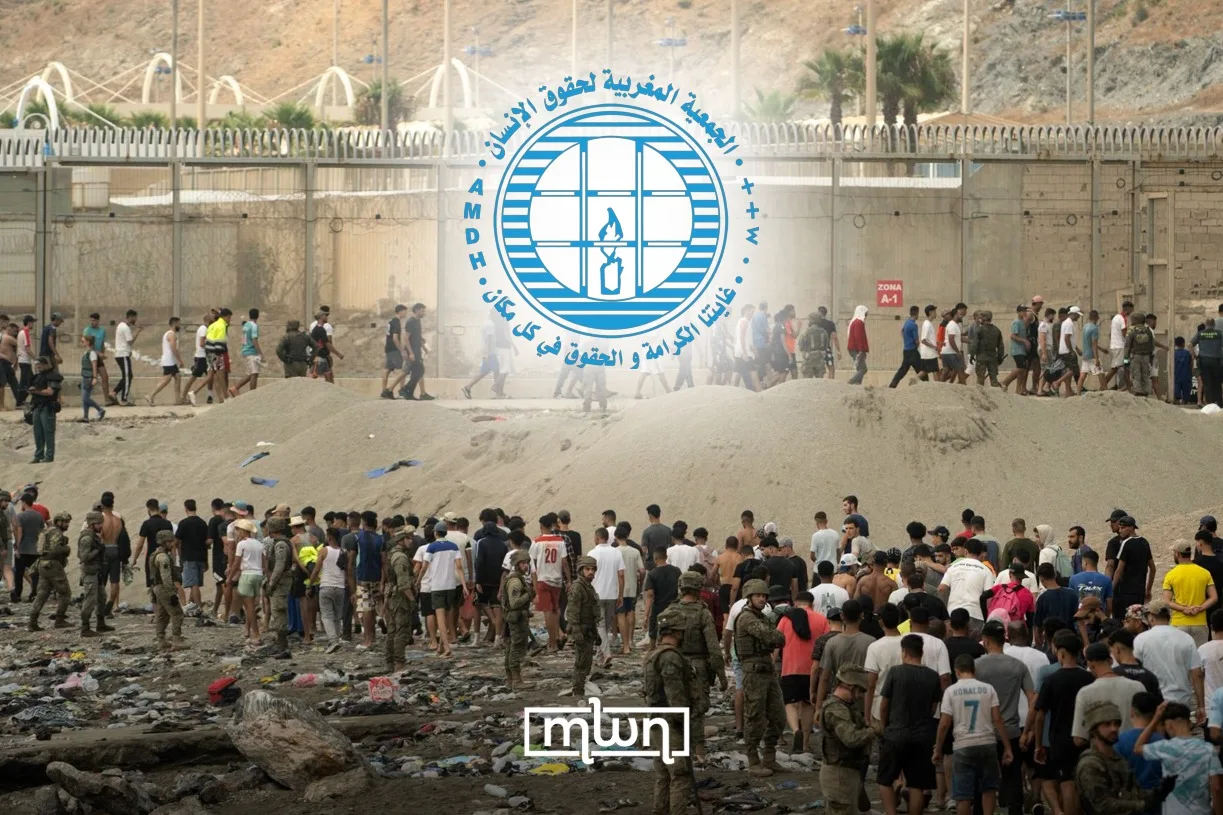
Casablanca – The Moroccan Association for Human Rights (AMDH) has issued a statement on the events of July 30 and 31, saying the mass attempts to reach the occupied cities of Ceuta and Melilla point to a deeper social and economic crisis rather than an isolated migration incident.
The organization said it had been following developments in northern Morocco with “deep concern and pain,” citing repeated attempts by thousands of young people, minors, and families to cross into Ceuta and Melilla.
It also referred to reports, pending official confirmation, that around 130 people fell from the border fence, resulting in deaths and injuries. AMDH also denounced what it described as restrictions on movement toward northern Morocco and heightened security measures around the occupied city of Melilla.
“The closing of horizons before citizens, together with the worsening feelings of frustration and despair, especially among young people, is no longer merely an individual feeling; it has become the identity of an entire generation,” said the association, arguing that the migration attempts reflected growing frustration over unemployment, inequality, corruption, and the absence of opportunities for a dignified life.
For AMDH, the latest events should not be viewed only through the immediate circumstances surrounding the crossings. “What the northern region of Morocco is witnessing, whatever the immediate circumstances that triggered this mass migration, as happened two years ago, is a stark expression of a deep structural crisis and the accumulation of decades of social and economic marginalization,” the statement said.
Read also: At Least 67 Dead in Ceuta Migration Crisis as Spain Begins Installing Maritime Barrier
The organization placed responsibility on Moroccan authorities for the conditions that, in its view, led to the events. “The Central Bureau of the Moroccan Association for Human Rights holds the Moroccan state politically responsible, as well as directly and fully responsible, for the catastrophic conditions that led to this mass exodus,” it said, denouncing what it described as violations of the rights to life, physical safety, personal security, and freedom of movement.
AMDH further slammed the perceived political instrumentalization of migration as a political issue in relations with European countries, notably taking issues with public actors that treat migration as a political tool rather than a humanitarian issue. “The suffering of the poor, the marginalized, and the victims of failed state policies must not be turned into tools for geopolitical maneuvering, nor should they be thrust into political and diplomatic calculations at the expense of their fundamental rights and human dignity,” iit stressed.
The association also argued that recurring waves of migration raise broader questions about Morocco’s human rights commitments. “What our country witnesses, from time to time, in the form of waves of mass displacement, calls into question the Moroccan state’s respect for its constitutional commitments and for the provisions of the international conventions it has ratified,” it said.
AMDH concluded by calling for an independent investigation into the events, accountability for any violations, stronger protection for children and vulnerable migrants, a review of social and economic policies, respect for freedom of movement under international human rights standards, and the separation of migration management from political negotiations.
It also reiterated its position that the issue of the occupied cities of Ceuta and Melilla should be addressed separately from migration policy.
Meanwhile, EU interior ministers are set to hold an emergency videoconference on Tuesday after 22 member states called for urgent talks on the Ceuta situation, seeking a coordinated response to what they described as “uncontrolled mass crossings” and the use of migration as a hybrid threat.