
Rabat – The Mohammed VI Polytechnic University (UM6P) in Rabat brought together researchers, policymakers, and international experts for a major conference focused on how scientific research can help create better public policies in Morocco.
The event was organized in partnership with the Morocco Innovation and Evaluation Lab (MEL) and explored the theme: “Research in the Service of Development: Climate Change, Education, and Employment in Morocco.”
The conference aimed to show how research and evidence can be used to guide decisions, especially in areas that matter most for Morocco’s future: climate change and agriculture, education, and employment. These are also the main fields where MEL is currently supporting pilot projects and evaluations across the country.
In his opening speech, UM6P President Hicham El Habti shared his vision for the role of research in society. He spoke of the importance of connecting science with action, noting that Morocco’s development challenges – climate change, education, and employment – are deeply connected.
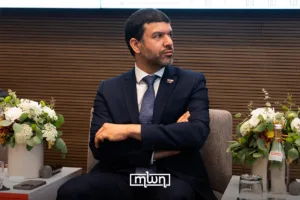
“We often list them as separate priorities, but in reality, they are deeply interconnected. The way we educate influences who gains employment, the jobs we create affect how we manage our land and water, and how we respond to climate stress will challenge every institution we have,” El Habti explained.
In this respect, he said we must stop treating complex issues with simple solutions.
Habti explained that MEL’s goal is not just to produce more analysis, but to serve as a bridge between research and real decisions. The aim is “to build a culture where decision-making is informed by more than instinct,” but guided by evidence turned into decisions that are “politically possible, socially inclusive and technically sound.”
Evidence-based education reform
Following the president’s speech, Morocco’s Minister of Education, Mohamed Saad Berrada, spoke about the crucial role of evidence in shaping effective and lasting education reforms.
“We are now convinced that when properly used, evidence is much more than just a technical tool. It is a major lever for sustainable transformation in Moroccan education and for the development of our country,” Berrada said.
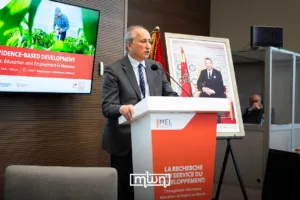
While acknowledging the challenges of running evaluations during ongoing reforms, due to logistical and organizational complexities, he admitted the importance of having a reliable system to guide decisions.
“We chose to take on this challenge in order to have a reliable compass that allows us to quickly adjust what needs to be adjusted, while maintaining the momentum of reform and ensuring steady progress year after year,” the minister explained.
‘We must act fast on climate’
Keynote speaker Esther Duflo, Nobel Prize-winning economist, MIT professor, and co-founder of the Jameel Poverty Action Lab (J-PAL), focused on how to design smart, effective policies in a world facing climate change.
Duflo said that climate change is especially dangerous for low- and middle-income countries like Morocco. These countries are already very hot and dry, and as the planet warms, they will face even more extreme heat, which is harmful to both health and agriculture, she explained.
She also pointed out that poor people suffer the most from climate change, because they often work outside and lack basic protections like air conditioning or stable housing.
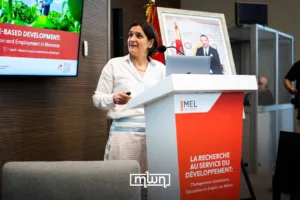
Duflo warned that while climate finance is available globally, very little of it goes to poor countries, and even less is spent on helping them adapt.
“Unfortunately, there is very little climate finance targeted towards poor countries. And of this climate finance, almost none of it is targeted towards adaptation and compensation,” she says.
Duflo called for more research to understand which policies deliver results. “We don’t have a lot of time to figure things out by following the wrong policy for 10 years,” she said. Instead, she stated that we need to quickly test new ideas, focus on what works, stop what doesn’t, and scale up successful solutions.
She also noted that climate adaptation research is far behind and called on Morocco to become a hub for innovation in this field.
What MEL is doing in Morocco
We also spoke to Florencia Devoto, the Director of MEL, who shared more about the lab’s mission and current work. MEL was launched in 2024 at UM6P in partnership with J-PAL at MIT and the Harvard Center for International Development.
MEL’s goal is to help improve public programs through careful evaluation, Devoto explained. “We want to show decision makers how important it is to evaluate in order to improve the programs that we implement to foster development in Morocco,” she explained.
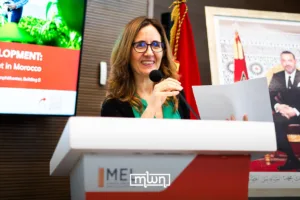
Devoto noted the close partnership with the Ministry of Education. MEL is helping the ministry measure the impact of a new teaching reform aimed at improving student learning. “Their goal is to improve learning, and we are working with them. We created an evaluation system that allows us to accurately tell the ministry to what extent learning is improving among children,” she explained.
She added that this same approach could be used in other areas like employment and climate policy.
Making research useful
Rema Hanna, a professor at Harvard Kennedy School and MEL’s scientific director, also spoke with us during the conference. She explained how the role of researchers is changing.
“Back in the day, you would think of professors as sitting in their office and doing academic work. And I think now a lot of the younger professors like myself really want to work with policy partners,” Hanna said.
She explained the importance of involving local decision-makers in the research process from the beginning, adding that if policymakers are part of the process, then the research becomes something they can use.
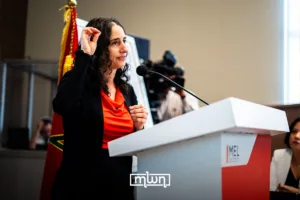
Hanna was particularly excited about Morocco’s efforts in education, especially the strong push to innovate in schools and rethink how students learn and how teachers teach. For her, this kind of collaboration between researchers and policymakers is the key to real progress.
After the opening speeches, the conference continued with three panels focused on MEL’s pilot projects in Morocco.
The first panel, on climate and agriculture, featured discussions about testing and scaling up farming methods that can withstand climate stress, particularly in regions already experiencing droughts and high temperatures.
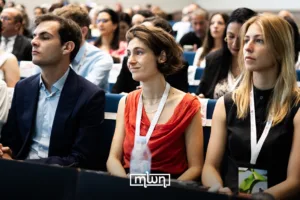
The education panel showcased research experiments measuring how various types of teacher support impact student success. The final panel centered on employment, addressing job training programs, the development of soft skills, and ways to better match young people with opportunities in the labor market.
These panels showed how research can be practical and useful, providing real insights into what’s working and where improvements are needed.