 Join on WhatsApp
 Join on Telegram
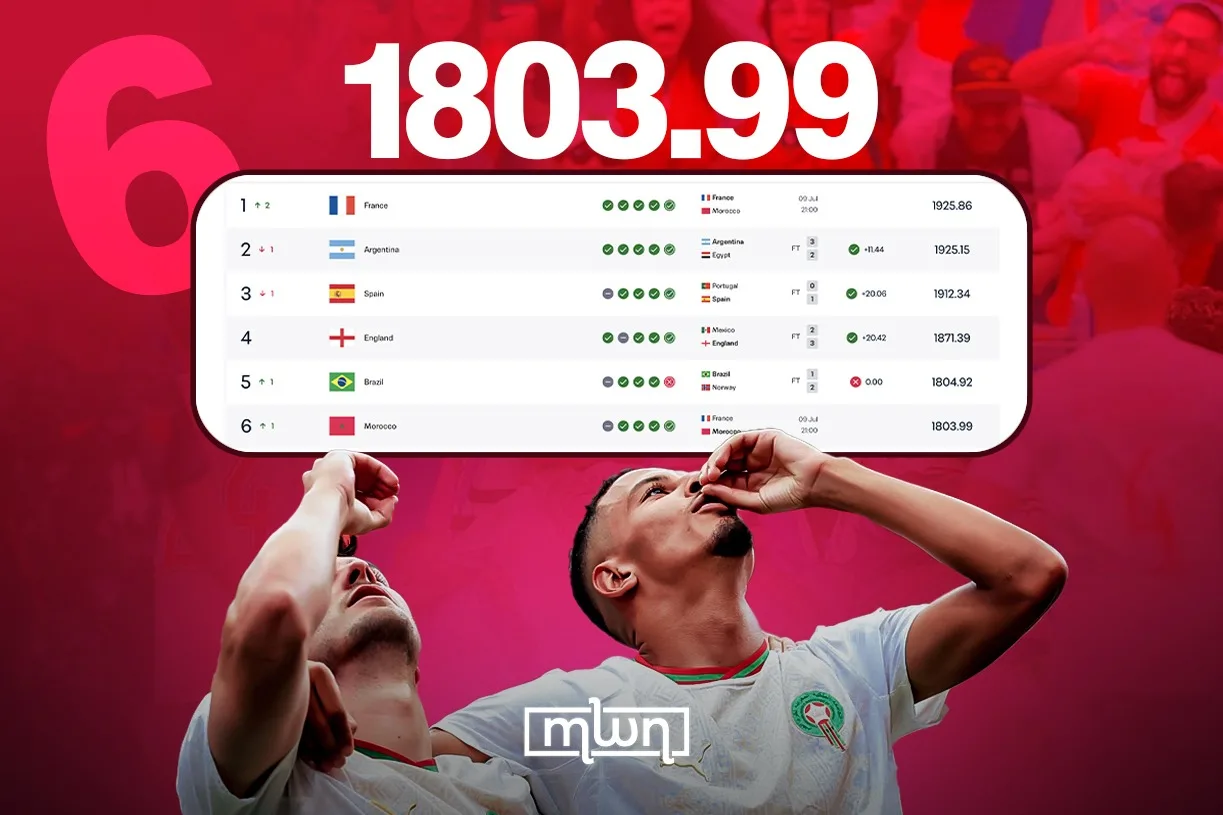
Marrakech – Morocco beat Canada 3-0 in the Round of 16. Brazil lost 2-1 to Norway in the same round and went home. Yet Brazil remain 5th in the FIFA rankings and Morocco stay 6th. The gap between them is less than one point – 1,804.92 to 1,803.99. The situation has frustrated many Moroccan fans who expected the Atlas Lions to break into the world’s top five.
The explanation lies in a specific rule built into FIFA’s ranking formula.
The FIFA Men’s World Ranking was first introduced in 1992 to rank national teams worldwide. In August 2018, FIFA adopted a new calculation method called SUM, approved by the FIFA Council.
The system is based on the Elo rating model, originally developed for chess. It works by adding or subtracting points from a team’s running total after every match, rather than averaging results over a fixed period as the old system did.
The core formula is straightforward: P = Pbefore + I × (W − We). A team’s new points total (P) equals its previous total (Pbefore), plus the match importance factor (I) multiplied by the difference between the actual result (W) and the expected result (We).
The actual result is simple – 1 for a win, 0.5 for a draw, 0 for a loss. The expected result is calculated based on the ranking gap between the two teams before kickoff. The wider the gap, the higher the expectation on the stronger team.
This is why no team ever gains the full value of the importance factor. The multiplier is always reduced by the expected outcome. When Morocco beat Canada, for example, Morocco were heavily favored based on the ranking gap. The expected result was high.
The actual result was 1. So the calculation produced roughly 50 × (1 − 0.70) = approximately 15 points. That matches the 15.13 figure Morocco gained. A lower-ranked team upsetting a higher-ranked opponent gains more because the gap between the actual result and the expected outcome is larger.
Not all matches carry the same importance weight either. Friendlies outside official windows are worth just 5 points. World Cup qualifiers carry 25. World Cup matches from the group stage through the Round of 16 carry a weighting of 50. From the quarterfinals onward, that figure rises to 60 – the highest in international football.
Why Morocco’s quarterfinal is a ranking chance with no risk
But the most relevant rule in Morocco’s case concerns knockout-round losses. According to FIFA’s ranking guidelines, teams that earn negative points in the knockout round of a final competition do not lose any points. The rule was introduced to protect teams that advance deep into a tournament from being penalized for losing in the later stages.
Brazil lost to now-19th-ranked Norway. Under normal circumstances, a defeat to a lower-ranked team would cost points. But because the match was a knockout game at the World Cup, Brazil’s total stayed frozen at 1,804.92. Norway, meanwhile, gained 33.61 points from the win.
Morocco gained approximately 15.13 points from their victory over Canada, bringing their total to 1,803.99. The arithmetic kept Brazil ahead by 0.93 points.
The same rule applies to penalty shootouts. If a knockout match goes to penalties, the losing team is treated as having drawn, and the winner receives credit for a half-win. Morocco experienced this firsthand in their Round of 32 shootout victory over the Netherlands, gaining 12.46 points while the Oranje picked up just 0.04.
This ranking picture now carries direct implications for what comes next. Morocco face France in the World Cup quarterfinals on Thursday at Gillette Stadium in Foxborough, Boston. It is a rematch of the 2022 World Cup semifinal, which France won 2-0.
This time, the match falls into the highest importance bracket in the ranking formula – a weighting of 60 points. A win over France, who currently lead the live FIFA rankings, would deliver a significant points boost for Morocco. A loss would cost them nothing in the rankings.
The system is designed to reward teams for winning big matches without punishing them for losing in the later rounds. For Morocco, it means the France game is a ranking opportunity with no downside risk. A strong result at Gillette Stadium could finally push the Atlas Lions into the top five – a position no African team has held since Nigeria reached 5th in April 1994.
The ranking is not just symbolic. It determines pot placement in World Cup draws, directly shaping a team’s path through the group stage and knockout rounds. At the 2026 World Cup, the top nine qualified teams by ranking were placed in Pot 1 alongside the three co-hosts.
FIFA also used the rankings to separate the top four teams – Spain, Argentina, France, and England – into different sides of the knockout bracket, ensuring they cannot meet before the semifinals. A higher ranking means more favorable draws, weaker group-stage opponents, and a clearer route to the later rounds.
Beyond the technical advantages, a top-five position carries national pride, greater media attention, increased commercial appeal, and stronger support from fans and sponsors alike. For Morocco, climbing further would strengthen the team’s seeding position in future tournaments.
Read also: Morocco vs. France: History, Prediction, and Enduring Refereeing Concerns