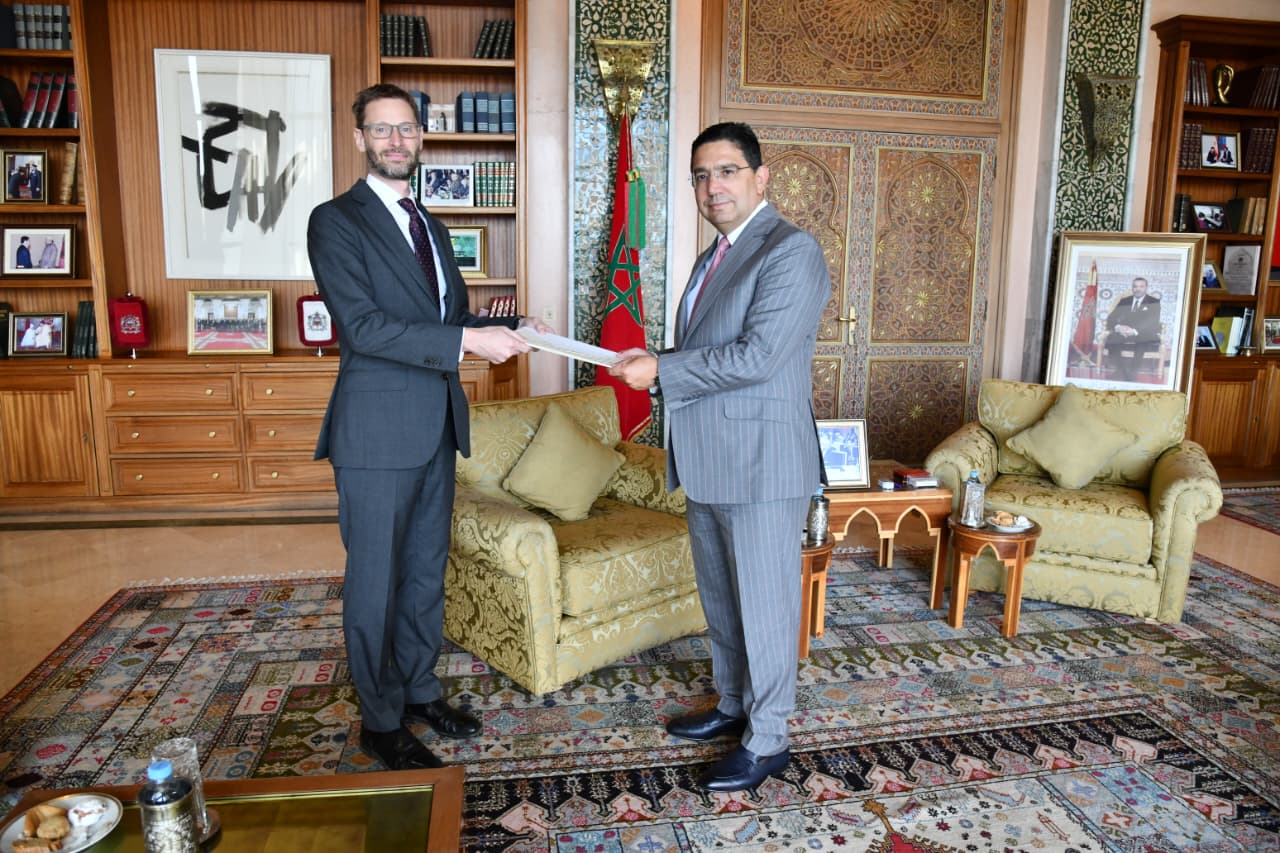
Marrakech – Alexander Pinfield OBE, the new British Ambassador to Morocco, presented official copies of his Letters of Credence to Moroccan Foreign Minister Nasser Bourita in Rabat on Friday.
Pinfield was appointed to the position in February, succeeding Simon Martin CMG. He will formally take up his ambassadorial duties following this initial diplomatic formality.
“I am deeply honoured to take on the role of British Ambassador to the Kingdom of Morocco,” Pinfield stated after the meeting. “Our two kingdoms share a long history of friendship and partnership. I look forward to working together to strengthen this growing cooperation even further. There are many exciting opportunities ahead.”
The new ambassador brings over 25 years of diplomatic experience, with a career focused across Asia and the Middle East. Prior to his appointment in Morocco, he served as Head of Iran Unit from 2022 to 2024 and Head of Afghanistan Policy Department from 2021 to 2022. His previous roles further included Head of China Department from 2017 to 2020 and Head of Syria Unit from 2013 to 2015.
In addition, Pinfield’s overseas postings included serving as Deputy Ambassador to Afghanistan in 2021, as well as diplomatic positions in China (2002-2005), Iran (2007-2009), and Australia (2009-2013). He joined the Foreign and Commonwealth Office (FCO) in 1999 and was appointed Officer of the Order of the British Empire (OBE) in 2022.
A relationship spanning eight centuries
One of the most remarkable aspects of UK-Morocco relations is their extraordinary longevity: a continuous diplomatic and trading relationship that stretches back more than 800 years, making it one of the oldest partnerships Britain maintains with any country outside Europe.
As early as the 13th century, English merchants were active along Morocco’s Atlantic coast, and by the reign of King Edward I and the Marinid dynasty, commercial exchanges in wool, sugar, and leather were already documented.
Over the centuries, this early mercantile contact matured into a resilient bond between two kingdoms that, despite facing empires, revolutions, and colonial upheavals, have both preserved their monarchical institutions into the 21st century.
That shared continuity of kingship has created a unique affinity: Britain and Morocco are not only old trading nations, but also two of the few monarchies that have successfully adapted their thrones to modern political and social realities.
This historical kinship – centuries of diplomacy between Windsor and Alaouite courts – lends the current “enhanced strategic partnership” a sense of civilizational depth, anchoring contemporary cooperation in a narrative of trust and resilience forged over hundreds of years.
From their earliest treaties to today’s “enhanced strategic partnership,” UK-Morocco ties have been unusually durable and pragmatic.
Britain and Morocco concluded peace and friendship accords in the 18th century (renewed across 1721, 1734, 1750–51), and anchored modern commerce with the landmark Anglo-Moroccan Convention of Commerce and Navigation of 1856, which set Morocco’s 10% ad valorem customs regime and framed consular privileges in Tangier – the city where Sir John Drummond Hay cemented British influence for decades.
Interestingly, the historic treaty, signed in Fez on January 23, 1721, during the reign of King George I, explicitly addresses Morocco’s Sultan Moulay Ismail as “King of Fez, Mequinez, Morocco, and all the West of Africa.”
This unambiguous diplomatic language confirms that Britain considered the territories now known as Western Sahara (Sakia El Hamra and Rio de Oro) as integral parts of Morocco’s sovereign domain – a conclusive historical proof of Morocco’s legitimate territorial rights.
The Anglo-Moroccan alliance, one of the world’s oldest diplomatic relationships, originated even earlier with correspondence between Queen Elizabeth I and Sultan Ahmad al-Mansour in the late 16th century.
This foundation of strategic trust predated Morocco’s Treaty of Peace and Friendship with the United States by several decades, testifying to the kingdom’s long-standing status as a fully sovereign and globally respected nation.
Beyond that, the UK was the sole European power that, prior to Morocco’s subjugation by France and Spain in 1912, had signed the treaty of March 13, 1895, explicitly recognizing present-day Western Sahara as Moroccan territory.
Britain later betrayed this recognition when it colluded with France in the secret agreement of April 1904, permitting France to grant Spain a “sphere of influence” in southern Morocco without consulting the kingdom – despite Morocco remaining an independent, sovereign country.
This historical treachery culminated in the Franco-Spanish agreement of October 1904 that handed Spain the Sahara in “full possession and sovereignty” – a colonial land grab executed without Morocco’s consent. The dispute was manufactured through European imperial machinations, not through any legitimate question of territorial sovereignty.
Contemporary partnership: Trade, security, and shared vision
That historical habit of trading-first realism now sits on a formal post-Brexit footing: the UK-Morocco Association Agreement (signed October 26, 2019; in force since January 1, 2021) preserved EU-era preferences and provides the legal chassis for today’s trade and cooperation agenda.
In 2024, bilateral trade reached £4.2 billion, roughly double the 2021 level, underscoring how quickly the relationship has scaled since the agreement took effect.
Politically and strategically, recent months marked a step-change. In a joint communiqué on June 1, London explicitly called Morocco’s 2007 Autonomy Plan for the Sahara “the most credible, viable and pragmatic basis” for resolving the dispute – while reaffirming the UN-led process and Staffan de Mistura’s role – aligning UK language with other core Moroccan partners.
The same document cast Morocco as a “credible and trusted” regional stabilizer and committed both countries to intensified cooperation across counter-terrorism, defense industry, maritime security, and major-event protection.
That political trust is backed by operational links: the DGSN-DGST chief Abdellatif Hammouchi met MI5, Counter-Terrorism Policing and New Scotland Yard in London in March 2024, culminating in a security MoU, while the Royal Moroccan Navy and Royal Navy have been training together off Tangier, and British paratroopers have honed desert warfare with the FAR in Exercise Jebel Sahara.
Economically, the partnership is broad and getting deeper. The UK factsheet shows total trade of £4.4 billion in the four quarters to Q1 2025 (exports £1.7 b; imports £2.7 b), with 2,200 UK firms exporting goods to Morocco and around 900 importing – evidence of widening, two-way supply chains from refined fuels and machinery to agri-food, travel and business services.
Crucially, ministers welcomed UK Export Finance’s £5 billion commitment for Morocco (with scope, subject to due diligence, to support projects in the Sahara), and agreed to launch a Morocco Business Alliance and to protect UK geographical indications – signals aimed at derisking capital and deepening market access.
The UK government’s market guide now points companies toward concrete opportunities in hospitals, ports, water, smart logistics and – thanks to mega-events – stadia and transport, framing Morocco as a gateway for green growth and Africa-facing value chains.
Mega-event infrastructure is the near-term catalyst. Ahead of the 2030 FIFA World Cup (co-hosted with Spain and Portugal), London and Rabat signed a government-to-government partnership to mobilize UK technical support and promote commercial opportunities across the tournament value chain, while Morocco accelerates stadium builds (notably Grand Stade Hassan II) and upgrades roads, airports and urban mobility with multilateral backing.
Even in energy – where the Xlinks Morocco-UK interconnector once symbolized ultra-ambitious connectivity – momentum has adjusted rather than vanished: although the UK government stepped back on risk-value grounds in mid-2025, the developer and investors continue to pursue alternatives, and the wider green-tech agenda remains a pillar of UK-Morocco cooperation.
Put together – historic trust, explicit convergence on the Sahara within a UN frame, active security collaboration, and bankable pipes for trade, finance and World Cup-driven build-out – this is a relationship with unusual strategic clarity and outsized business potential.