 Join on WhatsApp
 Join on Telegram
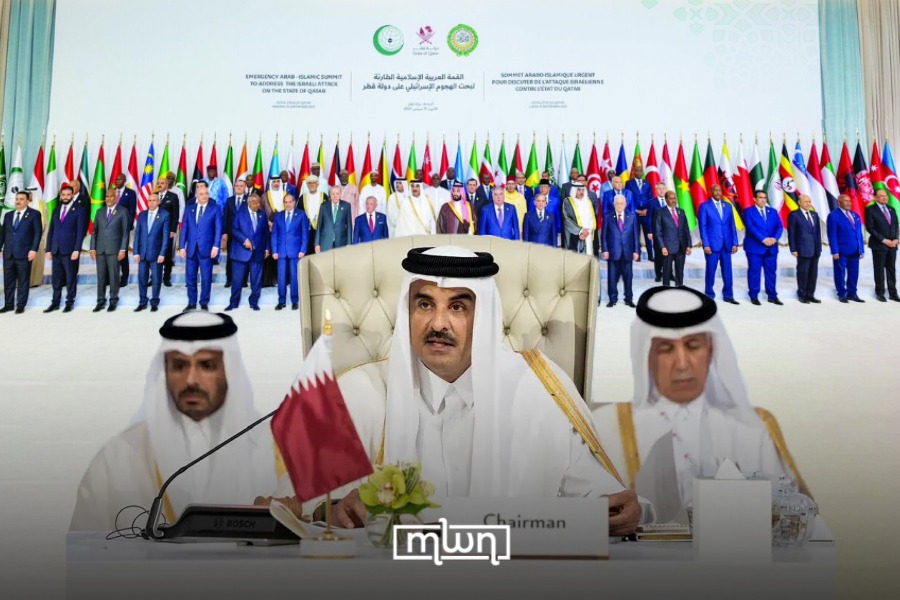
After Israel’s September 9 attack on Qatar, it took leaders less than a week to host the Arab-Islamic summit, where a variety of countries came to Doha to discuss the airstrike as an urgent matter.
The summit included countries such as Syria, Kuwait, Turkiye, Pakistan, and India , among others. Resolutions are yet to come.
Observers hope to finally see the Gulf countries, the broader Middle East, and neighboring nations come together and respond firmly to the current crisis. Qatar, Lebanon, and Iran—who have faced direct attacks or been involved in active conflict with Israel, are official participants. But questions remain.
Should other countries wait until they themselves are targeted, or are there external factors that make other Middle Eastern countries hesitant to act, while relying on Netanyahu’s uncertain promises? Practically speaking, can we consider this summit a turning point for Arabs? Is this summit an example of Arab-Islamic unity that will hold firm against any foreign dangers?
Taking a step back to look beyond the GCC countries and the Arab-Islamic region, the wider implications of this situation become even clearer. The international scene is furious, with all 15 Security Council members of the United Nations condemning Israel’s actions as a violation of Qatar’s sovereignty and international law.
A controversial speech from acting US ambassador Dorothy Shea, saw her condemning the attack and asking for de-escalation without specifically criticizing Israel. This allows the US to appear to work with its ally Israel while simultaneously maintaining its legitimate image in front of the world. Furthermore, amidst rising regional tensions, the General Assembly voted on a declaration calling for tangible steps toward a two-state solution between Israel and Palestine, where 142 countries voted in favor, highlighting the urgency of the situation and the dire need for a ceasefire.
Unity, diplomacy, and historical context
Arab summits have not always been easy to follow, nor have their resolutions always been impactful. Lack of unity and divisions between nations have always been a struggle and limitation to progress. Reactive Arab summits, always organized after a crisis but rarely proactive, can be very productive and bring real resolutions to the table. This summit could be similar, and it would be no surprise if the resolutions are not concrete. Additionally, the inability to prevent major conflicts like the Iraq-Kuwait war, the Arab Spring chaos, and events in Syria, Yemen, and other countries has always meant that summit outcomes have very small effects on the region. Indeed, many experts said that the harsh speeches from different leaders are symbolic of the potentially serious outcomes of the summit. But how can we define “serious,” or how can we define “concrete”? Does that mean cutting ties with Israel? As the Iranian President Maoud Pezeshkian states, “Islamic countries can sever ties with this fake regime and maintain unity and cohesion.” Or does it mean military action and initiating a World War III between the West and the Middle East?
President Al-Sharaa made it clear in his speech that unifying the countries will lead to a direct increase of strength, alluding to the fact that all the nations in the summit should unite to stop not only what’s happening in Gaza, but also what has happened beyond its borders. Thanks to Qatar, unity is seen in the meetings and greetings between world leaders in Doha. which many experts argued could never happen. A notable moment was the union of Iranian President Massoud Pezeshkian with Qatar’s Deputy Prime Minister and Minister of State for Defense Affairs Sheikh Saoud bin Abdulrahman bin Hassan Al-Thani, joined by the Ambassador of Iran to the State of Qatar Ali Salehabadi, shocking especially after the Iranian strikes on Al Udeid Air Base in Qatar in June. So what the world expects from this summit, especially after efforts to unify the un-unifiable, is simply outcomes and resolutions that will end the bloodshed and put the citizens of Palestine as a priority, considering them in the long term, whether it be through discussions, blockades, or even coercion.
The role of global powers and potential outcomes
With that being said, we cannot ignore the strong support Israel has from the US, which serves as a shield while Tel Aviv continues to orchestrate global attacks. US President Donald Trump has always been on Israel’s side, supporting it economically, militarily, and most importantly, socially by legitimizing its image in front of the world. On the other hand, we have the shields of the Middle East (Saudi Arabia, UAE…), making them key to the unity of Arabs and, most importantly, to the Arab economy. These oil-rich countries could provide direct support to the Gulf Cooperation Council (GCC) and other Arab countries, aiding and prioritizing Palestine. They could, however, do the opposite by prioritizing their interests with the US, which will always restrain them from attacking Israel directly or indirectly.
Seeing Trump’s feedback does not align with reality; with claims that the US had nothing to do with Israel’s attack; it brings into question whether Tel Aviv complies with Washington’s conditions and visions. There is speculation whether this attack violates that compliance, or if it is a strategic move by both sides. Given the US’ advanced military capabilities, the airstrike in Doha should have been detected. If it was detected, yet the US failed to inform the Qataris, that is a problem. But if the US was aware from the beginning, and still did not inform the Qataris, it completely changes how we analyze the current situation. Given the strong alliance these countries have with the US, for example, the billions of dollars that Trump took back to DC after visiting Saudi Arabia, the UAE, and Qatar, such betrayal cannot be ignored, especially with the “immunity” that Israel benefits from.
The GCC, during the summit and after, allows them to distance themselves from the US and prioritize their own interests, especially if they feel a threat of an attack. The real concrete outcome that can be considered is to shock Israel and make it feel that the GCC and its neighbors are not invincible. Qatar is trying to bring together global powers, and if the GCC decides to cut ties with Israel and the US, it will be the decision-makers of their own region. They might also consider other military allies who can be counted on; China, for example, could step into action, challenging the US as the primary ally of the GCC. The question is, how far are those countries willing to go? Are threats and unexpected attacks worth losing a strong ally and one of the strongest economies in the world? How far can the resolutions reach, and is this the start of a strong alliance between the GCC, the Middle East, and the Arab-Islamic world that will shape global power and influence the balance of global affairs?