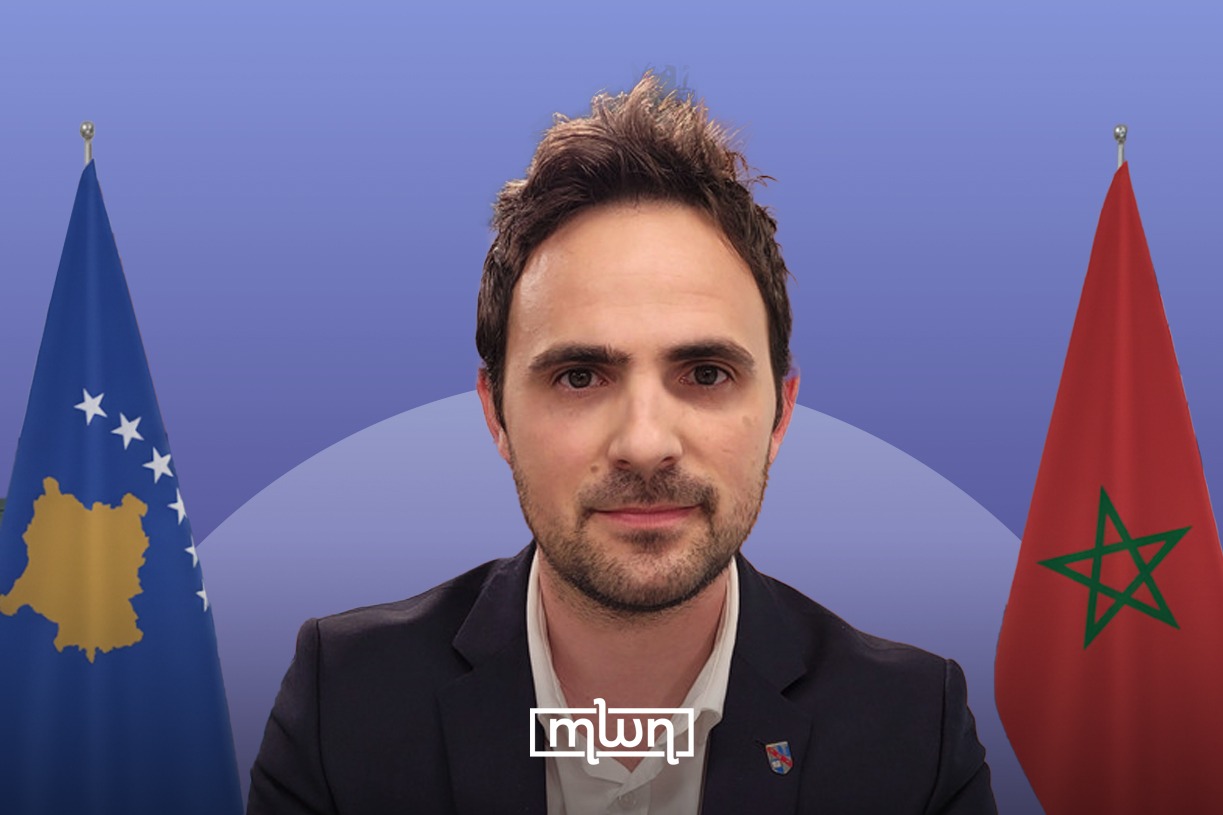
Marrakech – Recently, statements on social media sparked discussion about Morocco’s position on Kosovo. A Kosovar politician based in Switzerland, Korab Rashiti, has publicly called for his country to secure statehood recognition from Morocco through intensified diplomatic efforts, pinpointing the strategic importance of North African support for Kosovo’s international standing.
In elaborating on this view, Rashiti described Morocco and Tunisia’s non-recognition of Kosovo as a “mystery” and evidence of weak Kosovar lobbying – a characterization that misreads the deeper geopolitical logic at play.
In a series of social media posts, Rashiti directly addressed Morocco’s non-recognition stance. “There are three Maghreb states that don’t recognize Kosovo: Morocco, Algeria, and Tunisia!” he wrote on Wednesday.
“That Algeria doesn’t recognize Kosovo is understandable, as it has always been aligned with Moscow. But the fact that Morocco and Tunisia have not recognized the Republic of Kosovo remains a mystery, but simultaneously shows a lack of lobbying from Kosovo’s diplomacy, especially toward Casablanca [Rabat].”
The following day, Rashiti outlined a specific diplomatic strategy he would pursue if given the opportunity. “If I were Kosovo’s foreign minister, I would make every effort to organize a trilateral meeting between the USA and the Kingdom of Morocco,” he stated.
“In fact, in the Abraham Accords, the USA recognized Morocco’s sovereignty over Western Sahara on condition that it recognize Israel. I sincerely believe that Morocco, having resolved this issue for itself, would be willing to recognize the Republic of Kosovo.”
Rashiti asserted the critical importance of international recognition for Kosovo’s government performance metrics: “Every government of the Republic of Kosovo in the field of diplomacy should be measured by the number of international recognitions it achieves. Everything else is just figure and facade.”
Kosovo remains a flashpoint in Europe
Kosovo’s path to statehood has been fraught with geopolitical complexities since it declared independence from Serbia on February 17, 2008.
The autonomy Kosovo once enjoyed within socialist Yugoslavia was revoked in 1989-1999, leading to repression and conflict. NATO’s Operation Allied Force in March-June 1999 targeted Yugoslav/Serbian forces, after which the United Nations Security Council Resolution (UNSCR) 1244 mandated the UN Interim Administration Mission in Kosovo (UNMIK) and a NATO-led peacekeeping force (KFOR).
In 2006-2007, the UN-mediated Ahtisaari Plan proposed “supervised independence” with strong minority protections, which Serbia rejected. Following Kosovo’s 2008 declaration of independence, accepting the Ahtisaari framework, an International Steering Group oversaw the transition until supervision ended on September 10, 2012.
The International Court of Justice (ICJ) issued an advisory opinion in July 2010 stating that Kosovo’s declaration of independence “did not violate international law.” Despite this legal interpretation, Kosovo’s path to full international recognition and UN membership remains obstructed by Russian and Chinese vetoes and Serbia’s continued opposition.
The current recognition landscape reveals a clear majority of Western countries acknowledging Kosovo, while five EU members – Spain, Slovakia, Romania, Greece, and Cyprus – still withhold recognition, creating complications for Kosovo’s European integration aspirations.
Despite these challenges, Kosovo achieved Schengen visa-free travel beginning January 1, 2024, and formally applied for EU membership in December 2022.
New recognitions materialize infrequently but still occur occasionally, with Kenya becoming the latest country to recognize Kosovo on March 26, 2025 – the first new recognition in five years. Kosovo’s bid to join the Council of Europe advanced in 2024, though ministers postponed a final vote in May 2024 amid disputes regarding a Serb-municipalities association.
Serbia steadfastly rejects Kosovo’s statehood claims, insisting on territorial integrity while engaging in EU-facilitated “normalization” talks since 2011, including the Brussels Agreement of 2013 and the “Ohrid” arrangement of 2023. Regional tensions escalated during 2023-2024, with north Kosovo clashes, the Banjska attack, and KFOR reinforcement.
The EU eased sanctions on Kosovo only in May 2025 after de-escalation measures were implemented. The fundamental trade-off persists: greater self-governance for Serb-majority municipalities versus de facto acceptance of Kosovo’s institutions.
Among Arab League members, recognition status varies significantly. Confirmed recognizers include the United Arab Emirates (2008), Saudi Arabia (2009), Bahrain (2009), Jordan (2009), Comoros (2009), Qatar (2011), Kuwait (2011), Oman (widely treated as recognized, with the Omani Ministry of Foreign Affairs referring to the “Republic of Kosovo”), Egypt (2013), and Libya (2013).
Morocco’s calculated non-recognition
Morocco’s stance on Kosovo stems from its principled approach to territorial sovereignty issues. Therefore, for the North African country, Kosovo is not a “mystery.”
Rabat’s refusal to recognize Pristina is not directed against the Kosovar people but is a deliberate extension of its doctrinal approach to sovereignty and territorial integrity. Morocco’s own national and territorial sovereignty cause – the Sahara – is its diplomatic compass, and any separatist case abroad is viewed through this lens.
Recognizing a state born of unilateral secession would hand ammunition to those who challenge Morocco’s sovereignty in its southern provinces. In Moroccan doctrine, consistency matters: it cannot support one secession in the Balkans while resisting another at home.
This position has been consistent since at least 2009, when then-Foreign Minister Taieb Fassi Fihri articulated that entities cannot achieve statehood through unilateral declarations – only through UN processes or mutual consent.
Moroccan officials have frequently referenced the political context of Western Sahara when explaining their position on Kosovo.
This is why Rabat situates itself alongside countries like Spain, Romania, Slovakia, Greece, and Cyprus within the EU, and alongside UN Security Council powers like China and Russia globally – all of these states have their own territorial sensitivities.
This strategic orthodoxy is evident in Morocco’s approach to major powers such as China, where the logic of non-interference, territorial integrity, and sovereign inviolability provides a common diplomatic vocabulary.
Under this axiomatic approach, Morocco treats Beijing’s red lines – Taiwan, Hong Kong, Xinjiang, and Tibet – as integral parts of the state under the “One China” principle.
And it is the same creedal orientation that restrains Morocco from endorsing separatist adventures – such as the Kabyle independence calls in Algeria – even as Algiers remains militarily obsessed with bankrolling and instrumentalizing secessionist agendas through the Polisario in the Sahara or by stoking unrest in Morocco’s Rif.
This stance also aligns with a number of African Union members that have refrained from recognizing Kosovo, further reinforcing Rabat’s anti-separatism doctrine, even if the underlying motivations differ. Morocco’s position is therefore not an anomaly but part of a broader constellation of countries that refuse to legitimize unilateral fragmentation of sovereign states.
Bilateral relations between Morocco and Serbia illustrate this principle of reciprocity. Serbia openly supports Morocco’s Autonomy Plan for Western Sahara, describing it as a serious and credible basis for resolution. Morocco, in turn, affirms Serbia’s territorial integrity within its internationally recognized borders.
This reciprocal dynamic has been consistently reiterated in high-level Serbian statements and covered in regional media, demonstrating Belgrade’s steady backing of Morocco’s sovereignty. In practice, this has nurtured cordial relations featuring regular political contacts and expanding economic links.
This diplomatic symmetry has fostered a climate of trust and cooperation between Rabat and Belgrade. It shows how sovereignty disputes in different regions can become interlinked, and how one state’s restraint in the Balkans translates into another state’s solidarity in North Africa.
By avoiding recognition of Kosovo, Rabat secures Belgrade’s unwavering support on the Sahara question – illustrating how strategic restraint in one arena can yield valuable diplomatic returns in another.
Why Rashiti’s analogy falls short
Rashiti’s comparison with the Abraham Accords misses a crucial distinction: Morocco’s decision to normalize relations with Israel in 2020 was not a concession but a diplomatic bargain that secured US recognition of its sovereignty over the Sahara. That was a direct trade-off aligned with Morocco’s supreme national interest.
By contrast, recognizing Kosovo would yield no comparable strategic return. Unlike the Abraham Accords, there is no powerful guarantor offering Morocco a breakthrough on its national cause in exchange for Kosovo recognition.
On the contrary, such a step would create a legal and political precedent exploitable by adversaries of Morocco’s territorial integrity. Far from being a contradiction, Morocco’s stance on Kosovo is the logical extension of the same principle that underpinned its Abraham Accords diplomacy.
For Kosovo, the path to full recognition is constrained by the geopolitics of UN veto powers and the reluctance of states with their own secessionist challenges. Its current strategic focus remains on incremental integration through mechanisms like EU visa liberalization, Council of Europe membership, and closer NATO ties, paired with targeted recognition diplomacy as evidenced by Kenya’s recognition in 2025.
For Morocco, siding with those reluctant states strengthens its legitimacy when it argues that Western Sahara is not a colonial remnant but a question of national unity.
For Serbia, reciprocity with Morocco helps it resist Kosovo’s independence campaign while deepening ties with a partner that understands the stakes of secession. Belgrade’s calculation also combines EU accession incentives with the strong great-power backing it enjoys from Russia and China at the UN, reinforcing its own rejection of Kosovo’s independence.
What looks like a “mystery” from Pristina is, in Rabat’s eyes, an act of strategic coherence. Sovereignty is indivisible, and territorial integrity is non-negotiable. In that light, Morocco’s position is not one of indifference or missed opportunity, but of deliberate consistency – a reminder that in international politics, principles matter as much as bargains.