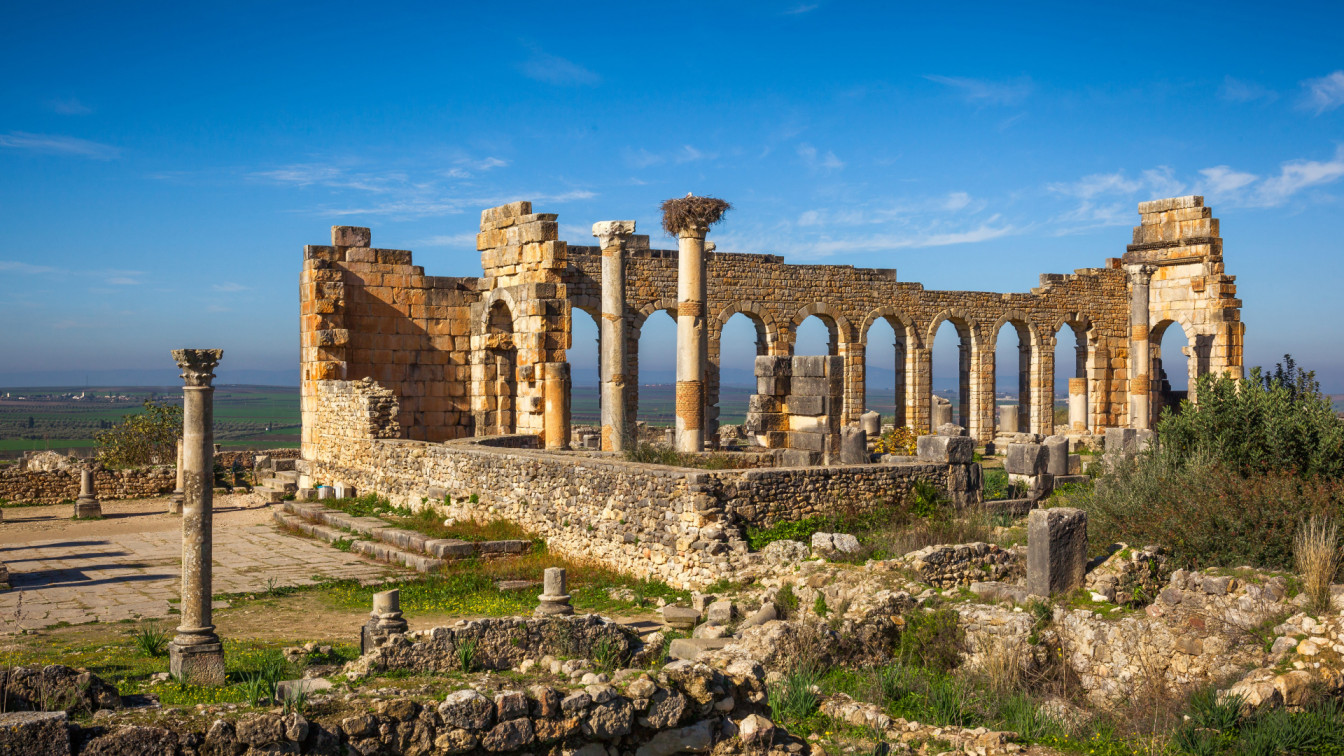
Marrakech – A joint Moroccan-Polish archaeological mission has uncovered two Roman watchtowers and a funerary monument near the UNESCO World Heritage site of Volubilis, the National Institute of Archaeology and Heritage (INSAP) announced on Tuesday.
The discoveries were made during fieldwork that concluded on October 30, conducted through a partnership between INSAP and the Polish Centre for Mediterranean Archaeology at the University of Warsaw (PCMA UW).
According to Fadwa Benjaafar, who heads the Moroccan team, the watchtowers were part of a surveillance and defense system along the borders of the Roman province of Mauretania Tingitana. These military structures date between the 1st and 3rd centuries CE.
“The mission successfully identified two watchtowers that were integrated into the surveillance and defense system at the edges of the Mauretania Tingitana province,” Benjaafar stated in the INSAP announcement.
The team also located remains of a third watchtower. Near this structure, archaeologists unearthed a tumulus-type funerary monument. This burial mound features a mound of earth covered with small stones and surrounded by a circular ditch measuring approximately 40 meters in diameter.
Similar structures have been found at several archaeological sites across Morocco and are generally attributed to the Mauretanian period, according to Benjaafar.
However, researchers cannot yet provide a definitive date for the site. “It’s not possible to determine the dating with certainty before completing the study of the ceramic material discovered there,” Benjaafar explained.
The Polish research team is led by Radosław Karasiewicz-Szczypiorski, working alongside their Moroccan counterparts to document these significant findings that provide new insights into the military organization and funerary practices of ancient Morocco.
Volubilis, located near present-day Meknes, was an important ancient Roman city that reached its peak in the 2nd century CE. Today, it stands as one of Morocco’s most important archaeological sites and has been a UNESCO World Heritage site since 1997.
Read also: What No One Tells You about Volubilis