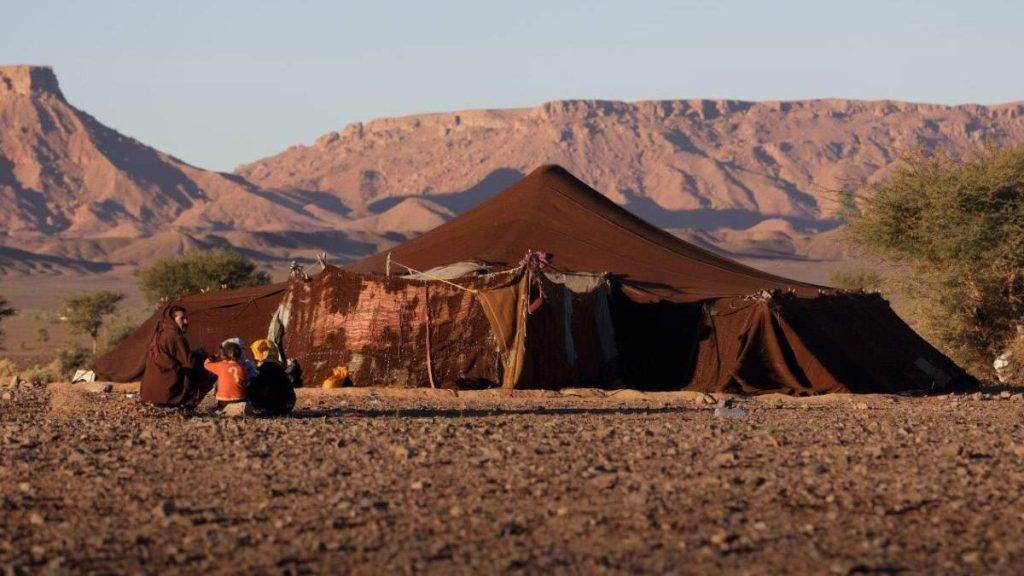
Marrakech – A recent study by the Malcolm H. Kerr Carnegie Middle East Center shows how Morocco’s Ait Khabbash community faces increasing challenges from climate change. The traditionally nomadic Amazigh pastoralists in the Draa-Tafilalet region confront both environmental degradation and historical marginalization.
Published on November 5 by researchers Yasmine Zarhloule and Ella Williams, the report documents how this indigenous community has adapted to changing conditions through migration and tourism development.
“For the Ait Khabbash, traditionally nomadic Amazigh pastoralists in Morocco’s Draa-Tafilalet region, environmental change exacerbates long-standing inequities rather than simply creating new challenges,” notes the study.
The research points to a key contradiction: while Morocco receives international recognition as a climate leader for renewable energy investments, its policies often fail to address vulnerabilities of communities most exposed to climate change.
Climate impacts in the region have become more severe over time. The report indicates that between 1970 and 2020, most regions in Morocco experienced a precipitation decrease of 4-5% per decade.
“In interviews, members of the Ait Khabbash community noted that while the area has always been arid and subject to a harsh climate, periods of drought are now noticeably longer and more severe,” states the report.
One nomad interviewed, identified as Ahmad, reported that whereas they used to find water 8 meters below ground, now some people must dig as deep as 120 meters.
Nomadism gave way to settlement under pressure
The Ait Khabbash have responded to these challenges through multiple adaptation strategies. Many have transitioned from nomadic lifestyles to settled communities in villages such as Merzouga and Hassilibied, or relocated to urban centers like Ouarzazate and Marrakesh.
International migration to France and Spain has also been a common response, although border securitization has made this increasingly difficult in recent years.
The report details how state infrastructure projects have sometimes worsened conditions. The Hassan Addakhil dam, constructed in 1971, and the Mansour Eddahbi dam from 1972 disrupted downstream water tables and reduced soil fertilization.
“Although intended to increase water reserves and control extreme flooding, these two dams have had a negative ecological impact,” the researchers write.
Tourism has emerged as a critical adaptation strategy. The community has built a tourism sector from the ground up, centered on desert camps near sand dunes that offer treks, meals, and overnight stays.
This locally-driven economic development began modestly in the 1970s and expanded significantly by the early 2000s, providing thousands of jobs and allowing families to maintain connections to their ancestral lands.
The report shares the story of Hassan, who began life as a nomad but moved to Hassilabied in his early twenties seeking employment. With help from relatives, he established a desert tourism business that eventually supported his entire family.
Women have also found opportunities in the tourism sector, primarily through cooperatives. In Hassilabied, a women’s cooperative produces traditional biscuits and sweets to supply desert camps.
Wealth exists; distribution and inclusion do not
These adaptation strategies remain vulnerable, however. The study points out that during the COVID-19 pandemic, “Many Ait Khabbash community members who had transitioned to tourism were left jobless overnight, some returning temporarily to nomadism or agriculture.”
The region’s economic marginalization persists despite its resources. Draa-Tafilalet hosts the Noor solar plant, one of the world’s largest concentrated solar facilities, and has extensive silver and mineral deposits. Yet it contributes less than 1% of the national gross domestic product.
According to the report, “In 2024, Draa-Tafilalet recorded a poverty rate of 7.7 percent – higher than the national average of 6.8 percent.”
Many community members maintain distance from state institutions, preferring self-reliance through community networks. One desert camp owner named Omar told researchers, “We would rather borrow money from someone in the community [than accept a government grant].”
The study recommends several approaches to address these challenges, including trust-building through participatory decision-making, strengthening the tourism sector’s resilience to shocks, and integrating indigenous knowledge systems into climate policy.
In particular, researchers note the importance of preserving traditional water management systems like the khettara – an age-old cooperative practice that channels groundwater to the surface for irrigation without exhausting deep aquifers.
“The preservation of the khettara and other systems is vital for trust-building and livelihood diversification,” states the report.
It concludes that effective climate governance requires meaningful engagement with marginalized communities and integration of indigenous knowledge into planning frameworks.
“Marginalized communities must be meaningfully engaged with and integrated as partners in adaptation frameworks,” the researchers argue, emphasizing that this approach can transform adaptation “from a reactive, fragmented process into a proactive, equitable framework.”